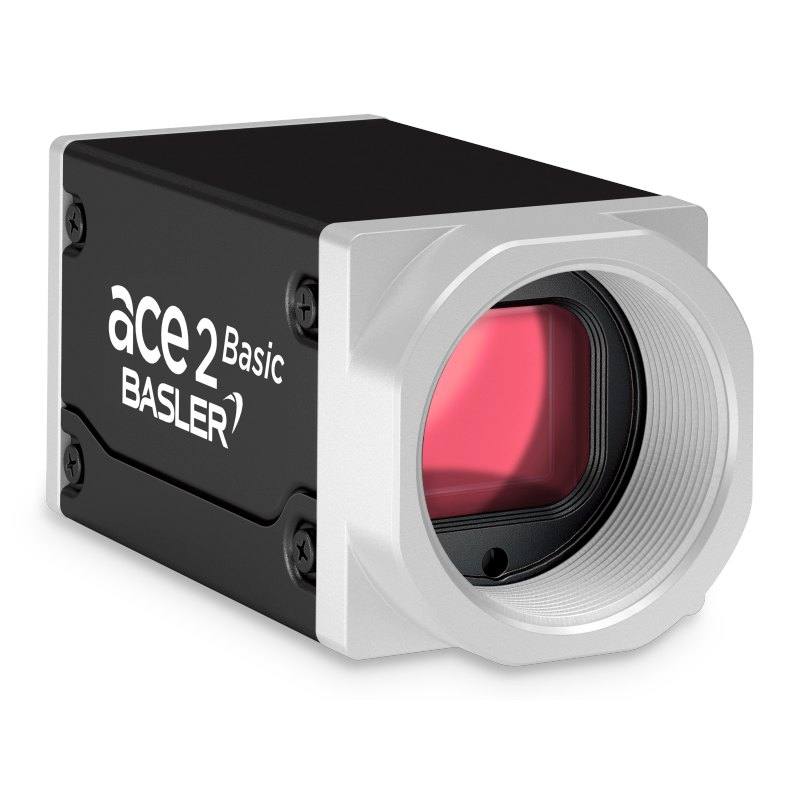
The Basler a2A2448-105g5cBAS is part of the ace 2 R series, featuring a Sony IMX547 progressive scan CMOS sensor with 2448 x 2048 pixel resolution and 2.74 µm pixel size in a 1/1.8" format. It delivers up to 106.9 fps over a 5GigE (NBASE-T) interface supporting Fast Ethernet through 5 Gigabit data rates. The camera uses a global shutter for distortion-free imaging of moving objects and outputs Bayer-pattern color at 8, 10, or 12-bit depth. It conforms to GigE Vision 2.0 and GenICam standards, is IP30 rated, and carries CE, FCC, UL, and UKCA certifications with a 3-year warranty.
The Basler ace 2 a2A2448-105g5cBAS pairs a Sony IMX547 Pregius S sensor with a 2448 x 2048 pixel array and 2.74 µm pixel pitch in a compact 1/1.8" optical format. The global shutter architecture captures all pixels simultaneously, eliminating the spatial distortion and motion blur that rolling-shutter designs introduce when imaging parts on a moving conveyor or under strobe illumination. At full 5 MP resolution the camera sustains 106.9 fps in default mode and 109.3 fps in Performance mode, giving integrators enough frame rate headroom to inspect multiple regions of interest per part or to run fast-moving lines without sacrificing spatial detail. The 2.74 µm pixel pitch is dense enough to resolve fine features — solder joints, thread flanks, laser-marked DataMatrix cells — yet the Sony Pregius S sensor keeps signal-to-noise ratios usable in the low-exposure windows that high-speed strobing demands.
Connectivity is handled by a 5GigE (NBASE-T) interface over an RJ45 connector with screw lock, supporting Fast Ethernet through 5 Gigabit data rates. In practice this means the camera streams full-resolution color frames at sustained throughput without the cable-distance penalties of USB 3 or the switching infrastructure costs of 10GigE — a single Cat 6A run up to 100 m suffices, and standard managed switches with NBASE-T ports carry multiple camera streams without dedicated frame grabbers. The camera is powered externally from 12–24 VDC via an M8 6-pin I/O connector; Power over Ethernet is not supported, so power cabling must be planned separately. The M8 connector also exposes hardware trigger and I/O lines, enabling deterministic exposure control from a PLC or encoder pulse. GigE Vision 2.0 and GenICam compliance mean the camera is natively addressable from any conformant SDK — Basler pylon, Cognex VisionPro, Halcon, or custom OpenCV pipelines — without proprietary drivers.
The 29 x 29 mm cross-section and 48.9 mm body depth allow the camera to fit inside compact enclosures and multi-camera gantries where space is constrained. The C-Mount accepts the broad catalogue of industrial C-Mount lenses; for a 1/1.8" sensor (8.8 mm diagonal) integrators should specify lenses with image circles rated for at least that format — standard 2/3" lenses cover this sensor comfortably, and 1" lenses provide margin for decentering tolerance. Bayer-pattern color output is available at 8, 10, or 12-bit depth, allowing the host to trade bandwidth for radiometric precision depending on the inspection task: 8-bit for straightforward color-classification and OCR, 12-bit for nuanced surface-shading analysis or pharmaceutical tablet color grading. The IP30 enclosure is suited to clean production environments; applications in wash-down or dusty conditions require an external enclosure. Operating temperature spans -10 to 50 °C and power consumption is 5.8 W, both compatible with closely packed multi-camera installations.
Best for
High-speed surface and defect inspection on fast-moving conveyors where global shutter and 106+ fps prevent motion artifacts at full 5 MP resolution
Electronics and semiconductor assembly verification — solder joint inspection, BGA, SMD presence/absence — where 2.74 µm pixel pitch resolves fine features and the Pregius S sensor enables short strobe windows
Pharmaceutical and medical-device packaging inspection requiring color discrimination (tablet color, label print quality) at 8, 10, or 12-bit Bayer depth
Robot guidance and bin-picking applications needing deterministic hardware-trigger synchronization via the M8 I/O connector and distortion-free global shutter frames
Multi-camera line installations where 5GigE over Cat 6A simplifies cabling infrastructure versus USB 3 distance limits, and GigE Vision 2.0 compliance allows mixing with other conformant cameras on a single managed switch
Selection notes
Power supply: the camera draws 12–24 VDC via the M8 6-pin connector — PoE is not supported. Budget a separate DC supply or DIN-rail PSU for each camera position and verify the M8 cable length against allowable voltage drop at 5.8 W draw.
Lens selection for 1/1.8" sensor: specify C-Mount lenses with an image circle rated for at least 8.8 mm diagonal (the 1/1.8" format). Lenses labeled for 2/3" (11 mm) or 1" (16 mm) sensors provide adequate coverage with alignment margin; lenses rated only for 1/2" or smaller will vignette.
Bandwidth budgeting: at 106.9 fps, full-resolution 8-bit Bayer frames produce roughly 535 MB/s of raw pixel data. The 5GigE link delivers ~625 MB/s theoretical, so the camera can stream continuously at full rate — but the host NIC, switch port, and CPU/GPU pipeline must all sustain that throughput. Enabling 10- or 12-bit output or adding a second camera on the same switch port will require ROI cropping or frame-rate reduction.
IP30 enclosure is rated for contact protection only — not for dust ingress or liquid splash. For food-and-beverage wash-down, injection-mold, or cutting-fluid environments, mount the camera inside an IP65/IP67 camera housing with a window appropriate to the working wavelength.
Trigger and lighting synchronization: the M8 I/O connector supports hardware trigger input for strobe-locked exposures. Pair with a strobe controller that accepts a trigger-out or use the camera's own flash output signal to drive LED lighting; confirm that strobe pulse width is within the camera's minimum exposure range so that motion blur does not reappear at the LED level.
Specifications: General
Brand
Basler
Camera type
Area Scan
Specifications: Sensor
Resolution
5 MP
Horizontal resolution
2448 x 2048 px
Mono / color
Color (Bayer pattern)
Sensor manufacturer
Sony Pregius S
Sensor model
Sony IMX547-AAQJ-C
Shutter
Global Shutter
Sensor size
1/1.8" (6.71 mm × 5.61 mm, diagonal 8.8 mm)
Pixel size
2.74 µm × 2.74 µm
Specifications: Performance
FPS
106.9 fps (default); 109.3 fps (Performance mode)
Specifications: Interface
Interface
5GigE (NBASE-T, RJ45 with screw lock)
Protocols
GigE Vision 2.0, GenICam
Specifications: Optics
Mount
C-Mount
Specifications: Electrical
Power
12–24 VDC via M8 6-pin I/O connector (PoE not supported)
Power consumption
5.8 W
Specifications: Environment
IP rating
IP30
Operating temperature
-10 to 50 °C
Specifications: Mechanical
Dimensions
48.9 x 29 x 29 mm
Weight
105 g
Housing material
Box
Applications this camera is commonly selected for. Open one to see the full recommended hardware and approach.
Matched automatically by: lens mount fits the camera mount · lens image circle covers the camera sensor — this camera: C-Mount · 1/1.8" (6.71 mm × 5.61 mm, diagonal 8.8 mm) sensor.
By category
All 220C-mount lenses 155Telecentric lenses 62F-mount / large-format lenses 3
By brand
All 220iRAYPLE 66Omron / Sentech 66Basler 59Datalogic / Datasensing 29
Get a first image quickly with the pylon Viewer, then move into the pylon SDK for your application. These cameras are GenICam/GenTL-compliant, so any compliant vision software can drive them as well.
Download and install the pylon Camera Software Suite for your OS from Basler. This provides the pylon Viewer, the GenTL transport-layer producers and the pylon SDK (C/C++/.NET/Python). On Windows the installer adds the needed drivers; on Linux follow the included setup notes for USB and network permissions.
2. Connect the camera and check the link
Cable the camera to its matching interface: GigE Vision to a GigE port (use a quality cable and, ideally, a dedicated NIC with jumbo frames enabled), USB3 Vision to a USB 3.x port with the supplied cable, or CoaXPress to the frame grabber. Provide power where required (PoE, USB bus power, or PoCXP). Open the pylon Viewer and confirm the camera appears in the device list; for GigE, make sure the camera and NIC are on the same subnet.
3. Grab a first image and set exposure, gain and pixel format
Select the camera in the pylon Viewer and start a continuous grab. Adjust exposure time and gain until the image is well exposed (avoid clipped highlights), set the pixel format (e.g. Mono8 or a Bayer/RGB format), and focus the lens. Use a test pattern if the lens or scene is not ready yet.
4. Configure triggering and acquisition
Decide between free-run and triggered acquisition. For synchronized capture, set the trigger source (software or a hardware line on the I/O connector), trigger mode and any debounce or exposure mode, then verify timing. Note the parameter names you change in the Viewer feature tree, as you will reuse them in code.
5. Move to the SDK or a GenICam-compliant library
Recreate your settings in code with the pylon SDK (C, C++, .NET or Python) to open the device, apply the same features and pull frames into your pipeline; pylon vTools and pylon AI can add processing blocks. Because the cameras are GenICam/GenTL standard, third-party vision libraries work too. Once the image stream is stable, you can route frames to a deep-learning inspection such as Rosepetal for automated defect detection.
Frequently asked questions
No. The a2A2448-105g5cBAS requires an external 12–24 VDC supply connected via the M8 6-pin I/O connector. PoE is explicitly not supported, so each installation needs a dedicated DC power feed.
5GigE (NBASE-T) over standard Cat 6A supports runs up to 100 m, the same as conventional GigE. The RJ45 connector has a screw lock for vibration resistance. No frame grabber is required — a host NIC or managed switch with NBASE-T ports is sufficient.
The camera uses a C-Mount. The sensor is 1/1.8" with a 6.71 × 5.61 mm active area and 8.8 mm diagonal. Lenses specified for 2/3" or 1" image circles cover the sensor without vignetting. Confirm the lens is rated for at least 8.8 mm image circle before ordering.
The camera outputs Bayer-pattern color (raw CFA) at 8, 10, or 12 bits per pixel. Demosaicing to RGB is performed in the host SDK or frame processor. There is no onboard ISP producing ready-decoded color frames, so the host pipeline must handle Bayer conversion.
The Sony IMX547 in this model is a dedicated global shutter sensor — it operates only in global shutter mode. Rolling-shutter operation is not available. This is a deliberate choice for motion-freeze capability and should be considered an inherent feature of this specific model rather than a configurable trade-off.