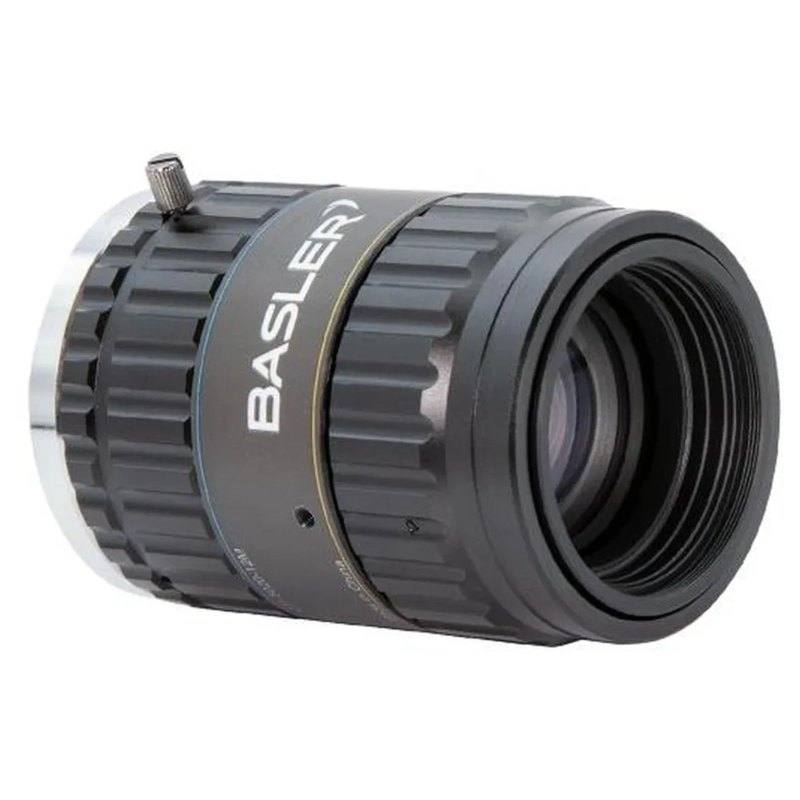
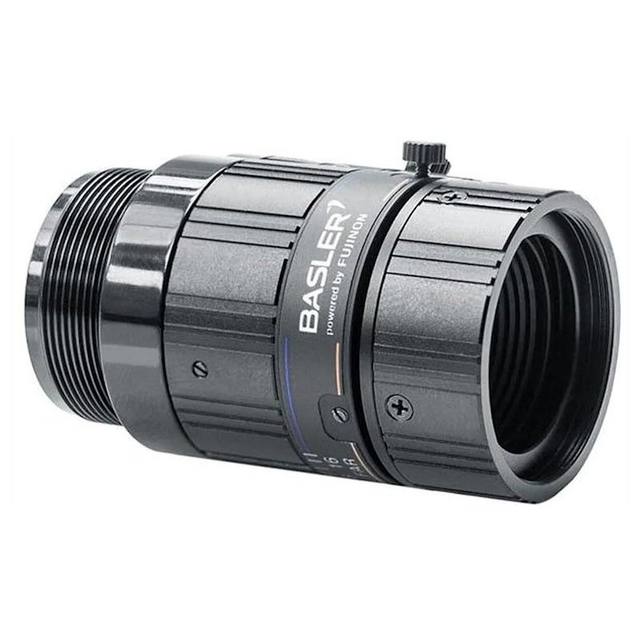
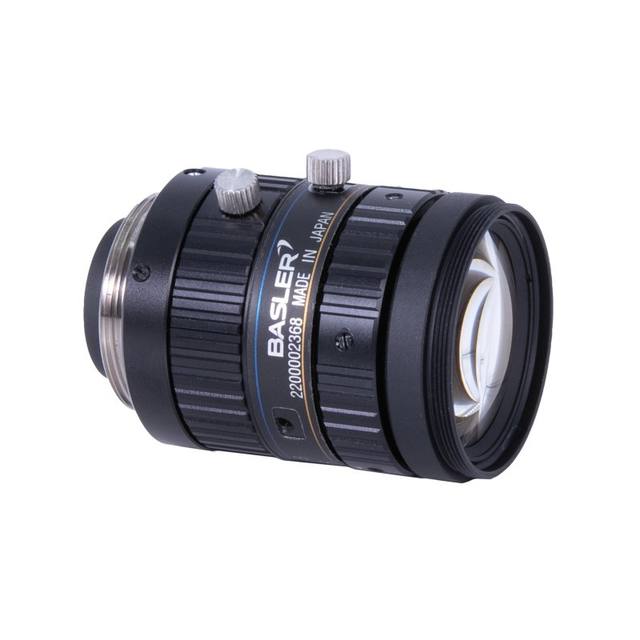
The Basler C11-5020-12M-P is a 50 mm fixed focal length C-mount lens from the Basler Premium line, designed for 12 MP cameras with sensors up to 1.1" (17.6 mm image circle). It delivers a maximum aperture of F2.0 with optimal resolution at F2.5, achieving MTF values of 0.66/0.52 (center, 90/140 LP/mm) and supports a focus range from 0.2 m to infinity. Optical distortion is a very low 0.06% typical, with a back focal length of 11.56 mm and a metal housing featuring manual iris and focus controls with locking screws.
Brand
Basler
Focal length
49.7 mm (nominal); marketed as 50 mm
Lens mount
C-mount
Aperture (f-number)
F2.0–F16
Image circle / max sensor
17.6 mm (1.1" format)
Optical resolution
No change needed; 3.57 µm per official docs is correct for lens design target
The Basler C11-5020-12M-P is a 50 mm fixed focal length C-mount lens from Basler's Premium line, purpose-built to resolve 12 MP sensors with pixel pitches down to approximately 3.57 µm. Its 17.6 mm image circle covers the full 1.1" sensor format, making it directly compatible with the growing family of large-format C-mount cameras without vignetting or corner softness. The F2.0 maximum aperture delivers a useful light-gathering advantage in lower-illumination setups, though Basler specifies optimal resolution is reached at F2.5 — a meaningful design-in note for installations where sharpness across the full field is critical. The aperture scales to F16 for depth-of-field-intensive tasks such as reading tilted labels or inspecting non-planar surfaces. Manual iris and focus rings are both fitted with locking screws, which is essential for production environments where vibration or incidental contact must not shift the calibration point.
With a minimum working distance of 200 mm and an optimum working distance of 500 mm, this lens is well suited to mid-range stand-off applications rather than close-coupled macro work. At those distances and with a 50 mm focal length, the resulting field of view on a 1.1" sensor is moderate and narrower than a 25 mm or 35 mm alternative, which translates to higher spatial sampling of a confined inspection region — beneficial for reading fine print, detecting sub-millimetre surface defects, or resolving small component markings. The MTF figures (center performance: 0.66 contrast at 90 lp/mm, 0.52 at 140 lp/mm) confirm that the optical design keeps contrast well above the 0.5 threshold even at spatial frequencies that stress lesser optics, underpinning measurement repeatability. Optical distortion of 0.06% typical is extremely low for a standard (non-telecentric) lens of this focal length and is sufficient for dimensional tasks where correction-table compensation is undesirable or impractical.
The all-metal housing at 277.5 g should be factored into the choice of lens mount and camera housing for robot-mounted or vertically-oriented camera assemblies. The -20 to 60 °C operating temperature range covers standard factory environments and light cold-storage applications. Because the lens is not telecentric, perspective error will increase as objects move out of the calibrated focal plane, so installations requiring true orthographic measurement of height-variable parts should account for this in calibration. The C-mount interface provides broad camera compatibility, and the back focal length of 11.56 mm is standard, posing no unusual flange-distance constraints with mainstream C-mount bodies.
Best for
12 MP area-scan inspection stations where a confined field of view — achieved via the 50 mm focal length at 200–500 mm working distance — delivers high pixels-per-millimetre sampling for detecting fine surface defects or verifying small features on PCBs, connectors, or precision-machined parts.
Industrial OCR and OCV applications on labels, packaging, or direct-part marks where the 0.06% distortion minimises character shape distortion and the F2.5 optimum aperture maintains legible contrast across the full 1.1" frame.
Dimensional gauging tasks that tolerate perspective-projection geometry (non-telecentric) and where the very low distortion value reduces the need for heavy software correction, such as measuring component footprints or label placement offset on flat substrates.
Robot guidance cells requiring a stable, lockable optical configuration — the locking screws on iris and focus prevent drift during payload vibration or TCP changes, preserving the hand-eye calibration between maintenance intervals.
Pharmaceutical and semiconductor visual inspection lines in the -20 to 60 °C operating range where a sealed metal housing resists cleaning agents and the image quality supports both print verification and cosmetic defect grading in the same station.
Selection notes
Sensor format compatibility: the 17.6 mm (1.1") image circle must meet or exceed the sensor diagonal of the camera in use. Pairing this lens with a 1" or smaller sensor is safe; using it on a sensor larger than 1.1" will produce vignetting.
Optimal aperture is F2.5, not the maximum F2.0. If the lighting budget allows stopping down from wide open, do so — the MTF specification is referenced at F2.5 and the center-to-edge contrast uniformity will be noticeably better.
Non-telecentric design: at 50 mm focal length the chief ray angle is non-zero, so part height variation within the depth of field introduces measurable lateral magnification error. For gauging applications, keep the object plane as close to the calibration plane as possible or apply a perspective-correction model in software.
Minimum working distance is 200 mm but optimum is 500 mm. Designing the fixture closer than 200 mm is not possible; designing near 500 mm will extract the best optical performance from the design. Field of view calculations should use the actual intended working distance, not the nominal figure.
The 277.5 g metal housing requires a camera with a mechanically robust C-mount — verify the camera's lens mount load rating when mounting on a robot arm or in orientations where the lens hangs downward, as stress on the flange thread over time can affect focus stability.
Specifications: General
Brand
Basler
Specifications: Optical
Focal length
49.7 mm (nominal); marketed as 50 mm
Lens mount
C-mount
Aperture (f-number)
F2.0–F16
Image circle / max sensor
17.6 mm (1.1" format)
Optical resolution
No change needed; 3.57 µm per official docs is correct for lens design target
Telecentric
No
Working distance
200 mm min, optimum 500 mm
Specifications: Environment
Operating temperature
-20 to 60 °C
Specifications: Mechanical
Weight
277.5 g
Housing material
Metal
Applications this camera is commonly selected for. Open one to see the full recommended hardware and approach.
Matched automatically by: camera mount fits the lens mount · camera sensor is covered by the lens image circle — this lens: C-mount · 17.6 mm (1.1" format) image circle.
Get a first image quickly with the pylon Viewer, then move into the pylon SDK for your application. These cameras are GenICam/GenTL-compliant, so any compliant vision software can drive them as well.
Download and install the pylon Camera Software Suite for your OS from Basler. This provides the pylon Viewer, the GenTL transport-layer producers and the pylon SDK (C/C++/.NET/Python). On Windows the installer adds the needed drivers; on Linux follow the included setup notes for USB and network permissions.
2. Connect the camera and check the link
Cable the camera to its matching interface: GigE Vision to a GigE port (use a quality cable and, ideally, a dedicated NIC with jumbo frames enabled), USB3 Vision to a USB 3.x port with the supplied cable, or CoaXPress to the frame grabber. Provide power where required (PoE, USB bus power, or PoCXP). Open the pylon Viewer and confirm the camera appears in the device list; for GigE, make sure the camera and NIC are on the same subnet.
3. Grab a first image and set exposure, gain and pixel format
Select the camera in the pylon Viewer and start a continuous grab. Adjust exposure time and gain until the image is well exposed (avoid clipped highlights), set the pixel format (e.g. Mono8 or a Bayer/RGB format), and focus the lens. Use a test pattern if the lens or scene is not ready yet.
4. Configure triggering and acquisition
Decide between free-run and triggered acquisition. For synchronized capture, set the trigger source (software or a hardware line on the I/O connector), trigger mode and any debounce or exposure mode, then verify timing. Note the parameter names you change in the Viewer feature tree, as you will reuse them in code.
5. Move to the SDK or a GenICam-compliant library
Recreate your settings in code with the pylon SDK (C, C++, .NET or Python) to open the device, apply the same features and pull frames into your pipeline; pylon vTools and pylon AI can add processing blocks. Because the cameras are GenICam/GenTL standard, third-party vision libraries work too. Once the image stream is stable, you can route frames to a deep-learning inspection such as Rosepetal for automated defect detection.
Frequently asked questions
The lens has a 17.6 mm image circle, which covers the 1.1" sensor format. Any sensor with a diagonal at or below 17.6 mm — including 1", 2/3", and smaller formats — is fully covered.
Basler specifies optimal resolution at F2.5. The MTF values of 0.66 at 90 lp/mm and 0.52 at 140 lp/mm are measured at this aperture. Shooting at the maximum F2.0 may show a marginal drop in contrast, particularly toward the corners of a large sensor, so lighting should be sized to allow F2.5 as the working aperture.
Typical optical distortion is 0.06%, which is very low for a standard fixed-focal-length C-mount lens. For most dimensional and print-verification applications this level is acceptable without correction. Only the most demanding sub-pixel metrology tasks would require a residual distortion correction table.
No — the lens is not telecentric. Objects at different heights within the depth of field will be imaged at slightly different magnifications due to perspective projection. For flat-field gauging at a controlled working distance it performs well, but for measuring height-variable or three-dimensional objects a telecentric lens is the correct choice.
The minimum working distance is 200 mm. The optimum working distance for best optical performance is 500 mm. Focus cannot be achieved at distances shorter than 200 mm with this lens.