Omron / Sentech 3Z4S-LE SV-04514V SV-V Series C-Mount Lens
3Z4S-LE SV-04514V
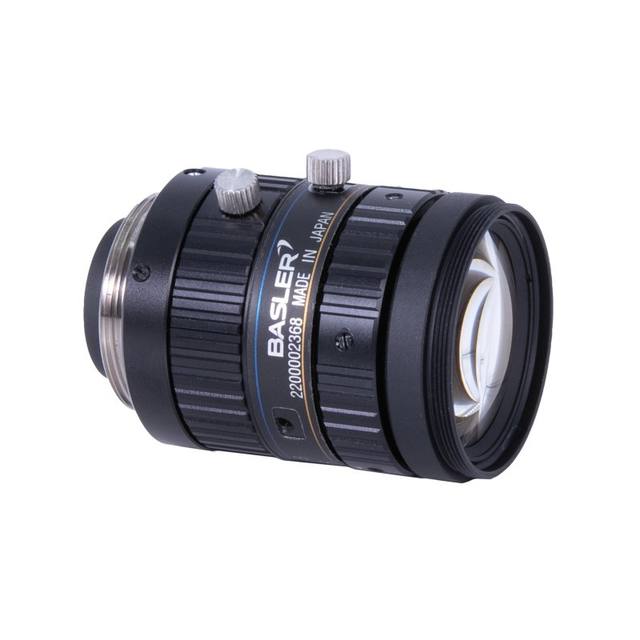
The 3Z4S-LE SV-04514V is a fixed focal length C-mount lens from Omron's SV-V series (manufactured by VS Technology Corporation) with a 4.5 mm (actual 4.62 mm) focal length and maximum aperture of F1.4. It supports up to 1/2" image sensors, provides a 59.7° × 79.9° field of view (100.4° diagonal), and has a TV distortion of -8.2%. The lens features manual iris and focus adjustment with locking screws, a minimum object distance of 200 mm, and is compatible with Omron FZ and FH series vision systems via C-mount.
The Omron 3Z4S-LE SV-04514V is a 4.5 mm fixed focal length C-mount lens from the SV-V series, manufactured in partnership with VS Technology Corporation and validated for direct integration with Omron FZ and FH vision platforms. Its ultra-wide field of view — 79.9° horizontal, 59.7° vertical, and 100.4° on the diagonal — makes it one of the widest-angle choices available in a standard C-mount form factor. That opening angle, combined with a fast F1.4 maximum aperture, means the lens can gather substantial light even when the scene is not brightly illuminated, which reduces flash-energy requirements and allows shorter strobe durations when paired with a triggered lighting controller. The maximum supported sensor format is 1/2", so it is suitable for cameras with 1/2" sensors as well as many legacy 1/3" and 1/4" sensors, all of which will see only the central, best-corrected portion of the image circle.
From an installer's perspective the 200 mm minimum object distance is the critical parameter to respect. At that distance the extremely short focal length delivers a very large field of view — ideal for capturing wide conveyor lanes, labels, or panel areas in a single shot. Because the lens is not telecentric, perspective distortion increases as parts approach the front element, so applications requiring sub-millimetre dimensional accuracy should keep parts at or beyond the specified 200 mm working distance and calibrate radial distortion in software; the rated TV distortion of -8.2% (barrel) is moderate for a 4.5 mm design and is readily corrected by most vision-system calibration routines. Focus and iris are set manually via adjustment rings secured by locking screws, which prevents vibration-induced drift once the lens is locked down on the production line. The compact barrel — 29.5 mm diameter by 29.5 mm length and 53 g — fits tight camera housings and robot end-of-arm tooling without adding significant mass or moment.
Lens-camera matching follows straightforwardly from the C-mount register distance and the 1/2" image circle. Any C-mount camera with a sensor at or smaller than 1/2" — including Omron FH series cameras and many GigE / USB3 area-scan cameras — is mechanically and optically compatible. Because the SV-V series is megapixel-graded, it resolves comfortably at the pixel pitches found on megapixel 1/2" sensors without becoming the limiting factor in system resolution. Lighting pairing should account for the wide angle: dome or diffuse on-axis lighting is typically preferred to minimise the bright-edge vignetting that structured ring lights can introduce at sub-F2 apertures on wide-angle lenses. When triggering strobes, the fast aperture means the iris can be stopped down one to two stops from F1.4 to trade light for improved depth of field and reduced field curvature at working distances beyond 500 mm.
Best for
Wide-area label and barcode reading on conveyors where a 1/2" camera must cover a large web width from a short standoff of 200 mm to 400 mm
Robot-mounted vision heads on compact end-of-arm tools where the 29.5 mm barrel length and 53 g mass keep inertia low during fast pick-and-place cycles
Packaging line inspection covering full carton faces or tray footprints in a single frame, leveraging the 79.9° horizontal field without stitching multiple cameras
OCR and code reading on pharmaceutical or food-and-beverage lines where large character fields must be captured close-in and the Omron FZ/FH platform handles the decode logic natively
General-purpose defect and surface inspection cells where the application requires wide-field overview imaging before a higher-magnification camera performs detail analysis
Selection notes
Sensor format ceiling is 1/2": cameras with 2/3" or larger sensors will produce vignetting and corner blur; verify your camera's sensor format before ordering
The -8.2% barrel distortion is significant and must be corrected with the vision system's distortion-calibration routine before any dimensional measurement result can be trusted; Omron FZ/FH includes a built-in distortion correction wizard suited for this purpose
Because the lens is non-telecentric, part height variation changes apparent size — keep Z-axis variation within your depth-of-field budget (stop down from F1.4 as needed) and avoid using this lens for precision gauging where a telecentric lens would eliminate parallax error
Minimum object distance is 200 mm; mounting the camera closer than this will result in a blurred image regardless of focus adjustment, so confirm the mechanical envelope allows at least 200 mm of clearance between the front element and the nearest part surface
Manual iris and focus locking screws are the stability mechanism — tighten the screws after final setup and re-verify focus after any lens removal or camera swap, as C-mount registration depth tolerances can shift apparent focus
Specifications: General
Brand
Omron / Sentech
Specifications: Optical
Focal length
4.5 mm
Lens mount
C-mount
Aperture (f-number)
F1.4 ~ Close (manual)
Image circle / max sensor
1/2" (max sensor size)
Working distance
200 mm ~ ∞
Telecentric
No
Specifications: Mechanical
Dimensions
φ29.5 (MAX) × L=29.5 mm
Weight
53 g
Applications this camera is commonly selected for. Open one to see the full recommended hardware and approach.
Matched automatically by: camera mount fits the lens mount · camera sensor is covered by the lens image circle — this lens: C-mount · 1/2" (max sensor size) image circle.
By category
All 375Area scan cameras 289High-speed cameras 66High-resolution cameras 20
By brand
All 375Omron / Sentech 178Basler 97iRAYPLE 93Datalogic / Datasensing 7
These steps take an Omron Sentech (STC) camera from the box to a stable first image and on to your own application. They apply across the GigE Vision, USB3 Vision and CoaXPress STC families; the interface only changes how you cable and power the camera.
Download and install the Sentech SDK on the host PC. The package provides StViewer, the viewing and configuration software you use to bring the camera up, and StApi, the programming SDK you integrate later. Because the cameras are GenICam/GenTL-compliant, StApi also registers a GenTL producer, so any GenICam-compliant third-party vision software can discover and drive the camera as an alternative front end.
2. Cable, power and connect the camera
Connect according to the interface. GigE Vision: link to a Gigabit NIC (use PoE or the separate power input) and put the camera and host on the same subnet; for USB3 Vision use a USB 3.x port and a certified cable; for CoaXPress (STC) connect to a CoaXPress frame grabber, which also supplies Power-over-Coax. Then open StViewer and let it enumerate the camera. If a GigE camera does not appear, check the IP configuration and firewall, and on USB3 confirm the host bandwidth and driver.
3. Configure exposure, gain and white balance
Open the device in StViewer and start a live stream. Set exposure and gain for a well-exposed, low-noise image: raise exposure first and only add gain when more light or a faster shutter is not an option, keeping exposure short enough to freeze motion on global-shutter models. On colour cameras, run white balance under your actual production lighting. Adjust the lens aperture and focus on a representative target before tuning anything else.
4. Set the trigger and grab a first image
Start in free-run (continuous) acquisition to confirm a clean, stable image. For inline inspection switch to hardware or software triggering: select the trigger source, set the active edge and any delay, and wire the strobe or illumination to the camera's I/O so lighting fires with each exposure. Acquire and save a frame in StViewer; this saved image is your reference for the SDK stage and for downstream inspection.
5. Move to the StApi SDK (or any GenICam software)
Once the image is stable, reproduce the same settings in code. Use StApi to open the device, apply the GenICam features you validated in StViewer (exposure, gain, trigger, pixel format) and grab frames into your application via the bundled C++, C, C#/.NET or Python interfaces; the included samples are the fastest starting point. Prefer a different stack? The same GenICam/GenTL camera works with third-party vision libraries. With a reliable feed, you can route it into a deep-learning inspection such as Rosepetal for AI-based defect detection.
Frequently asked questions
The lens is rated for a maximum image circle of 1/2". Sensors at that format or smaller — including 1/3" and 1/4" — will be fully covered. Cameras with 2/3" or larger sensors are not supported and will show darkened corners.
The specification lists TV distortion of -8.2%, which is barrel distortion characteristic of wide-angle designs. This is correctable using the distortion calibration function in the Omron FZ or FH vision system, or through standard camera-calibration workflows in PC-based systems.
Yes. The mount is standard C-mount, so it fits any industrial camera with a C-mount receiver and a sensor no larger than 1/2". The Omron FZ/FH compatibility is a validated integration, but the lens will function optically on any conforming C-mount camera body.
The published angular field is 79.9° horizontal × 59.7° vertical (100.4° diagonal). The exact linear field at 200 mm depends on the camera's sensor dimensions and pixel pitch; use the angular values together with your sensor's active area to calculate the precise millimetre coverage for your specific camera.
Both iris (from F1.4 to closed) and focus are manually adjustable via dedicated rings on the barrel. Each ring has a locking screw so the settings can be secured against vibration once finalised during commissioning.