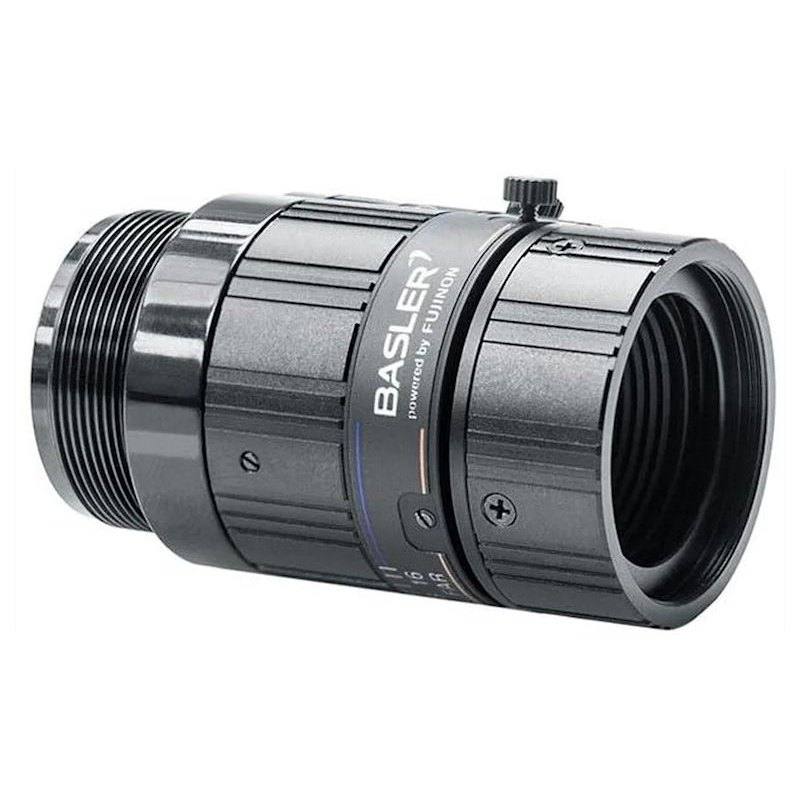
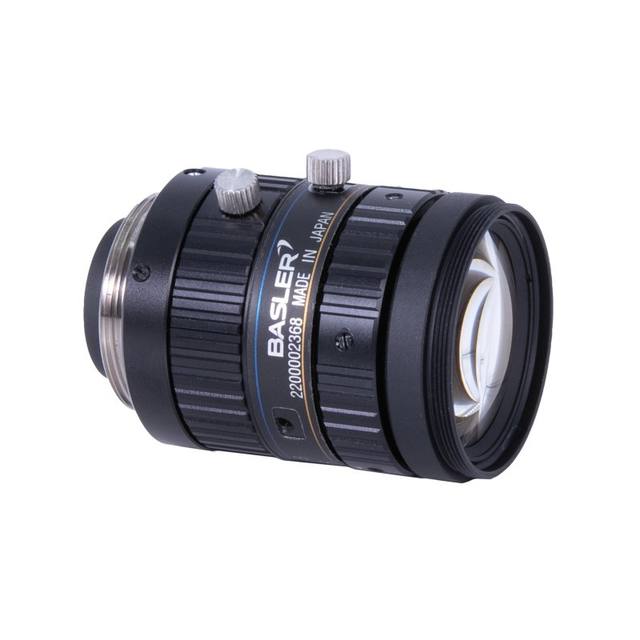
The Basler C125-1218-5M is a premium fixed focal length C-mount lens with a 12 mm focal length (12.05 mm ±5%) and maximum aperture of F1.8, designed for 5 MP sensors with a 2.2 µm pixel pitch on up to 1/2.5" format sensors. It provides a 7.3 mm image circle, supports 230 LP/mm resolution, and exhibits typical barrel distortion of -2.2%. The lens covers the visible-to-NIR spectral range (400–1000 nm), has a minimum object distance of 200 mm, and features manual focus and iris with locking screws. It weighs approximately 65 g and operates in the -10 to +50 °C temperature range.
The Basler C125-1218-5M is a 12 mm fixed focal length C-mount lens developed in cooperation with Fujinon and purpose-built for 5 MP sensors with a 2.2 µm pixel pitch on up to 1/2.5" format sensors. The 7.3 mm image circle is sized precisely for this sensor class — it fully illuminates the sensor area without vignetting while avoiding the weight and cost overhead of larger-format glass. At F1.8 maximum aperture, the lens gathers enough light to support short exposure times in moderate ambient conditions or with standard continuous lighting, while the F1.8–F22 range gives integrators meaningful depth-of-field control for scenes with varying part heights. Resolving power is rated at 230 LP/mm, which matches well with the 2.2 µm pixel pitch of the target sensor: the Nyquist limit for that pitch sits around 227 LP/mm, meaning the optics do not become the resolution bottleneck in a correctly assembled system.
A minimum object distance (MOD) of 200 mm governs the closest working distance at which the lens can achieve sharp focus; below this distance the image degrades regardless of aperture. For typical conveyor or fixture-mounted camera setups this is not a constraint, but integrators designing very compact enclosures or close-in robot-guidance cells should verify the camera-to-part standoff against this figure before committing to the layout. The spectral response window of 400–1000 nm spans the full visible range and extends into near-infrared, which makes this lens compatible with both white-light and NIR illumination strategies without requiring a separate IR-cut or band-pass filter for most applications. Barrel distortion is specified at a typical -2.2%, a figure characteristic of wide-to-normal focal lengths; for most presence/absence, code-reading and surface-inspection tasks this level is acceptable, but dimensional measurement applications that require sub-pixel geometric accuracy should apply distortion correction in software or evaluate whether a lower-distortion optic better suits their tolerance budget.
Manual focus and iris adjustments are secured by locking screws, which is the correct mechanism for fixed-station industrial installations: once the lens is set during commissioning, vibration or incidental contact cannot shift the focus or exposure point. The 65 g mass keeps camera-head assembly weight low, easing choices for robot-arm end-effector payloads and lightweight gantry mounts. Operating temperature of -10 to +50 °C covers standard factory and warehouse environments; applications in cold stores or outdoor enclosures near the thermal limits should confirm that the camera body's own thermal spec is not more restrictive. With its C-mount interface, the lens is compatible with any C-mount camera targeting the 1/2.5" format, giving system integrators broad flexibility when selecting the imaging chain.
Best for
5 MP area-scan inspection stations on 1/2.5" format C-mount cameras where the optical chain must not limit sensor resolution, such as electronics PCB defect inspection and surface-scratch detection.
Packaging line code reading (1D/2D/DPM) and OCR/OCV where the 12 mm focal length provides a useful field of view at typical conveyor standoffs and the F1.8 aperture supports sufficient light throughput for strobe-triggered acquisition.
Robot-guidance end-effector cameras with C-mount interfaces where the 65 g lens weight is a meaningful payload consideration and a fixed focus/iris locked by screws prevents shift during arm motion.
Pharmaceutical and semiconductor tray or wafer inspection in controlled, stable-temperature factory environments where the 230 LP/mm resolving power and visible-to-NIR spectral range support both white-light and NIR illumination schemes.
General-purpose fixed-station machine vision builds in automotive and logistics where integrators want a cost-effective, name-brand C-mount lens pre-matched to 5 MP sensors without over-specifying the optics.
Selection notes
Sensor format compatibility is critical: the 7.3 mm image circle is sized for 1/2.5" sensors. Pairing this lens with a larger sensor format (e.g., 1/1.8" or 2/3") will produce corner shading or vignetting; verify the target camera's sensor diagonal before ordering.
The -2.2% typical barrel distortion should be factored in for any dimensional measurement application. Sub-pixel geometric accuracy tasks may require distortion calibration or a lens with a lower distortion figure; for pure presence/absence or code-reading tasks this level is generally acceptable.
Minimum object distance of 200 mm is a hard optical constraint. If the application requires the camera to be closer than 200 mm to the part, this lens cannot achieve sharp focus at that distance; verify the working distance in the layout before committing to the lens.
The 400–1000 nm spectral range enables NIR illumination strategies (e.g., 850 nm LEDs for contrast enhancement on silicon or certain plastics) without swapping glass, but integrators should confirm that no additional IR-cut filter is in the camera body path if purely visible imaging is needed.
Manual focus and iris are locked by screws — this is ideal for permanent installations but means any field adjustment requires physical access to the lens. In applications with multiple working distances or changeable part heights, evaluate motorised iris or telecentric alternatives before finalising the design.
Specifications: General
Brand
Basler
Specifications: Optical
Focal length
12 mm
Lens mount
C-mount
Aperture (f-number)
F1.8–F22
Image circle / max sensor
7.3 mm (1/2.5" format)
Optical resolution
5 MP
Working distance
200 mm–∞ (MOD 200 mm)
Telecentric
No
Specifications: Environment
Operating temperature
-10–50 °C
Specifications: Mechanical
Weight
65 g
Applications this camera is commonly selected for. Open one to see the full recommended hardware and approach.
Matched automatically by: camera mount fits the lens mount · camera sensor is covered by the lens image circle — this lens: C-mount · 7.3 mm (1/2.5" format) image circle.
By category
All 310Area scan cameras 228High-speed cameras 64High-resolution cameras 18
By brand
All 310Omron / Sentech 151Basler 82iRAYPLE 73Datalogic / Datasensing 4
Get a first image quickly with the pylon Viewer, then move into the pylon SDK for your application. These cameras are GenICam/GenTL-compliant, so any compliant vision software can drive them as well.
Download and install the pylon Camera Software Suite for your OS from Basler. This provides the pylon Viewer, the GenTL transport-layer producers and the pylon SDK (C/C++/.NET/Python). On Windows the installer adds the needed drivers; on Linux follow the included setup notes for USB and network permissions.
2. Connect the camera and check the link
Cable the camera to its matching interface: GigE Vision to a GigE port (use a quality cable and, ideally, a dedicated NIC with jumbo frames enabled), USB3 Vision to a USB 3.x port with the supplied cable, or CoaXPress to the frame grabber. Provide power where required (PoE, USB bus power, or PoCXP). Open the pylon Viewer and confirm the camera appears in the device list; for GigE, make sure the camera and NIC are on the same subnet.
3. Grab a first image and set exposure, gain and pixel format
Select the camera in the pylon Viewer and start a continuous grab. Adjust exposure time and gain until the image is well exposed (avoid clipped highlights), set the pixel format (e.g. Mono8 or a Bayer/RGB format), and focus the lens. Use a test pattern if the lens or scene is not ready yet.
4. Configure triggering and acquisition
Decide between free-run and triggered acquisition. For synchronized capture, set the trigger source (software or a hardware line on the I/O connector), trigger mode and any debounce or exposure mode, then verify timing. Note the parameter names you change in the Viewer feature tree, as you will reuse them in code.
5. Move to the SDK or a GenICam-compliant library
Recreate your settings in code with the pylon SDK (C, C++, .NET or Python) to open the device, apply the same features and pull frames into your pipeline; pylon vTools and pylon AI can add processing blocks. Because the cameras are GenICam/GenTL standard, third-party vision libraries work too. Once the image stream is stable, you can route frames to a deep-learning inspection such as Rosepetal for automated defect detection.
Frequently asked questions
The lens provides a 7.3 mm image circle, which corresponds to the 1/2.5" sensor format. Sensors with a diagonal larger than 7.3 mm will exhibit corner shading. The lens is specified and optimised for 5 MP sensors with a 2.2 µm pixel pitch on this format.
The typical barrel distortion is -2.2%. For applications where geometric accuracy is critical, software-based distortion correction should be applied and the corrected residual error validated against the tolerance budget. This lens is not telecentric, so perspective error also increases away from the optical axis and with depth variation in the scene.
The minimum object distance is 200 mm. Objects closer than 200 mm cannot be brought to sharp focus. If the working distance in the application is less than 200 mm, a different lens or optical arrangement must be considered.
Yes. The lens is specified for a spectral range of 400–1000 nm, covering visible light and near-infrared up to 1000 nm. It is compatible with standard NIR LED illuminators (e.g., 850 nm or 940 nm) without requiring a lens change.
Both focus and iris are adjusted manually and then secured with locking screws. Once locked at commissioning, they are resistant to vibration and incidental contact during normal operation. Any change to working distance or lighting level requires physical access to the lens to re-adjust and re-lock.