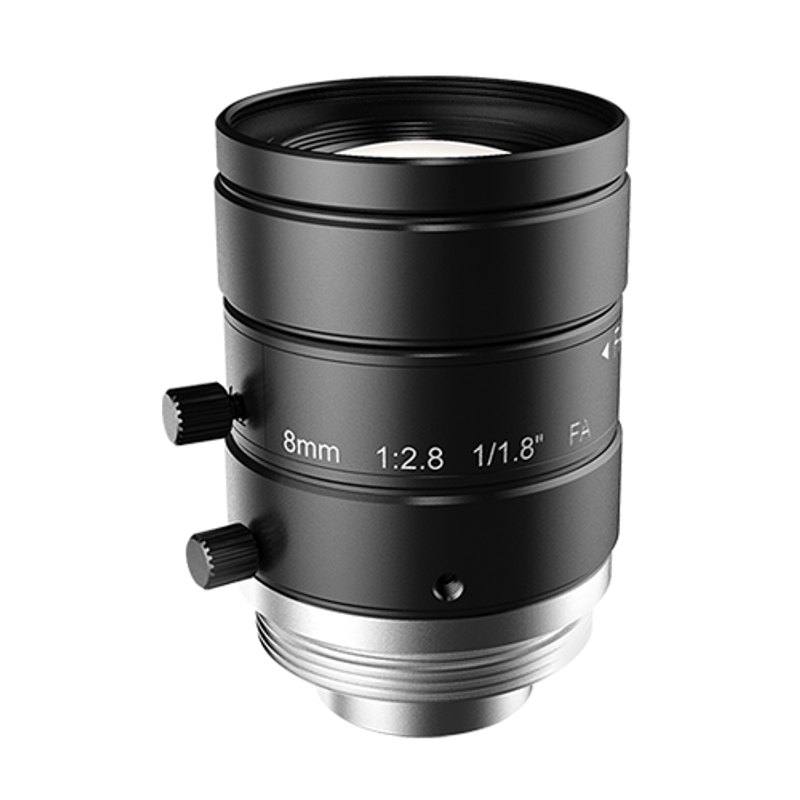
The iRAYPLE MH0828SP is part of the MH-SP Series of area scan lenses covering focal lengths from 6mm to 50mm, all designed for 1/1.8" camera sensors. It features an 8mm focal length with a maximum aperture of F2.8 and supports up to 3MP cameras with high edge definition and ultra-low distortion (-0.9% optical). The lens is built for close working distances (minimum focus 0.1m), manual focus and iris controls, and offers stable optical performance across -10°C to +50°C operating temperature range.
The iRAYPLE MH0828SP is an 8 mm fixed focal length C-mount lens rated for sensors up to 1/1.8" (image circle diameter 9.4 mm) and validated to resolve 3 MP — the combination that defines its optical scope. At 8 mm, this is a wide-angle-to-normal lens for industrial sensor formats: on a 1/1.8" sensor it delivers a broad field of view that suits close-in inspection of medium to large parts without the excessive perspective distortion that ultra-short focal lengths introduce. The maximum aperture of F2.8 gives installers meaningful light-gathering headroom, which matters when choosing continuous versus strobe illumination or when working in low-contrast surface-inspection scenarios; stopping down toward F8–F16 trades throughput for depth of field and diffraction-limited edge sharpness in setups where the part plane is not perfectly flat. Ultra-low optical distortion of -0.9% is the headline optical performance figure: at this level, straight-line dimensional measurements and grid-based calibrations converge quickly, and the residual barrel tendency is predictable enough to calibrate out in a single correction pass if sub-pixel accuracy is required.
The minimum focus distance of 0.1 m (100 mm) governs the closest working distance at which the lens can form a sharp image, which directly sets the maximum achievable magnification. Manual focus and manual iris rings provide in-field adjustment without requiring electrical lens control from the frame grabber or camera, simplifying integration and wiring in fixed-mount vision stations where the working distance and target illumination level are stable. The compact envelope — 36.34 mm length, 29 mm diameter, 56.2 g — makes this lens straightforward to mount on cameras using standard C-mount adapters.
The operating temperature range of -10 °C to +50 °C covers the majority of factory-floor environments including cold-storage logistics lines, outdoor-rated enclosures in mild climates, and standard assembly and packaging halls. As part of the MH-SP Series — which spans 6 mm to 50 mm at the same 1/1.8" image-circle spec — this lens can be paired with identical camera bodies and bracket hardware across a multi-station line that uses different focal lengths for different field-of-view requirements, reducing spare-part complexity. The C-mount standard ensures broad camera compatibility across area-scan cameras built around sensors in the 1/2.9" to 1/1.8" range; sensors smaller than the 9.4 mm image circle will simply use the central, highest-performing zone of the optical design.
Best for
Close-range surface defect inspection on PCBs, metal stampings, or pharmaceutical blisters where the 8 mm focal length provides a wide enough field to cover the part in one frame at short working distances, while the -0.9% distortion preserves feature geometry for pass/fail scoring.
Dimensional measurement of small-to-medium components (fasteners, connectors, packaging closures) at working distances from 0.1 m upward, where the low distortion and 3 MP resolution support per-pixel gauge values without an expensive telecentric alternative when the depth of field budget allows a moderate depth of part.
Packaging inspection and OCR/OCV on label or lid surfaces where the broad field of view at short working distance captures the full label area on a 1/1.8" sensor and the F2.8 aperture provides enough light throughput to freeze motion with moderate strobe energy.
Code reading (1D/2D barcodes and DPM) on parts at close range in electronics assembly or automotive traceability lines, where the combination of wide field, 3 MP resolution, and low distortion ensures consistent decode rates across the full frame without optical-corner degradation.
Multi-station machine vision lines within the MH-SP Series ecosystem where the same camera body is reused across stations with different focal lengths (6 mm to 50 mm), keeping spare inventory and integration overhead low.
Selection notes
Sensor format compatibility: the 9.4 mm image circle fully covers 1/1.8" and smaller sensors (1/2", 1/2.5", 1/2.9"). Using it on a sensor format larger than 1/1.8" will produce visible vignetting in the corners — verify your camera's sensor diagonal before ordering.
Distortion vs. telecentric trade-off: at -0.9% distortion this lens is not telecentric. For gauging tasks where the part height varies (e.g., connectors or fasteners with significant Z-depth) or where the camera angle cannot be perfectly orthogonal, residual perspective error should be assessed; if sub-0.1 mm accuracy is required over a depth range, a telecentric lens should be considered instead.
Aperture and depth of field: the F2.8 maximum aperture enables fast imaging with low strobe energy, but depth of field at F2.8 and short working distances is narrow. For parts with significant height variation, stopping down to F5.6–F8 is advisable, requiring proportionally higher illumination power or longer exposure — verify this budget against the camera's maximum shutter time and motion-blur tolerance.
Manual iris and focus rings: this lens has no electronic iris or autofocus control. For fixed-mount, fixed-working-distance stations this is an advantage (no calibration drift, no driver dependency), but it is unsuitable for applications requiring in-line focal length adjustment or remote iris control via camera SDK.
Working distance and field of view planning: at 8 mm focal length on a 1/1.8" sensor, confirm the field of view at your target working distance with a standard thin-lens approximation or the manufacturer's FOV table before finalising bracket design; the minimum focus distance of 0.1 m sets a hard lower bound on the camera-to-part standoff.
Specifications: General
Brand
iRAYPLE
Specifications: Optical
Focal length
8 mm
Lens mount
C-Mount
Aperture (f-number)
F2.8 - F16
Image circle / max sensor
Ф9.4 mm (1/1.8")
Optical resolution
3 MP
Telecentric
No
Working distance
0.1 m to ∞
Specifications: Environment
Operating temperature
-10°C ~ +50°C
Specifications: Mechanical
Dimensions
36.34 x Ф29 mm
Weight
56.2 g
Applications this camera is commonly selected for. Open one to see the full recommended hardware and approach.
Matched automatically by: camera mount fits the lens mount · camera sensor is covered by the lens image circle — this lens: C-Mount · Ф9.4 mm (1/1.8") image circle.
By category
All 589Area scan cameras 477High-speed cameras 86High-resolution cameras 26
By brand
All 589Omron / Sentech 254Basler 168iRAYPLE 154Datalogic / Datasensing 13
Follow these steps to bring up your iRAYPLE camera, capture a first image, and move from the viewer to your own application. The flow is the same across the A, AE, AX and L series; only the physical interface differs.
Download and install the iRAYPLE machine-vision SDK together with its viewer client for your operating system. The installer provides the camera drivers, the GenTL producer, and the viewer you will use for first light. For GigE Vision models, also install or enable the bundled filter/performance driver on the network adapter to maximize throughput.
2. Connect the camera to the correct interface
Wire the camera to its matching host interface: a dedicated Gigabit (or 10 GigE) NIC for GigE Vision models, a USB3 Vision port with a quality cable for USB3 models, or a frame grabber for CoaXPress models. Power the camera (PoE, USB bus power, or PoCXP / external supply as applicable). For GigE Vision, put the NIC and camera on the same subnet and, where supported, enable jumbo frames.
3. Detect and open the camera in the viewer
Launch the iRAYPLE viewer, run device enumeration, and select your camera from the discovered list. Open it to load the device feature tree (GenICam node map). If a GigE camera is found but cannot be opened, correct the IP configuration so the camera and NIC are in the same address range.
4. Set exposure, gain and trigger, then grab a first image
Start with continuous (free-run) acquisition under stable lighting. Adjust exposure time and gain for a well-exposed, low-noise image, set the pixel format (e.g. Mono8 or a Bayer/RGB format), and tune white balance on color models. Once the live image looks correct, switch trigger mode to hardware or software trigger to synchronize capture with your process, and verify a single triggered frame.
5. Move from the viewer to the SDK or a GenICam library
With imaging confirmed, reproduce the same settings in code using the SDK's C/C++ or Python API: enumerate, open, configure the relevant GenICam features, register a frame callback or grab loop, and convert frames to your pipeline's buffer format. Since the cameras are GenICam/GenTL-compliant, you can alternatively drive them from a third-party GenICam vision library. From here a stable image stream can feed a deep-learning inspection step such as Rosepetal for automated quality control.
Frequently asked questions
The MH0828SP has an image circle of 9.4 mm (Ø), which corresponds to the 1/1.8" sensor format. Any sensor whose diagonal is 9.4 mm or smaller — including 1/2", 1/2.5", and 1/2.9" formats — will be fully covered. Sensors larger than 1/1.8" will see corner shading.
The minimum focus distance is 0.1 m (100 mm). At that distance on a 1/1.8" sensor the field of view is at its smallest and magnification at its highest — exact field size depends on the sensor's pixel pitch and array dimensions, which should be calculated for your specific camera.
Yes, for most industrial gauging tasks. At -0.9% the lens introduces less than 1 pixel of positional error per 100 pixels of image height, which is within the calibration-correctable range for standard machine vision calibration routines. For very high-accuracy metrology requiring sub-pixel absolute accuracy, a residual calibration step is recommended.
No. Both the iris (F2.8 to F16) and focus rings are manual-only. The aperture and focus must be set mechanically at installation. There is no p-iris, DC-iris, or liquid lens interface on this model.
The MH0828SP is specified from -10 °C to +50 °C. This covers standard cold-storage inspection environments (above -10 °C) and most factory-floor and outdoor-enclosure installations in temperate climates. It is not rated for deep-freeze applications below -10 °C.