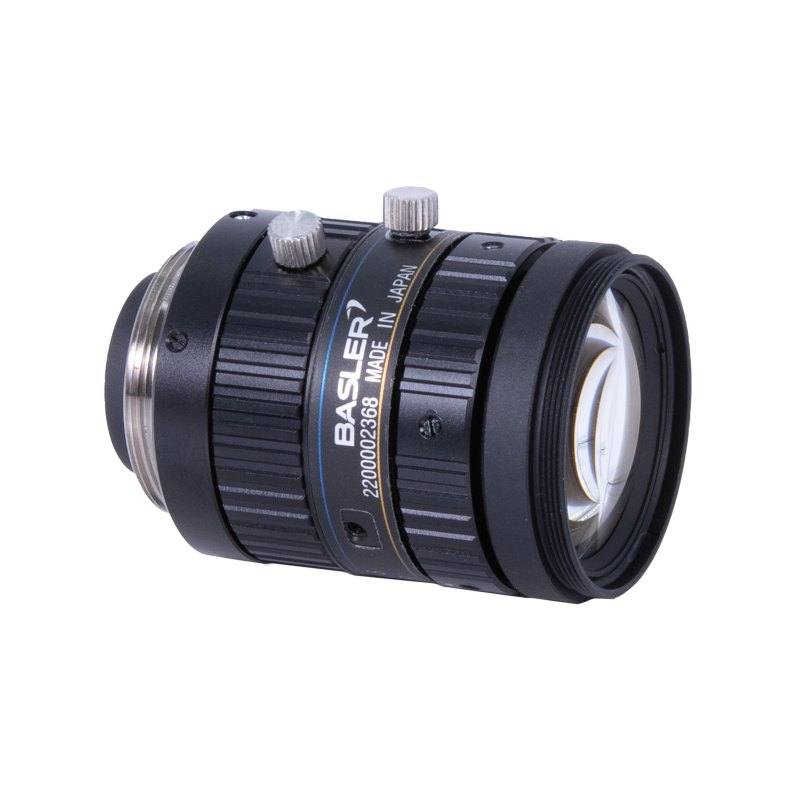
The Basler C23-0828-16M is a premium C-mount machine vision lens with an 8 mm fixed focal length and an F2.8–F16 aperture range, optimized for 16 MP sensors with up to 2 µm pixel size in 2/3" format. It covers an 11.8 mm image circle and achieves a minimum focus distance of 100 mm with a floating design that maintains image quality from close range to infinity. The lens offers very low optical distortion (0.07%) and provides a 56.4° horizontal field of view on a 2/3" sensor. It features a manual aperture with click-stop mechanism for reproducible settings and is shock/vibration resistant up to 10G, suitable for harsh industrial environments.
The Basler C23-0828-16M is an 8 mm fixed focal length C-mount lens built around the demands of modern 16 MP imaging. Its optical resolution is specified at 250 LP/mm, making it one of the few short focal-length lenses capable of rendering detail down to a 2.0 µm pixel pitch without becoming the limiting factor in the imaging chain. The 11.8 mm image circle fully covers a 2/3" sensor diagonal, so installers pairing this lens with today's popular 2/3" 16 MP area-scan cameras will see illuminated corners rather than vignetting. The F2.8 maximum aperture provides sufficient light-gathering for moderately bright scenes or moderate strobe intensities, while the F16 minimum gives depth-of-field control when the application demands it. Because the lens is not telecentric, magnification will vary with working distance — the specified optimum working distance of 300 mm is the sweet spot where the manufacturer has balanced distortion, MTF uniformity, and field curvature; use at the 100 mm minimum focus distance is feasible but should be validated against the specific acceptance criteria of the application.
Optical distortion is a standout attribute of this design at only 0.07%, which is extremely low for an 8 mm wide-angle lens. At a 56.4° horizontal field of view on a 2/3" sensor this is effectively a wide field lens, and wide-angle optics typically carry barrel distortion that can easily reach 1–3% — values that demand software correction before any pixel-based dimensional measurement is trustworthy. The 0.07% figure means that a 10 mm feature at the edge of the field is displaced by roughly 7 µm from its ideal position, a correction that is often negligible relative to the permitted tolerance in high-throughput inspection. This makes the lens directly applicable to dimensional gauging and presence/absence verification without mandatory distortion calibration, simplifying integration. The floating lens element design maintains this low distortion performance from the 100 mm minimum focus distance through to longer working distances, avoiding the image quality cliff that simpler lens constructions exhibit at close range.
The mechanical specification targets industrial deployment without concession. The all-metal housing, shock and vibration resistance to 10G, and an operating temperature range of -10 to 50°C all align with machine-line and robotic-cell environments where thermal cycling, conveyor vibration, and occasional tooling impacts are routine. The manual aperture incorporates a click-stop mechanism, which is significant for repeatability: each aperture position can be reliably re-engaged after lens removal, cleaning, or lens swap without introducing a light-level variable that would invalidate previously acquired calibration data. At 89 g the lens is light enough for robot-mounted end-of-arm tool (EOAT) configurations without adding meaningful payload to a collaborative-robot wrist. The C-mount thread is the most widely supported mount in industrial machine vision, ensuring broad camera compatibility and straightforward replacement sourcing.
Best for
Wide-area PCB and electronics sub-assembly inspection on 16 MP 2/3" cameras, where the 56.4° field of view lets a single camera cover a full board zone and the 250 LP/mm resolution resolves fine-pitch component placement and solder-joint detail simultaneously.
Dimensional gauging of small-to-medium parts — stamped metal, moulded plastic, pharmaceutical tablets — where the 0.07% distortion eliminates the need for per-image distortion correction and measurement uncertainty can be kept within tight GD&T tolerances.
Surface and cosmetic inspection of packaging, labels, or coated panels where a wide field keeps cycle-time-per-station low and the high optical resolution still captures print defects, scratches, or coating voids at pixel-level contrast.
Robot-guidance and bin-picking applications in automotive or logistics where the compact metal housing survives the vibration profile of a moving arm, the wide FOV gives sufficient scene context for pose estimation, and the C-mount interface is compatible with the vast majority of industrial GigE and USB3 vision cameras.
OCR/OCV and 1D/2D code reading on high-density labels or small data-matrix marks, where matching 2.0 µm pixel-size resolving power to a 16 MP sensor yields fine per-pixel element size over a wide working area without needing a longer, narrower lens.
Selection notes
Sensor format compatibility is a hard constraint: the 11.8 mm image circle covers 2/3" sensors but will vignette on larger formats such as 1" or 4/3". Confirm the target camera's sensor diagonal before ordering — pairing this lens with a 1" sensor will darken corners and may produce gradient shading that compromises inspection uniformity.
The lens is not telecentric, which means object-to-image magnification changes with working distance. For gauging applications where part height variation is expected (e.g., parts resting at different heights on a conveyor), telecentric optics or a tightly controlled Z-axis fixture is the better choice; this lens is best where part height is consistent or where the measurement tolerance absorbs the resulting magnification error.
The optimum working distance is 300 mm, not the 100 mm minimum. Designers tempted to shrink enclosure depth by running close to the minimum should verify MTF and distortion against their own acceptance criteria at that distance — the floating design mitigates degradation but does not eliminate it entirely, and the wide FOV at 100 mm will be very large, likely over-filling the sensor with a field far larger than needed.
Aperture setting interacts directly with depth of field and exposure. At F2.8 on a 16 MP sensor the depth of field is shallow; parts that are not co-planar may show focus roll-off at image edges. For applications with depth variation, stopping down to F5.6–F8 recovers depth of field at the cost of needing higher strobe intensity or longer exposure — confirm the lighting budget before fixing the aperture in the integration specification.
The 10G shock/vibration rating and click-stop aperture make this lens suitable for mobile or robot-mounted deployments, but the C-mount thread should be secured with a lock ring or thread adhesive in high-vibration environments to prevent gradual focus drift — a consideration not needed on a static gantry but critical on a six-axis robot arm.
Specifications: General
Brand
Basler
Specifications: Optical
Focal length
8 mm
Lens mount
C-mount
Aperture (f-number)
F2.8–F16
Image circle / max sensor
11.8 mm (2/3" format)
Optical resolution
16 MP (250 LP/mm, 2.0 µm pixel size)
Telecentric
No
Working distance
100 mm min (optimum: 300 mm)
Specifications: Environment
Operating temperature
-10 to 50°C
Specifications: Mechanical
Weight
89 g
Housing material
Metal
Applications this camera is commonly selected for. Open one to see the full recommended hardware and approach.
Matched automatically by: camera mount fits the lens mount · camera sensor is covered by the lens image circle — this lens: C-mount · 11.8 mm (2/3" format) image circle.
By category
All 759Area scan cameras 622High-speed cameras 108High-resolution cameras 29
By brand
All 759Omron / Sentech 297Basler 242iRAYPLE 201Datalogic / Datasensing 19
Get a first image quickly with the pylon Viewer, then move into the pylon SDK for your application. These cameras are GenICam/GenTL-compliant, so any compliant vision software can drive them as well.
Download and install the pylon Camera Software Suite for your OS from Basler. This provides the pylon Viewer, the GenTL transport-layer producers and the pylon SDK (C/C++/.NET/Python). On Windows the installer adds the needed drivers; on Linux follow the included setup notes for USB and network permissions.
2. Connect the camera and check the link
Cable the camera to its matching interface: GigE Vision to a GigE port (use a quality cable and, ideally, a dedicated NIC with jumbo frames enabled), USB3 Vision to a USB 3.x port with the supplied cable, or CoaXPress to the frame grabber. Provide power where required (PoE, USB bus power, or PoCXP). Open the pylon Viewer and confirm the camera appears in the device list; for GigE, make sure the camera and NIC are on the same subnet.
3. Grab a first image and set exposure, gain and pixel format
Select the camera in the pylon Viewer and start a continuous grab. Adjust exposure time and gain until the image is well exposed (avoid clipped highlights), set the pixel format (e.g. Mono8 or a Bayer/RGB format), and focus the lens. Use a test pattern if the lens or scene is not ready yet.
4. Configure triggering and acquisition
Decide between free-run and triggered acquisition. For synchronized capture, set the trigger source (software or a hardware line on the I/O connector), trigger mode and any debounce or exposure mode, then verify timing. Note the parameter names you change in the Viewer feature tree, as you will reuse them in code.
5. Move to the SDK or a GenICam-compliant library
Recreate your settings in code with the pylon SDK (C, C++, .NET or Python) to open the device, apply the same features and pull frames into your pipeline; pylon vTools and pylon AI can add processing blocks. Because the cameras are GenICam/GenTL standard, third-party vision libraries work too. Once the image stream is stable, you can route frames to a deep-learning inspection such as Rosepetal for automated defect detection.
Frequently asked questions
The lens produces an 11.8 mm image circle, which covers 2/3" format sensors. Sensors larger than 2/3" — including 1" formats — will see vignetting toward the corners and this lens is not recommended for those formats.
The lens is specified at 250 LP/mm, which corresponds to a 2.0 µm resolvable feature size. This matches the minimum pixel pitch for 16 MP sensors in 2/3" format, meaning the lens is designed to be pixel-matched rather than a resolution bottleneck. Using it with sensors of larger pixel pitch (e.g., 3.45 µm) provides additional margin.
For most gauging tolerances, yes. A 0.07% distortion on a 2/3" sensor means a worst-case positional error of roughly a few micrometres at the image edge. Whether this is acceptable depends on the permitted dimensional tolerance in the application — most mechanical inspection tasks with tolerances of ±0.05 mm or wider will find this level of distortion negligible. Metrology-grade applications with sub-pixel tolerances should still perform a calibration verification.
The minimum focus distance is 100 mm, with the optimum specified at 300 mm. The floating lens design is intended to maintain optical quality across this range, but best MTF and lowest distortion are at the optimum distance. Where mechanical constraints force a closer setup, image-quality verification at the actual working distance is recommended before finalising the mechanical design.
Yes, within limits. The metal housing, 10G shock/vibration rating, and -10 to 50°C operating range are compatible with robot-arm environments. The click-stop aperture mechanism ensures that aperture can be re-set to the same F-stop after removal or cleaning. In high-vibration conditions the C-mount thread should be mechanically secured to prevent focus drift.