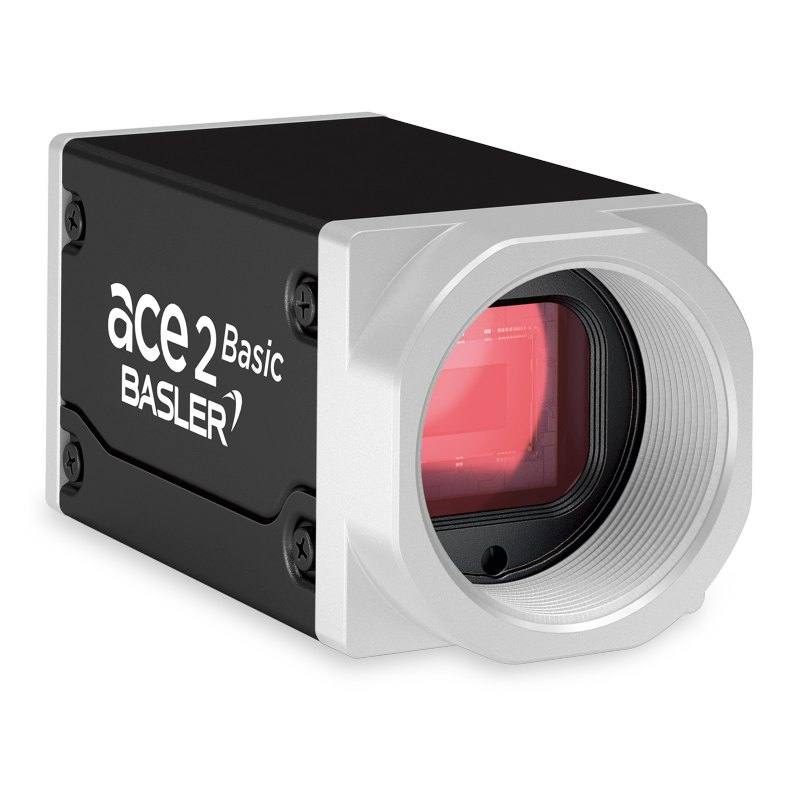
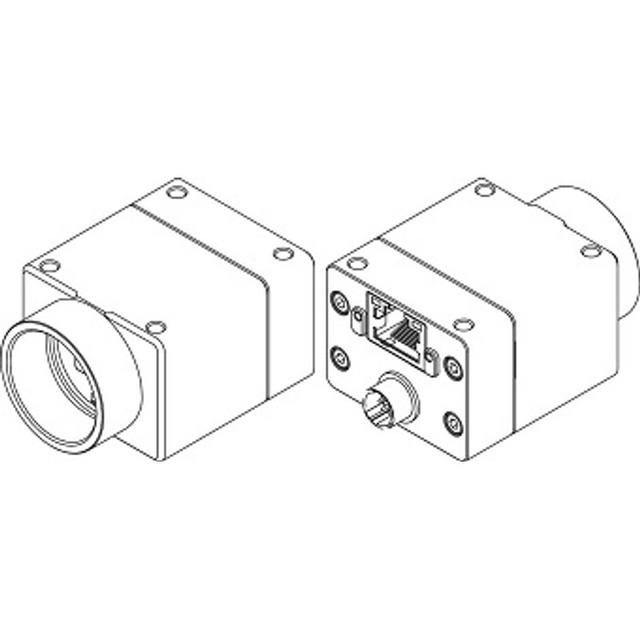
The Basler a2A1920-165g5cBAS is a compact area scan camera in the ace 2 R family, delivering 1920 x 1200 pixels at 168 fps over a 5GigE interface (NBASE-T, supporting 100/1000/2500/5000 Mbit/s). It uses a Sony IMX392LQR-C progressive scan CMOS sensor with a global shutter and 3.45 µm pixel pitch in a 1/2.3" format. The camera supports GigE Vision 2.0 and GenICam protocols, offers 8/10/12-bit pixel formats, hardware and software triggering, and is rated IP30 with an operating temperature range of -10 to 50 °C. Power is supplied via the M8 I/O connector (12–24 VDC); Power-over-Ethernet is not supported.
The Basler a2A1920-165g5c is built around the Sony IMX392LQR-C, a 1/2.3" progressive-scan CMOS sensor from the Pregius global-shutter family. At 1920 x 1200 pixels (2.3 MP) with a 3.45 µm pixel pitch, the sensor captures a 6.6 x 4.1 mm image circle, making it a natural fit for standard C-mount optics designed for 1/2" or 2/3" formats. Because the entire pixel array integrates simultaneously — global shutter — moving parts, conveyor-borne labels, or robot-held components are frozen in a single exposure without the skew or partial-blur artefacts that a rolling shutter would produce. This is the foundational property that makes the camera trustworthy for dimensional gauging, code reading, and any application where the part is in motion when the trigger fires.
The 5GigE (NBASE-T) interface is the defining throughput advantage of this model over standard GigE equivalents. Running at up to 5000 Mbit/s, the link sustains the camera's full 168 fps at 2.3 MP — a rate that a standard 1 GigE link cannot sustain at this resolution, where available bandwidth is reduced substantially. The multi-rate NBASE-T auto-negotiation (100 / 1000 / 2500 / 5000 Mbit/s) means the camera can connect to existing GigE or 2.5GigE switch infrastructure without dropping to single-digit frame rates, giving integrators a graceful upgrade path. GigE Vision 2.0 and GenICam compliance ensures compatibility with all major vision software frameworks. Power is supplied at 12–24 VDC through the M8 I/O connector; PoE is not supported, so a separate power run is required at each installation point. The 29 x 29 mm cross-section fits into tight enclosures and gantry channels, and at 105 g the camera imposes minimal load on robot wrists or moving stages.
With 8/10/12-bit pixel formats available, the camera trades frame rate for bit depth on demand: 8-bit output suits high-speed sorting lines, while 12-bit output provides 4096 grey levels per channel for colour-accurate surface grading or subtle defect contrast. Hardware and software triggering are both supported, allowing synchronisation to encoder pulses, PLC outputs, or photoelectric presence sensors. The IP30 enclosure and −10 to 50 °C operating range are appropriate for climate-controlled factory floors and logistics environments, though the modest IP30 rating means the camera should not be exposed to coolant spray or wash-down conditions without additional enclosure protection. At 5.9 W total consumption, thermal management is straightforward in even the densest multi-camera panels.
Best for
High-speed colour surface inspection on moving conveyors — 168 fps with global shutter eliminates motion blur on lines running up to several metres per second, while the 2.3 MP resolution resolves fine surface defects across a wide field
Barcode, QR, and DataMatrix traceability reading on packaging lines — global shutter prevents code distortion on fast-moving labels and the 5GigE bandwidth supports back-to-back triggers at full rate without frame drops
Robot guidance and pick-and-place — the compact 29 x 29 mm body and light 105 g weight suit wrist-mount configurations, and global shutter ensures accurate part-pose estimation regardless of robot velocity at trigger time
Colour-critical packaging and label verification — 12-bit output and the Sony Pregius colour sensor resolve print quality, label placement, and colour-match tasks that demand per-channel fidelity beyond what 8-bit pipelines provide
Electronics PCB and component inspection — 3.45 µm pixels deliver sufficient spatial resolution to detect solder bridging, component misplacement, and polarity errors across board panels at production throughput
Selection notes
PoE is not supported — every camera installation requires a 12–24 VDC power feed via the M8 I/O connector in addition to the Ethernet cable. Verify cabinet wiring and cable-chain budgets before committing to multi-camera layouts, and note that standard PoE switches will not power this camera.
5GigE requires NBASE-T-capable NICs or switches. A standard 1 GigE server port will auto-negotiate to 1 Gbit/s, which significantly reduces achievable throughput at full 1920 x 1200 resolution relative to the 168 fps maximum. Budget for 5GigE or 2.5GigE network hardware if sustained high-speed operation is required.
The 1/2.3" sensor measures 6.6 x 4.1 mm with a 7.77 mm diagonal. Any C-mount lens rated for a 1/2" or larger image circle will cover the sensor fully with no vignetting; lenses designed for smaller formats should be avoided. Focal length selection should account for the 6.6 x 4.1 mm active area when computing field of view and working distance.
IP30 provides basic protection against solid objects larger than 2.5 mm but offers no ingress protection against liquids. Applications near coolant, cleaning jets, or condensation require an additional sealed enclosure or lens-tube arrangement. Consider IP67-rated alternatives if wash-down or outdoor deployment is anticipated.
Bit-depth and frame-rate trade-offs are application-specific: 8-bit output maximises throughput on pure presence/absence or code-reading tasks, while 12-bit reduces achievable frame rate. Confirm that the host PC and frame grabber (or NIC driver buffer) can sustain the chosen bit-depth at the required trigger rate before finalising the system design.
Specifications: General
Brand
Basler
Camera type
Area Scan
Specifications: Sensor
Resolution
2.3 MP
Horizontal resolution
1920 x 1200 px
Mono / color
Color
Sensor manufacturer
Sony Pregius
Sensor model
Sony IMX392LQR-C
Shutter
Global Shutter
Sensor size
1/2.3" (6.6 x 4.1 mm, 7.77 mm diagonal)
Pixel size
3.45 µm
Specifications: Performance
FPS
168 fps
Specifications: Interface
Interface
5GigE (NBASE-T; 100/1000/2500/5000 Mbit/s)
Protocols
GigE Vision 2.0, GenICam
Specifications: Optics
Mount
C-mount
Specifications: Electrical
Power
12–24 VDC via M8 I/O connector (PoE not supported)
Power consumption
5.9 W
Specifications: Environment
IP rating
IP30
Operating temperature
-10 to 50 °C
Specifications: Mechanical
Dimensions
55.5 x 29 x 29 mm (with mount/connectors); 48.9 x 29 x 29 mm (body only)
Weight
105 g
Housing material
Box
Applications this camera is commonly selected for. Open one to see the full recommended hardware and approach.
Matched automatically by: lens mount fits the camera mount · lens image circle covers the camera sensor — this camera: C-mount · 1/2.3" (6.6 x 4.1 mm, 7.77 mm diagonal) sensor.
By category
All 237C-mount lenses 172Telecentric lenses 62F-mount / large-format lenses 3
By brand
All 237Omron / Sentech 74iRAYPLE 66Basler 65Datalogic / Datasensing 32
Get a first image quickly with the pylon Viewer, then move into the pylon SDK for your application. These cameras are GenICam/GenTL-compliant, so any compliant vision software can drive them as well.
Download and install the pylon Camera Software Suite for your OS from Basler. This provides the pylon Viewer, the GenTL transport-layer producers and the pylon SDK (C/C++/.NET/Python). On Windows the installer adds the needed drivers; on Linux follow the included setup notes for USB and network permissions.
2. Connect the camera and check the link
Cable the camera to its matching interface: GigE Vision to a GigE port (use a quality cable and, ideally, a dedicated NIC with jumbo frames enabled), USB3 Vision to a USB 3.x port with the supplied cable, or CoaXPress to the frame grabber. Provide power where required (PoE, USB bus power, or PoCXP). Open the pylon Viewer and confirm the camera appears in the device list; for GigE, make sure the camera and NIC are on the same subnet.
3. Grab a first image and set exposure, gain and pixel format
Select the camera in the pylon Viewer and start a continuous grab. Adjust exposure time and gain until the image is well exposed (avoid clipped highlights), set the pixel format (e.g. Mono8 or a Bayer/RGB format), and focus the lens. Use a test pattern if the lens or scene is not ready yet.
4. Configure triggering and acquisition
Decide between free-run and triggered acquisition. For synchronized capture, set the trigger source (software or a hardware line on the I/O connector), trigger mode and any debounce or exposure mode, then verify timing. Note the parameter names you change in the Viewer feature tree, as you will reuse them in code.
5. Move to the SDK or a GenICam-compliant library
Recreate your settings in code with the pylon SDK (C, C++, .NET or Python) to open the device, apply the same features and pull frames into your pipeline; pylon vTools and pylon AI can add processing blocks. Because the cameras are GenICam/GenTL standard, third-party vision libraries work too. Once the image stream is stable, you can route frames to a deep-learning inspection such as Rosepetal for automated defect detection.
Frequently asked questions
No. The a2A1920-165g5c does not support Power-over-Ethernet. Power must be supplied separately at 12–24 VDC through the M8 I/O connector on the camera body.
The camera will auto-negotiate to 1 Gbit/s on a standard GigE port. That bandwidth is substantially lower than the 5 Gbit/s the camera is designed for, so achievable throughput at full 1920 x 1200 resolution will be well below the 168 fps maximum. Reaching or approaching 168 fps requires a 5GigE (NBASE-T) NIC or switch port running at 5000 Mbit/s.
The Sony IMX392 in this camera uses a global shutter, meaning all pixels integrate simultaneously. On a moving conveyor or with any part in motion at trigger time, a rolling shutter would introduce geometric distortion and partial-frame blur. For code reading, dimensional measurement, or any task where the part moves relative to the camera during exposure, the global shutter is the correct choice.
The camera uses a standard C-mount. The sensor measures 6.6 x 4.1 mm with a 7.77 mm diagonal, which falls within the 1/2.3" format. When selecting a lens, specify a C-mount lens rated for a 1/2" or larger image circle; such a lens will cover the sensor fully with no corner shading.
The enclosure is rated IP30, which protects against solid objects larger than 2.5 mm but provides no protection against water or liquids. The camera should not be used in environments with coolant spray, cleaning jets, or significant condensation without additional external enclosure protection.