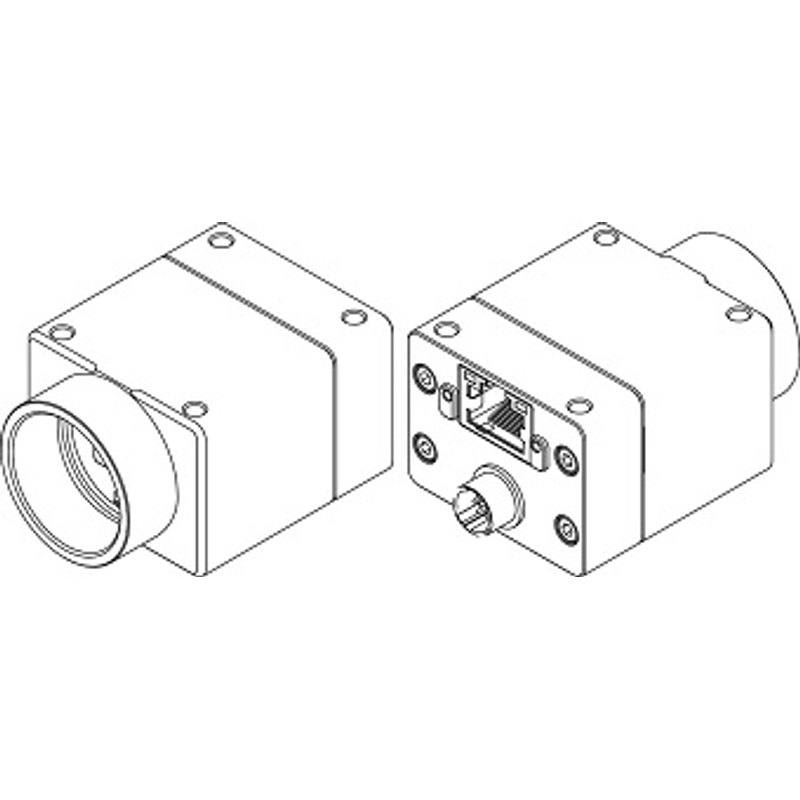
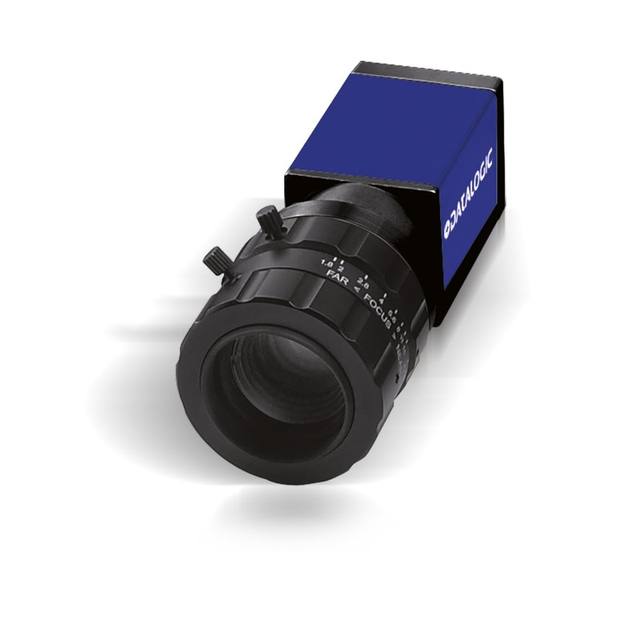
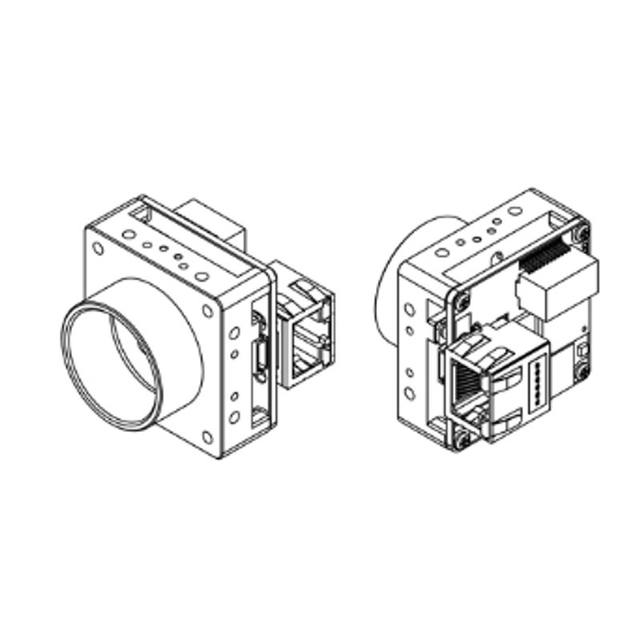
Omron / Sentech Sentech STC-MBS881POE / STC-MCS881POE GigE PoE Camera
STC-MBS881POE
The STC-MBS881POE (mono) and STC-MCS881POE (color) are GigE Vision 2.1 compliant area scan cameras from Omron Sentech featuring the Sony IMX267 back-illuminated global shutter CMOS sensor at 8.9 megapixels (4096 x 2160 pixels) with a 3.45 µm pixel pitch in a 1-inch optical format. Both cameras deliver 12.4 fps over a standard GigE (1000BASE-T) interface with Power over Ethernet (IEEE 802.3af) support, eliminating the need for a separate power supply. The compact aluminum housing measures 40 x 30 x 54.5 mm and weighs approximately 100 g, with a C-mount lens interface. Additional features include flat field correction (FFC), defective pixel correction (up to 2048 pixels), PTP time synchronization, auto exposure/gain control, and an exposure range from 1 µs to 16.777 seconds.
The STC-MBS881POE and STC-MCS881POE are built around Sony's IMX267 back-illuminated global shutter CMOS sensor — a Sony Pregius device that delivers 8.9 megapixels (4096 x 2160) on a 1-inch optical format with 3.45 µm pixel pitch. Global shutter is the decisive design choice here: every pixel integrates simultaneously, so fast-moving parts, conveyor belts, or robotic end-effectors are captured without the motion blur or spatial distortion that rolling-shutter sensors introduce. Back-side illumination adds meaningful low-light sensitivity without enlarging the pixel, which matters whenever inspection lighting budgets are constrained or working distances are long. At 12.4 fps full-frame over GigE (1000BASE-T), throughput is well-matched to moderate-speed lines — and the 1-inch format gives installers access to a wide range of C-mount lenses that fully cover the sensor circle, including telecentric optics for distortion-free dimensional gauging.
Power over Ethernet (IEEE 802.3af) fundamentally simplifies cabinet and field wiring: a single Cat-5e/Cat-6 drop carries both data and up to 15.4 W of PoE power, well above the 4.6 W the camera actually consumes. No separate branch circuit, no connector splitter, no cable bundle at the camera head — an advantage in cleanroom, tight-enclosure, and retrofit installations where routing separate power is costly. The camera also accepts 10.8–26.4 Vdc via its own power input, so it drops into existing DC-powered vision frames without PoE infrastructure. GigE Vision 2.1 and GenICam compliance mean any conformant host SDK — including Omron's own FH/FZ series controllers, Cognex VisionPro, HALCON, and open-source libraries — will enumerate and configure the camera without a custom driver. PTP (IEEE 1588) time synchronization enables precise multi-camera timestamping for stereo or multi-view setups on a shared Ethernet switch.
On-camera image quality features reduce host processing load significantly. Flat field correction (FFC) compensates for lens vignetting and illumination nonuniformity in one calibration step, which is essential when measuring gray-level gradients for surface inspection. Defective pixel correction handles up to 2048 pixels, well above the defect budget of a typical production sensor, so minor sensor imperfections never surface in output images. Auto exposure and gain control allow the camera to stabilize against slow illumination drift during a shift. Exposure range spans 1 µs to 16.777 seconds, covering strobe flash capture at the short end and long-integration dark-field applications at the long end. The aluminium housing (40 x 30 x 54.5 mm, 100 g) fits standard 30 mm rail mounts and leaves clearance for compact C-mount lenses. Operating temperature is rated 0–40 °C, appropriate for conditioned factory floors and lab environments.
Best for
High-resolution surface and cosmetic defect inspection on electronics PCBs, semiconductor substrates, and medical device housings, where the 4096 x 2160 pixel array provides fine spatial sampling across a wide field without stitching.
Dimensional measurement and gauging of machined or pressed components in automotive and electronics lines, where the global shutter eliminates positional error from part motion and the 1-inch sensor format is compatible with low-distortion telecentric lenses.
Traceability and code reading — 1D/2D barcodes and DPM codes — on packaging and pharmaceutical lines where high pixel count resolves small, dense symbologies and the PoE interface simplifies wiring on high-rack or moving-gantry installations.
Robot guidance and bin-picking in logistics and automotive assembly cells, where the global shutter freezes the field during gripper motion and PTP time synchronization aligns image timestamps with robot controller events across a multi-camera cell.
Packaging inspection and label verification in food, pharma, and consumer goods lines where either the monochrome variant (STC-MBS881POE) prioritises contrast-based inspection or the color variant (STC-MCS881POE) is needed for color-match or print verification.
Selection notes
Lens format and coverage: the 1-inch optical format requires lenses with an image circle of at least 16 mm. Standard 2/3-inch C-mount lenses will vignette at the corners; verify the lens datasheet specifies 1-inch or larger coverage before ordering. Telecentric lenses for this sensor size are available but physically larger and more expensive than those for 1/2-inch formats.
GigE bandwidth ceiling: 1000BASE-T delivers ~125 MB/s theoretical throughput. At 8.9 MP × 8-bit mono the raw frame is ~8.6 MB, so 12.4 fps approaches the wire limit at full resolution. If partial-scan ROI or pixel binning is supported by the firmware, use them to increase frame rate on a narrower inspection window; confirm this with the current firmware release notes before committing to a cycle-time budget.
PoE switch selection: the camera draws 4.6 W but the 802.3af standard allocates up to 15.4 W per port. Any 802.3af or 802.3at (PoE+) managed switch port will power the camera. Avoid passive PoE injectors that operate outside the 802.3af voltage range (44–57 V), as these may damage the input stage. For multi-camera cells, budget switch port count and total PoE wattage at the design stage.
Flat field correction calibration: FFC requires a calibration capture against a spatially uniform reference (diffuse white target or integrating sphere illumination). The correction coefficients are stored in camera non-volatile memory. Re-run calibration any time the lens, illumination geometry, or focus distance changes, as FFC is specific to the installed optical configuration.
Monochrome vs. color variant: for pure grayscale defect detection, dimensional measurement, or code reading, the monochrome STC-MBS881POE delivers higher contrast and better SNR per pixel than the Bayer-pattern color STC-MCS881POE, which incurs demosaicing interpolation. Choose the color variant only when spectral discrimination — color-match, print verification, label color sorting — is a defined inspection requirement.
Specifications: General
Brand
Omron / Sentech
Camera type
Area Scan
Specifications: Sensor
Resolution
8.9 MP
Horizontal resolution
4096 px
Mono / color
Mono (STC-MBS881POE) / Color (STC-MCS881POE)
Sensor manufacturer
Sony Pregius
Sensor model
Sony IMX267
Shutter
Global Shutter
Sensor size
1 inch
Pixel size
3.45 µm
Specifications: Performance
FPS
12.4 fps
Specifications: Interface
Interface
GigE PoE (IEEE802.3af, 1000BASE-T)
Protocols
GigE Vision 2.1, GenICam
Specifications: Optics
Mount
C-Mount
Specifications: Electrical
Power
PoE (IEEE802.3af) or external 10.8–26.4 Vdc
Power consumption
4.6 W
Specifications: Environment
Operating temperature
0 to +40 °C
Specifications: Mechanical
Housing material
Aluminium
Dimensions
40 x 30 x 54.5 mm
Weight
100 g
Applications this camera is commonly selected for. Open one to see the full recommended hardware and approach.
These steps take an Omron Sentech (STC) camera from the box to a stable first image and on to your own application. They apply across the GigE Vision, USB3 Vision and CoaXPress STC families; the interface only changes how you cable and power the camera.
Download and install the Sentech SDK on the host PC. The package provides StViewer, the viewing and configuration software you use to bring the camera up, and StApi, the programming SDK you integrate later. Because the cameras are GenICam/GenTL-compliant, StApi also registers a GenTL producer, so any GenICam-compliant third-party vision software can discover and drive the camera as an alternative front end.
2. Cable, power and connect the camera
Connect according to the interface. GigE Vision: link to a Gigabit NIC (use PoE or the separate power input) and put the camera and host on the same subnet; for USB3 Vision use a USB 3.x port and a certified cable; for CoaXPress (STC) connect to a CoaXPress frame grabber, which also supplies Power-over-Coax. Then open StViewer and let it enumerate the camera. If a GigE camera does not appear, check the IP configuration and firewall, and on USB3 confirm the host bandwidth and driver.
3. Configure exposure, gain and white balance
Open the device in StViewer and start a live stream. Set exposure and gain for a well-exposed, low-noise image: raise exposure first and only add gain when more light or a faster shutter is not an option, keeping exposure short enough to freeze motion on global-shutter models. On colour cameras, run white balance under your actual production lighting. Adjust the lens aperture and focus on a representative target before tuning anything else.
4. Set the trigger and grab a first image
Start in free-run (continuous) acquisition to confirm a clean, stable image. For inline inspection switch to hardware or software triggering: select the trigger source, set the active edge and any delay, and wire the strobe or illumination to the camera's I/O so lighting fires with each exposure. Acquire and save a frame in StViewer; this saved image is your reference for the SDK stage and for downstream inspection.
5. Move to the StApi SDK (or any GenICam software)
Once the image is stable, reproduce the same settings in code. Use StApi to open the device, apply the GenICam features you validated in StViewer (exposure, gain, trigger, pixel format) and grab frames into your application via the bundled C++, C, C#/.NET or Python interfaces; the included samples are the fastest starting point. Prefer a different stack? The same GenICam/GenTL camera works with third-party vision libraries. With a reliable feed, you can route it into a deep-learning inspection such as Rosepetal for AI-based defect detection.
Frequently asked questions
PoE fully powers the camera. The interface spec confirms IEEE 802.3af compliance, and the camera consumes only 4.6 W — well within the 15.4 W 802.3af budget. An 802.3af-compliant switch or midspan injector is all that is needed. The camera also accepts 10.8–26.4 Vdc via its own power connector if a PoE infrastructure is not available.
The Sony IMX267 implements a true global shutter: all pixels start and stop integration at the same instant. There is no rolling readout during exposure, so fast-moving subjects or strobe flash illumination will not introduce spatial distortion or partial-frame illumination artefacts.
The sensor is a 1-inch optical format device. You must use C-mount lenses that specify 1-inch (or larger) image-circle coverage to avoid vignetting across the full 4096 x 2160 pixel array. Many industrial macro and telecentric lenses are available in 1-inch C-mount variants.
Yes. The camera supports PTP (IEEE 1588) time synchronisation over the GigE network, allowing multiple cameras connected to a PTP-capable switch to share a common timebase and align their image timestamps. Hardware trigger inputs for frame-synchronised capture should be confirmed in the full I/O specification for the camera model.
The camera is GigE Vision 2.1 and GenICam compliant. Any SDK or vision software that implements these standards — including Omron FH/FZ vision controllers, MVTec HALCON, Cognex VisionPro, National Instruments Vision, and open-source libraries such as Aravis — will detect and configure the camera without a proprietary driver.