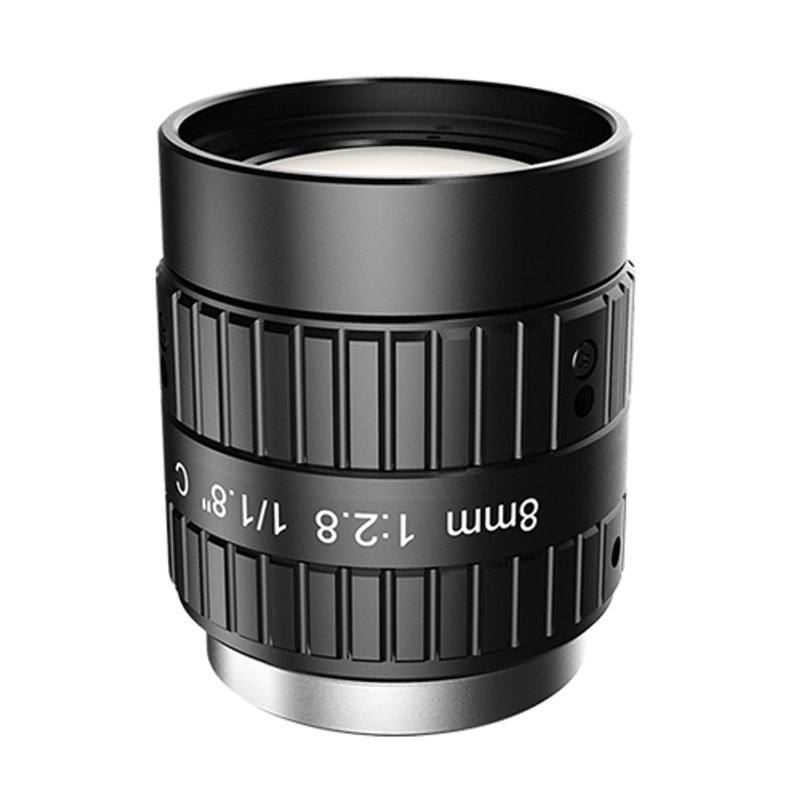
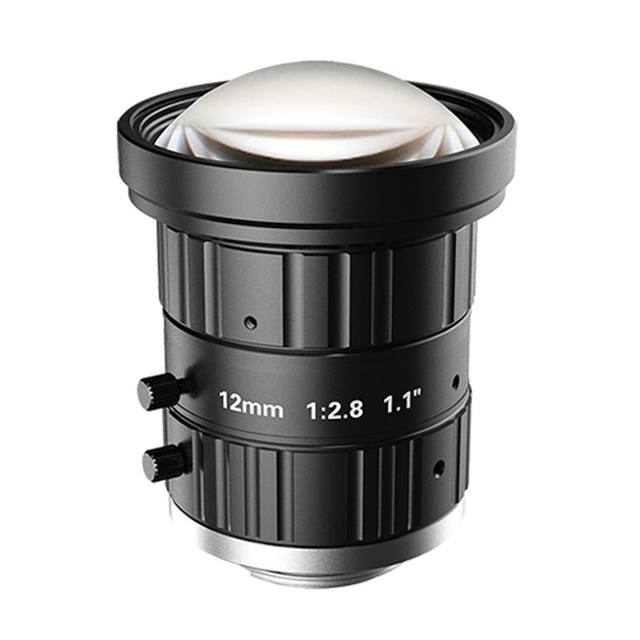
The A9-1228-6MP is part of iRAYPLE's A9-6MP series offering six focal lengths from 8mm to 50mm, all covering 1/1.8" (Φ9.4mm) sensors at 6MP resolution. At F2.8, the 12mm model delivers 78% relative illumination and TV distortion of only -0.10%, optimized for close working distances from 100mm. The compact 30mm barrel with M27×P0.5 filter thread, manual focus, and manual iris meets industrial demands across -20°C to +50°C operating temperatures.
The iRAYPLE A9-1228-6MP is a 12mm fixed-focal-length C-mount lens engineered specifically for 6-megapixel industrial cameras. A 12mm focal length sits in the moderate wide-to-normal range for machine vision: paired with a 1/1.8" sensor (9.4mm diagonal image circle), it delivers a horizontal field of view of approximately 34° at infinity focus, translating to a field width of roughly 92mm horizontal at a 150mm working distance. The lens focuses from 100mm to infinity, making it well-suited to benchtop inspection fixtures, conveyor-mounted stations, and any application where the camera must work in close proximity to the part without needing a macro attachment.
Optical resolution is certified to 6MP, meaning the lens resolves fine detail to match sensors with pixel pitches in the 2–3.5µm range typical of 6MP 1/1.8" sensors. TV distortion is held to just −0.10%, an exceptionally low figure that preserves straight edges and right-angle geometry across the full image frame without software correction. Relative illumination at the rated maximum aperture of F2.8 reaches 78%, ensuring that corners remain well-lit and do not require heavy flat-field correction in post-processing. The aperture range of F2.8 to F16 provides flexibility: opening to F2.8 maximises light throughput for dimly lit scenes or high-speed strobing but narrows depth of field, while stopping down to F8–F11 recovers depth of field at the cost of reduced brightness — a practical trade-off for dimensional gauging of parts with height variation.
The lens body measures 30mm long by 30mm in diameter and weighs only 48g, a compact and lightweight form factor that reduces vibration sensitivity on moving gantries or robot arms. Manual focus and manual iris are both adjustable via the barrel, a standard arrangement for fixed-mount machine vision stations where settings are locked once during commissioning. The M27×P0.5 filter thread accepts standard 27mm optical filters — useful for pairing with narrow-band illumination or polarisers to enhance contrast. Operating temperature spans −20°C to +50°C, covering cold-storage lines, outdoor enclosures, and high-bay factory environments without thermal focus drift.
Best for
6MP area-scan cameras on 1/1.8" sensors requiring a compact, all-round inspection lens
Close-range surface inspection and defect detection at working distances of 100–400mm, such as PCB inspection, semiconductor wafer marking, and pharmaceutical blister-pack checking
OCR/OCV and code reading tasks where near-zero distortion is critical to character recognition accuracy and barcode decode reliability
Dimensional measurement applications where the flat field and −0.10% distortion eliminate the need for lens distortion correction in the metrology software
Packaging and food-beverage line inspection where the wide aperture (F2.8) supports high shutter speeds under strobe lighting to freeze fast-moving products
Selection notes
Match sensor format before ordering: this lens covers a maximum image circle of 9.4mm (1/1.8"). Using it on a larger sensor will produce visible vignetting and unsharp corners. It is fully compatible with sensors smaller than 1/1.8" (e.g. 1/2", 1/2.9"), which will simply use the centre portion of the image circle.
Verify working distance against your field-of-view requirement. At 100mm (the minimum focus distance), horizontal FOV on a 1/1.8" sensor is approximately 62mm; at 300mm it widens to around 185mm. If you need a narrower FOV at a given distance, consider a longer focal length; if you need a wider FOV, consider the 8mm model in the A9-6MP series.
Aperture affects both exposure and depth of field: for fast conveyor lines using short-duration strobes, F2.8 maximises light collection. For parts with significant height variation (e.g. connectors, assembled PCBs), stopping down to F8 or F11 recovers depth of field at the cost of needing brighter or longer illumination pulses.
The M27×P0.5 filter thread is a less-common pitch than M30.5 or M37; confirm that any bandpass or polarising filter you plan to add is available in this thread size, or use a step-up/step-down ring.
Resolving power is rated to 6MP — do not pair this lens with higher-resolution sensors expecting full-frame sharpness at the sensor's native pixel pitch. For cameras above 6MP on the same 1/1.8" format, a higher-resolution lens should be selected.
Specifications: General
Brand
iRAYPLE
Specifications: Optical
Focal length
12mm
Lens mount
C-Mount
Aperture (f-number)
F2.8–F16
Image circle / max sensor
1/1.8" / Φ9.4mm
Optical resolution
6MP
Telecentric
No
Working distance
100mm to ∞
Specifications: Environment
Operating temperature
-20°C to +50°C
Specifications: Mechanical
Dimensions
30mm × Φ30mm
Weight
48 g
Applications this camera is commonly selected for. Open one to see the full recommended hardware and approach.
Matched automatically by: camera mount fits the lens mount · camera sensor is covered by the lens image circle — this lens: C-Mount · 1/1.8" / Φ9.4mm image circle.
By category
All 589Area scan cameras 477High-speed cameras 86High-resolution cameras 26
By brand
All 589Omron / Sentech 254Basler 168iRAYPLE 154Datalogic / Datasensing 13
Follow these steps to bring up your iRAYPLE camera, capture a first image, and move from the viewer to your own application. The flow is the same across the A, AE, AX and L series; only the physical interface differs.
Download and install the iRAYPLE machine-vision SDK together with its viewer client for your operating system. The installer provides the camera drivers, the GenTL producer, and the viewer you will use for first light. For GigE Vision models, also install or enable the bundled filter/performance driver on the network adapter to maximize throughput.
2. Connect the camera to the correct interface
Wire the camera to its matching host interface: a dedicated Gigabit (or 10 GigE) NIC for GigE Vision models, a USB3 Vision port with a quality cable for USB3 models, or a frame grabber for CoaXPress models. Power the camera (PoE, USB bus power, or PoCXP / external supply as applicable). For GigE Vision, put the NIC and camera on the same subnet and, where supported, enable jumbo frames.
3. Detect and open the camera in the viewer
Launch the iRAYPLE viewer, run device enumeration, and select your camera from the discovered list. Open it to load the device feature tree (GenICam node map). If a GigE camera is found but cannot be opened, correct the IP configuration so the camera and NIC are in the same address range.
4. Set exposure, gain and trigger, then grab a first image
Start with continuous (free-run) acquisition under stable lighting. Adjust exposure time and gain for a well-exposed, low-noise image, set the pixel format (e.g. Mono8 or a Bayer/RGB format), and tune white balance on color models. Once the live image looks correct, switch trigger mode to hardware or software trigger to synchronize capture with your process, and verify a single triggered frame.
5. Move from the viewer to the SDK or a GenICam library
With imaging confirmed, reproduce the same settings in code using the SDK's C/C++ or Python API: enumerate, open, configure the relevant GenICam features, register a frame callback or grab loop, and convert frames to your pipeline's buffer format. Since the cameras are GenICam/GenTL-compliant, you can alternatively drive them from a third-party GenICam vision library. From here a stable image stream can feed a deep-learning inspection step such as Rosepetal for automated quality control.
Frequently asked questions
At 200mm working distance, a 12mm lens on a 1/1.8" sensor (approximately 7.4mm × 5.6mm active area) yields a horizontal field of view of roughly 123mm and a vertical field of view of roughly 93mm. Use the relation FOV = sensor_dimension × (working_distance / focal_length) as a first approximation, then fine-tune with the actual back-focus distance during commissioning.
Yes, for most practical measurement tasks. A −0.10% barrel distortion means a point at the extreme corner of a 7.4mm-wide sensor is displaced by less than 7µm — well below the pixel pitch of any 6MP 1/1.8" sensor. Software correction is typically unnecessary unless your measurement tolerances are sub-pixel and you are measuring features close to the image periphery.
Yes. Both formats are smaller than the 1/1.8" image circle this lens covers, so there is no vignetting. The effective field of view will be narrower because only the central portion of the image circle is captured — equivalent to using a slightly longer focal length. This can actually be advantageous if you need a slightly tighter FOV without changing the lens.
This lens uses a manual iris — the aperture ring is set mechanically and stays fixed during operation. No iris motor or controller board is required. A DC-iris lens, by contrast, accepts a voltage signal from the camera to adjust aperture automatically (common in CCTV applications with variable ambient light). For fixed industrial lighting setups, manual iris is preferred because it is simpler, more repeatable, and eliminates any aperture hunting.
The A9-1228-6MP is rated to −20°C, so it is suitable for refrigerated and cold-chain inspection environments without any special housing modification. Thermal focus shift can occur with large temperature swings, so it is advisable to set focus and lock the focus ring after the system has stabilised at the target operating temperature.