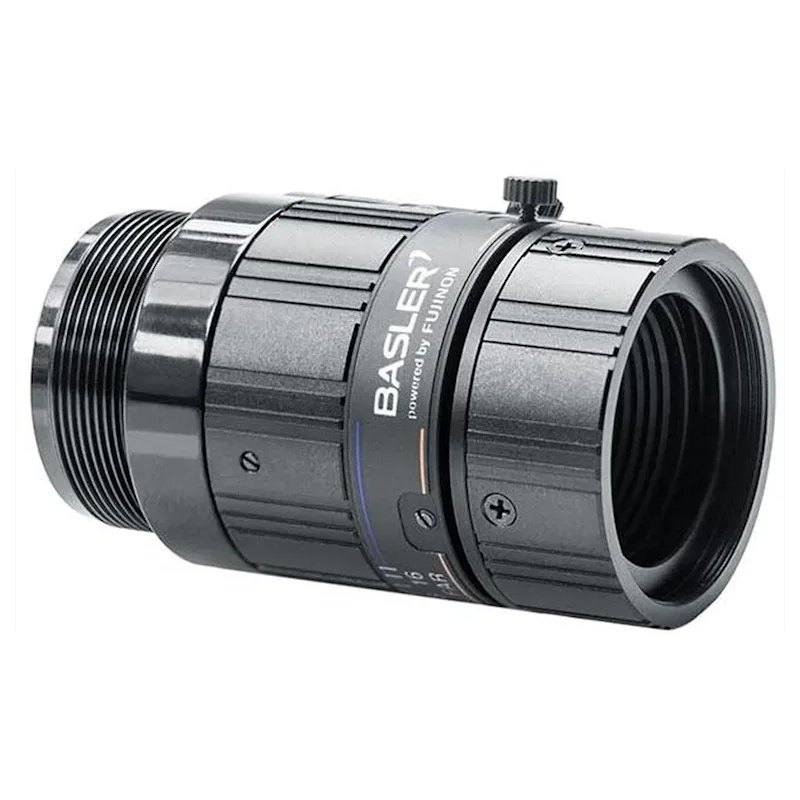
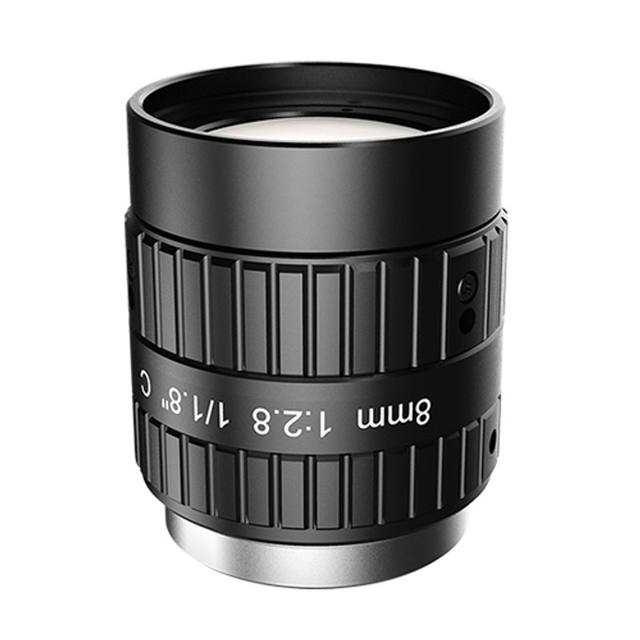
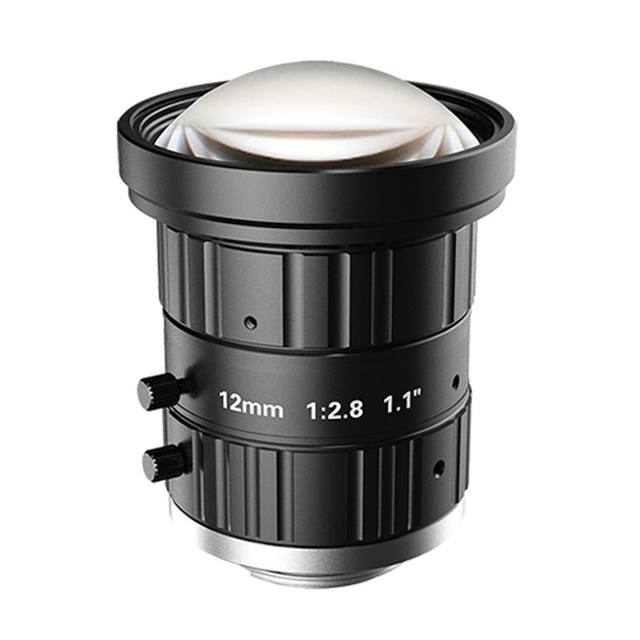
The Basler Lens C125-1620-5M is a 16 mm fixed-focal C-mount lens from Basler's Standard product line, optimized for sensors up to 1/2.5" (7.3 mm image circle). It supports up to 5 MP resolution with a pixel pitch down to 2.2 µm and delivers a typical barrel distortion of only -1%. The aperture runs from F2.0 to F22 with manual iris, and the focus range extends from 0.2 m to infinity.
The Basler Lens C125-1620-5M is a 16 mm fixed-focal C-mount lens rated for sensors up to 1/2.5" (7.3 mm image circle). At 16 mm, this is a moderate wide-to-normal focal length for C-mount optics: paired with a 1/2.5" sensor at typical machine-vision working distances of 200 mm to 500 mm, it produces a horizontal field of view of roughly 55–140 mm, making it well-suited for component-level inspection tasks where the part fits within that footprint. The minimum focus distance of 0.2 m keeps the lens practical for close-range conveyor or fixture-mounted setups. The lens is not telecentric, so some perspective error will be present at very short working distances or near the image periphery; applications requiring sub-pixel dimensional metrology should account for this or use a dedicated telecentric design.
Optical resolution is specified for sensors up to 5 MP with a minimum pixel pitch of 2.2 µm. This means the lens resolves detail down to the 2.2 µm pixel level without becoming the limiting factor in the imaging chain, provided the aperture is not set too wide. The F2.0–F22 manual iris range gives considerable flexibility: wide open at F2.0 the lens gathers substantially more light than stopped down to F22, enabling shorter exposure times or operation in dim environments, while closing the iris to F8–F11 generally optimises resolution and minimises aberrations across the field. Barrel distortion is held to a typical -1%, meaning a straight edge at the image periphery bends inward by roughly 1% of field height — acceptable for most inspection and identification tasks without software correction.
At 60 g the lens is lightweight enough for compact machine-vision cameras mounted on robot arms or in space-constrained enclosures. The C-mount thread (17.526 mm flange focal distance) is the most common standard in machine vision, giving access to a wide ecosystem of cameras from Basler and other manufacturers. The -10 to +50 °C operating range covers industrial production environments without requiring special thermal management. Fujinon-cooperated optical design ensures controlled chromatic and geometric aberrations within the stated resolution envelope, and the manual iris and focus rings allow one-time calibration once the working distance and depth-of-field requirements are fixed.
Best for
Inspection of small components on 1/2.5" 5 MP sensors at working distances of 200 mm to ~600 mm, where a field of view in the 50–150 mm range is required
Code reading (1D/2D barcodes, DataMatrix, QR) and OCR/OCV tasks where 5 MP resolution and low -1% distortion deliver clean character and symbol edges without heavy correction
Packaging line inspection — label presence, fill-level, cap verification — where the wide F2.0 aperture enables short exposures under existing line lighting
Surface and defect inspection on electronics PCBs or small automotive parts, where the 2.2 µm pixel-pitch compatibility ensures the sensor is the resolution limit, not the optics
Multi-axis robot-arm or pick-and-place vision cells where the 60 g weight and compact C-mount body keep payload and mounting footprint minimal
Selection notes
Match image circle before purchasing: this lens covers 1/2.5" (7.3 mm diameter). Sensors larger than 1/2.5" — such as 1/1.8", 1/1.2", or 2/3" — will show vignetting at the corners. Sensors smaller than 1/2.5" (e.g. 1/3") are fully covered and will use only the central, sharpest portion of the optical field.
Estimate your required field of view before committing to 16 mm: at 300 mm working distance a 1/2.5" sensor gives approximately 85 mm × 64 mm FOV with this lens. If you need a narrower FOV (higher magnification) at the same distance, step up to a 25 mm or 35 mm lens; for a wider FOV, consider 12 mm or 8 mm.
The lens is not telecentric. For applications requiring accurate dimensional measurement (gauging, edge detection at sub-pixel accuracy), parallax error grows as the part moves toward or away from the focal plane. Either use a fixed focal plane with tight depth-of-field or switch to a telecentric lens for true metric imaging.
Set iris between F5.6 and F11 for best sharpness across the full 1/2.5" field. F2.0 is useful for exposure headroom under dim or uncontrolled lighting, but depth of field shrinks to a few millimetres at close range and corner resolution may soften slightly — compensate with structured, on-axis lighting.
Verify camera flange focal distance (FFD): C-mount is standardised at 17.526 mm. Using CS-mount cameras (FFD 12.526 mm) requires a 5 mm CS-to-C adapter ring. Without the adapter the lens will not reach infinity focus.
Specifications: General
Brand
Basler
Specifications: Optical
Lens mount
C-mount
Focal length
16 mm
Aperture (f-number)
F2.0–F22
Image circle / max sensor
1/2.5" / Ø7.3 mm
Optical resolution
5 MP
Telecentric
No
Working distance
200 mm to ∞
Specifications: Environment
Operating temperature
-10 to +50 °C
Specifications: Mechanical
Weight
60 g
Applications this camera is commonly selected for. Open one to see the full recommended hardware and approach.
Matched automatically by: camera mount fits the lens mount · camera sensor is covered by the lens image circle — this lens: C-mount · 1/2.5" / Ø7.3 mm image circle.
By category
All 310Area scan cameras 228High-speed cameras 64High-resolution cameras 18
By brand
All 310Omron / Sentech 151Basler 82iRAYPLE 73Datalogic / Datasensing 4
Get a first image quickly with the pylon Viewer, then move into the pylon SDK for your application. These cameras are GenICam/GenTL-compliant, so any compliant vision software can drive them as well.
Download and install the pylon Camera Software Suite for your OS from Basler. This provides the pylon Viewer, the GenTL transport-layer producers and the pylon SDK (C/C++/.NET/Python). On Windows the installer adds the needed drivers; on Linux follow the included setup notes for USB and network permissions.
2. Connect the camera and check the link
Cable the camera to its matching interface: GigE Vision to a GigE port (use a quality cable and, ideally, a dedicated NIC with jumbo frames enabled), USB3 Vision to a USB 3.x port with the supplied cable, or CoaXPress to the frame grabber. Provide power where required (PoE, USB bus power, or PoCXP). Open the pylon Viewer and confirm the camera appears in the device list; for GigE, make sure the camera and NIC are on the same subnet.
3. Grab a first image and set exposure, gain and pixel format
Select the camera in the pylon Viewer and start a continuous grab. Adjust exposure time and gain until the image is well exposed (avoid clipped highlights), set the pixel format (e.g. Mono8 or a Bayer/RGB format), and focus the lens. Use a test pattern if the lens or scene is not ready yet.
4. Configure triggering and acquisition
Decide between free-run and triggered acquisition. For synchronized capture, set the trigger source (software or a hardware line on the I/O connector), trigger mode and any debounce or exposure mode, then verify timing. Note the parameter names you change in the Viewer feature tree, as you will reuse them in code.
5. Move to the SDK or a GenICam-compliant library
Recreate your settings in code with the pylon SDK (C, C++, .NET or Python) to open the device, apply the same features and pull frames into your pipeline; pylon vTools and pylon AI can add processing blocks. Because the cameras are GenICam/GenTL standard, third-party vision libraries work too. Once the image stream is stable, you can route frames to a deep-learning inspection such as Rosepetal for automated defect detection.
Frequently asked questions
At 300 mm working distance, the 16 mm focal length produces approximately 85 mm × 64 mm (horizontal × vertical) on a 1/2.5" sensor (sensor dimensions roughly 5.7 mm × 4.3 mm). The relationship is linear: at 150 mm WD the FOV halves to ~43 mm × 32 mm, and at 600 mm WD it doubles to ~170 mm × 128 mm. Use the formula: FOV = sensor dimension × (WD / focal length) for quick estimates at other distances.
The specified image circle is 7.3 mm (1/2.5"). A 1/2" sensor has a diagonal of approximately 8 mm, which exceeds this circle, so corner vignetting is likely. For sensors at 1/2" or larger, select a lens with a matching or larger image circle — Basler and other brands offer 16 mm options rated for 1/1.8" and 2/3" formats.
For a 1/2.5" sensor, F5.6 to F11 typically delivers the best balance of diffraction-limited sharpness, field flatness, and depth of field with this lens. F2.0 provides the most light but reduces sharpness slightly toward the corners and gives very shallow depth of field at short working distances. F16–F22 can introduce diffraction softening on 2.2 µm pixel sensors.
The C125-1620-5M is a non-telecentric (perspective) lens, meaning magnification changes slightly as object distance varies. This introduces parallax error when measuring features that are not all at the same focal plane. For casual pass/fail sizing with tolerances above ~0.5% of FOV it performs well, but for accurate sub-pixel gauging a telecentric lens is the correct choice. Software-based distortion correction can remove the -1% barrel distortion component but not the perspective error.
Yes. C-mount is an open industry standard with a 17.526 mm flange focal distance and 1-inch 32 TPI thread, supported by virtually all machine-vision camera manufacturers. Provided the camera sensor is 1/2.5" or smaller and the camera uses a true C-mount (not CS-mount without adapter), this lens will mount and function correctly.