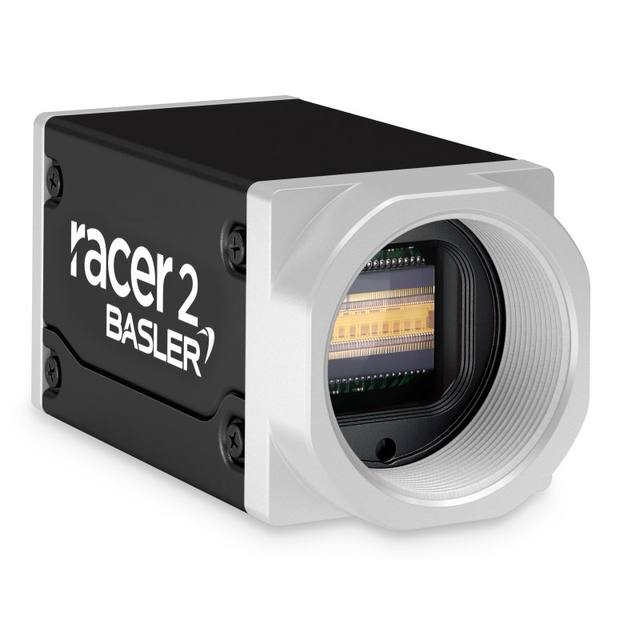
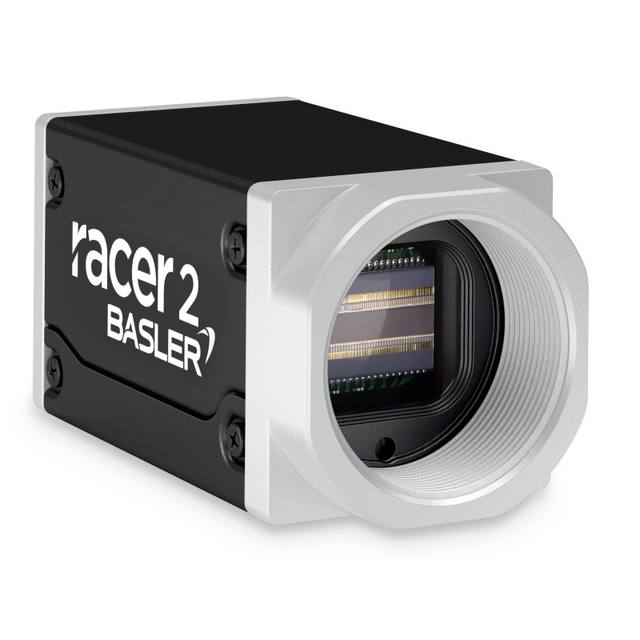
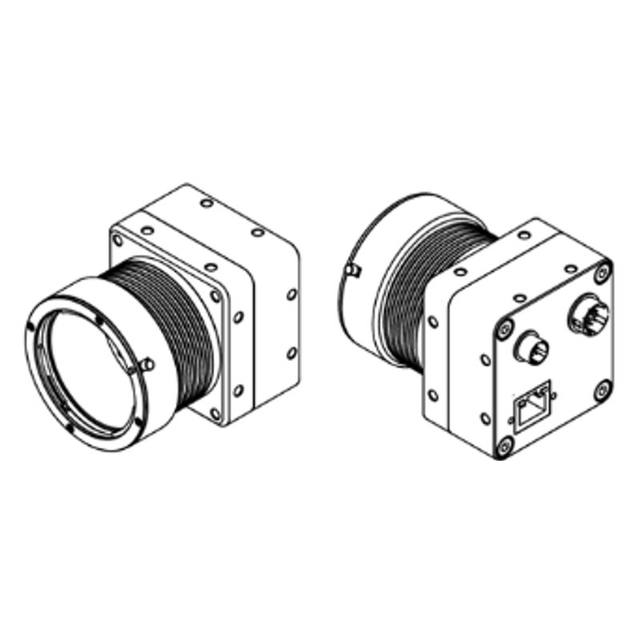
Sentech FS-C4KU7DCLU-F 4K Color Camera Link Dual Line Scan Camera
FS-C4KU7DCLU-F
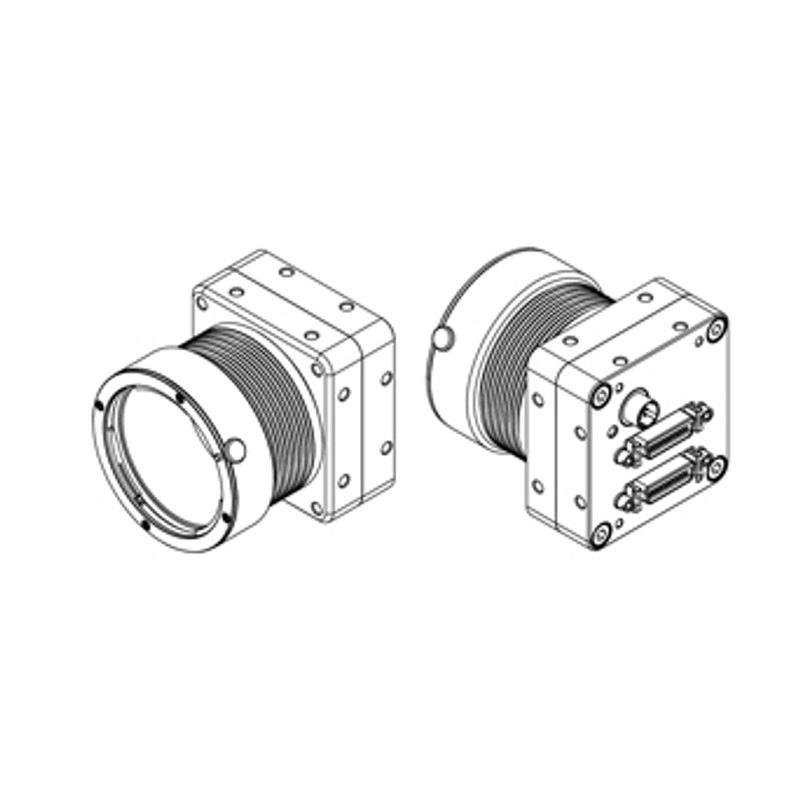
The FS-C4KU7DCLU-F is a high-speed color line scan camera with a 4,096 × 2 pixel (4K dual-line) configuration using the ams OSRAM DR-2X4K-7-inver-RGB global shutter CMOS sensor. It outputs Bayer-pattern data (BayerGB8/10/12) via Camera Link Full/Medium/Base (protocol v2.1), reaching a maximum line rate of 80 kHz with dual MDR connectors. The camera supports flat-field correction (FFC), analog gain (×1/×4), digital gain (×1–×5), and image flip functions; power is supplied externally at 10.8–26.4 Vdc with less than 5.8 W consumption. Physical dimensions are 56 × 58 × 65 mm and weight is approximately 250 g.
The FS-C4KU7DCLU-F is a 4K color dual-line scan camera built around the ams OSRAM DR-2X4K-7-inver-RGB CMOS sensor, configured as 4,096 × 2 pixels with a 7.0 × 7.0 µm pixel pitch. The dual-line architecture is what distinguishes this sensor from a single-line design: two staggered rows sample the same scene line in quick succession, enabling on-sensor Bayer demosaicing (BayerGB8/10/12 output modes) while sustaining the full 80 kHz maximum line rate. For installers, 80 kHz means a web or conveyor moving at 800 mm/s can be imaged at 10 µm line spacing — or a 400 mm/s line can be imaged at 5 µm — giving very fine cross-web pixel density for color surface work without sacrificing throughput. Global shutter operation eliminates the spatial distortion that rolling shutters introduce on moving targets, which is critical when the encoder-triggered line rate must map faithfully to physical distance.
Interface flexibility is handled through Camera Link Full/Medium/Base (protocol v2.1) carried over dual MDR connectors. Camera Link Full is required to push the full 4,096-pixel wide color data at maximum line rate; Medium and Base configurations are available when the host frame grabber has fewer taps, at the cost of reduced line rate. On-camera processing includes flat-field correction (FFC) to compensate for non-uniform illumination across the 4K swath — essential for wide-web color inspection — plus analog gain at ×1 or ×4 and digital gain from ×1 to ×5, offering sensitivity adjustment without changing integration time. An image flip function simplifies installation when the camera is mounted inverted. Power accepts a wide 10.8–26.4 Vdc range delivered externally, drawing less than 5.8 W — well within typical 24 Vdc machine cabinet supplies — so no dedicated power conditioning is required.
The F-mount lens interface is the key mechanical decision point for installers. F-mount gives access to a large catalog of well-corrected large-format Nikon-compatible lenses that fully cover the 4,096 × 7 µm = 28.7 mm sensor width. Lenses must be specified to cover this width without vignetting; verify image circle against the 28.7 mm active row before finalising the optical BOM. The compact body — 56 × 58 × 65 mm, 250 g — fits tight cabinet mounting brackets, and the 0–40 °C operating range suits standard factory-floor enclosures. Encoders feeding line-rate triggers should be sized so the maximum line period matches or exceeds the sensor's minimum integration window at the chosen gain setting; the 80 kHz ceiling gives approximately 12.5 µs minimum line period as a system planning figure.
Best for
High-speed color web and sheet inspection — textiles, films, coated papers, and laminates where both color fidelity and 80 kHz throughput are needed simultaneously.
Printed packaging and label verification at production speed, where Bayer color output allows simultaneous color deviation detection and barcode / 2D code reading from the same scan.
Electronics and battery electrode surface inspection where wide-swath 4K resolution combined with FFC-corrected uniform illumination is needed to detect coating defects, streaks, or contamination across the full web width.
Automotive paint and trim surface audit on fast-moving conveyor lines, leveraging global shutter to prevent geometric distortion of scratch or dent signals regardless of belt speed variation.
Semiconductor substrate and display panel macro-defect screening in step-and-scan configurations where the Camera Link Full interface delivers lossless raw Bayer data to a high-performance frame grabber for downstream color analysis.
Selection notes
Camera Link Full interface is mandatory for maximum throughput: confirm the frame grabber supports Camera Link Full with dual MDR cabling before finalizing the system BOM; Camera Link Medium or Base operation is possible but limits usable line rate.
The dual-line Bayer sensor outputs BayerGB8, BayerGB10, or BayerGB12 — demosaicing to RGB must be performed by the frame grabber or host software. Validate that the vision software pipeline supports the specific Bayer pattern order (GB) to avoid hue inversion.
Flat-field correction (FFC) requires a calibration step during commissioning: the illumination source must be stable and the optical path complete before FFC coefficients are captured. Bar lights with good uniformity across the 28.7 mm sensor width are strongly recommended to maximise FFC headroom.
F-mount lenses must provide adequate image circle for the full 28.7 mm sensor width (4,096 pixels × 7 µm pixel pitch); lenses that do not cover this width will vignette at the row edges. Specify lenses rated for full-frame or large-format coverage and verify MTF performance at the field edge.
External power supply must deliver 10.8–26.4 Vdc; use a regulated 24 Vdc supply with adequate current headroom above the 5.8 W draw and route power separately from signal cables to avoid noise coupling into the analog gain stages.
Specifications: General
Brand
Omron / Sentech
Camera type
Line Scan
Specifications: Sensor
Horizontal resolution
4,096 px (4K)
Mono / color
Color (Bayer)
Sensor manufacturer
ams OSRAM
Sensor model
ams OSRAM DR-2X4K-7-inver-RGB
Shutter
Global Shutter
Pixel size
7.0 × 7.0 µm
Specifications: Performance
Line rate
80 kHz (max)
Specifications: Interface
Interface
Camera Link Full / Medium / Base (v2.1)
Specifications: Optics
Mount
F-Mount
Specifications: Electrical
Power
External +10.8 to +26.4 Vdc
Power consumption
5.8 W
Specifications: Environment
Operating temperature
0 to +40 °C
Specifications: Mechanical
Dimensions
56 × 58 × 65 mm
Weight
250 g
Applications this camera is commonly selected for. Open one to see the full recommended hardware and approach.
These steps take an Omron Sentech (STC) camera from the box to a stable first image and on to your own application. They apply across the GigE Vision, USB3 Vision and CoaXPress STC families; the interface only changes how you cable and power the camera.
Download and install the Sentech SDK on the host PC. The package provides StViewer, the viewing and configuration software you use to bring the camera up, and StApi, the programming SDK you integrate later. Because the cameras are GenICam/GenTL-compliant, StApi also registers a GenTL producer, so any GenICam-compliant third-party vision software can discover and drive the camera as an alternative front end.
2. Cable, power and connect the camera
Connect according to the interface. GigE Vision: link to a Gigabit NIC (use PoE or the separate power input) and put the camera and host on the same subnet; for USB3 Vision use a USB 3.x port and a certified cable; for CoaXPress (STC) connect to a CoaXPress frame grabber, which also supplies Power-over-Coax. Then open StViewer and let it enumerate the camera. If a GigE camera does not appear, check the IP configuration and firewall, and on USB3 confirm the host bandwidth and driver.
3. Configure exposure, gain and white balance
Open the device in StViewer and start a live stream. Set exposure and gain for a well-exposed, low-noise image: raise exposure first and only add gain when more light or a faster shutter is not an option, keeping exposure short enough to freeze motion on global-shutter models. On colour cameras, run white balance under your actual production lighting. Adjust the lens aperture and focus on a representative target before tuning anything else.
4. Set the trigger and grab a first image
Start in free-run (continuous) acquisition to confirm a clean, stable image. For inline inspection switch to hardware or software triggering: select the trigger source, set the active edge and any delay, and wire the strobe or illumination to the camera's I/O so lighting fires with each exposure. Acquire and save a frame in StViewer; this saved image is your reference for the SDK stage and for downstream inspection.
5. Move to the StApi SDK (or any GenICam software)
Once the image is stable, reproduce the same settings in code. Use StApi to open the device, apply the GenICam features you validated in StViewer (exposure, gain, trigger, pixel format) and grab frames into your application via the bundled C++, C, C#/.NET or Python interfaces; the included samples are the fastest starting point. Prefer a different stack? The same GenICam/GenTL camera works with third-party vision libraries. With a reliable feed, you can route it into a deep-learning inspection such as Rosepetal for AI-based defect detection.
Frequently asked questions
The camera's maximum line rate is 80 kHz (80,000 lines per second). At that rate, a conveyor moving at 800 mm/s produces 10 µm of spacing between scan lines. For tighter sampling — say 5 µm line spacing — the web speed must be at or below 400 mm/s. The global shutter ensures each line is geometrically accurate regardless of speed variation within this envelope.
The camera outputs raw Bayer pattern data in BayerGB8, BayerGB10, or BayerGB12 format. On-camera demosaicing to RGB is not performed; the frame grabber or host software must execute the Bayer-to-RGB conversion. Confirm your vision software explicitly supports the GB Bayer order.
Full Camera Link (dual MDR connectors) is required to stream 4,096-pixel wide Bayer data at 80 kHz. Camera Link Medium and Base configurations are electrically compatible but will constrain the achievable line rate due to lower tap bandwidth.
The camera uses an F-mount (Nikon F-mount compatible). The active sensor width at 4,096 pixels × 7 µm pixel pitch is approximately 28.7 mm. Lenses must provide an image circle that covers this width without vignetting; full-frame or large-format coverage lenses are the appropriate selection criterion.
Yes. The FS-C4KU7DCLU-F includes flat-field correction (FFC) to compensate for non-uniform illumination across the sensor width. FFC coefficients are captured during a calibration procedure with the final lens and light source in place. The camera also offers analog gain (×1 or ×4) and digital gain (×1 to ×5) to tune sensitivity without changing the integration time.