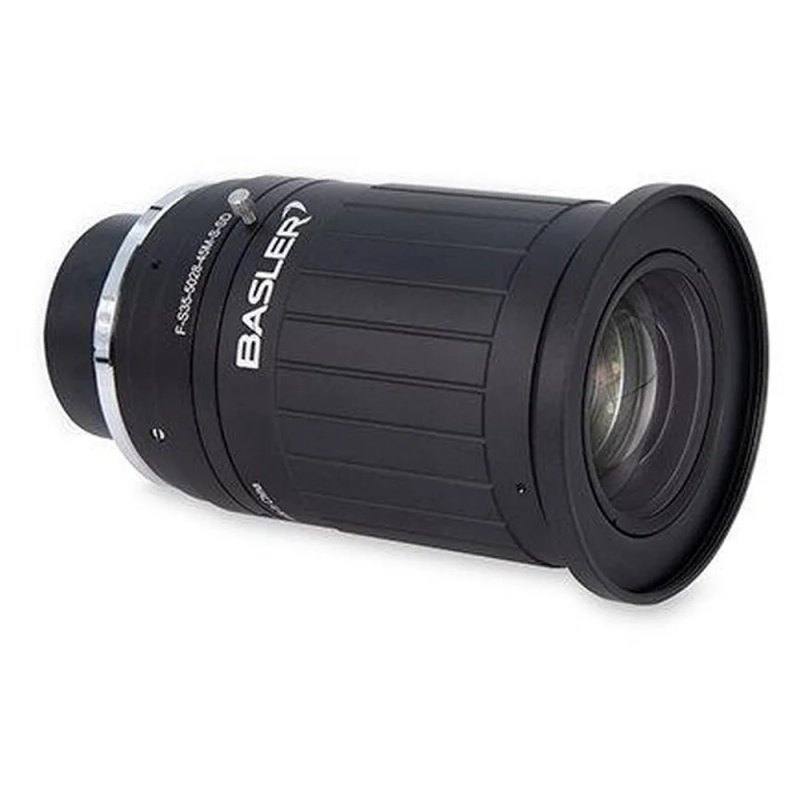
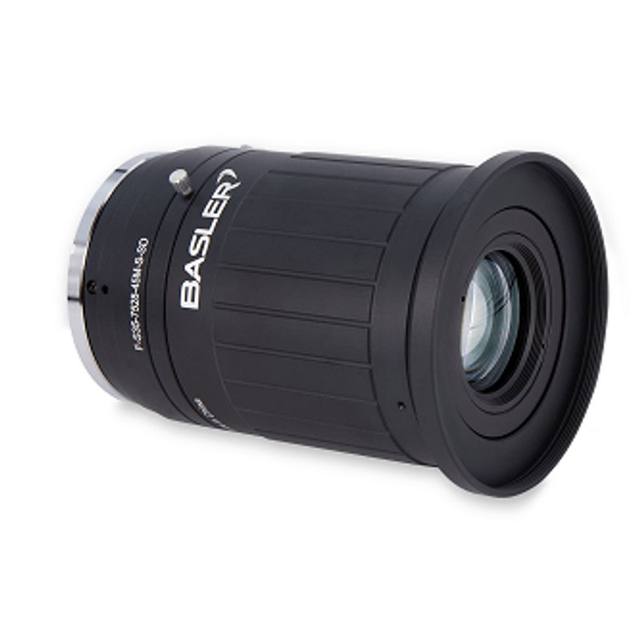
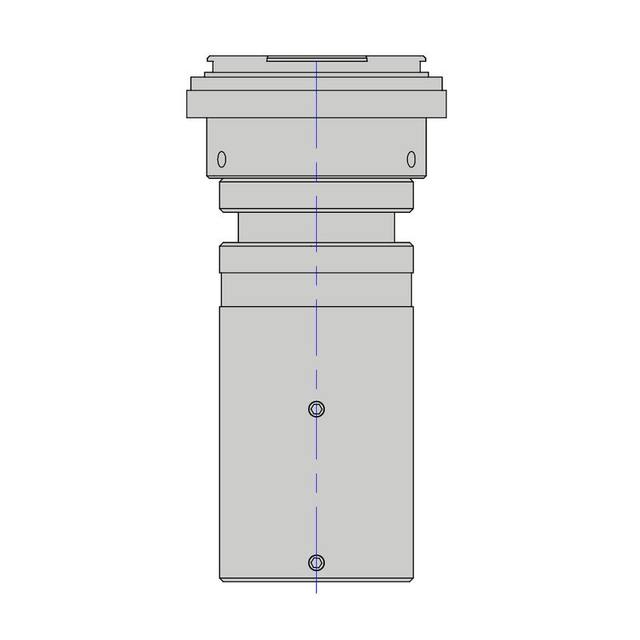
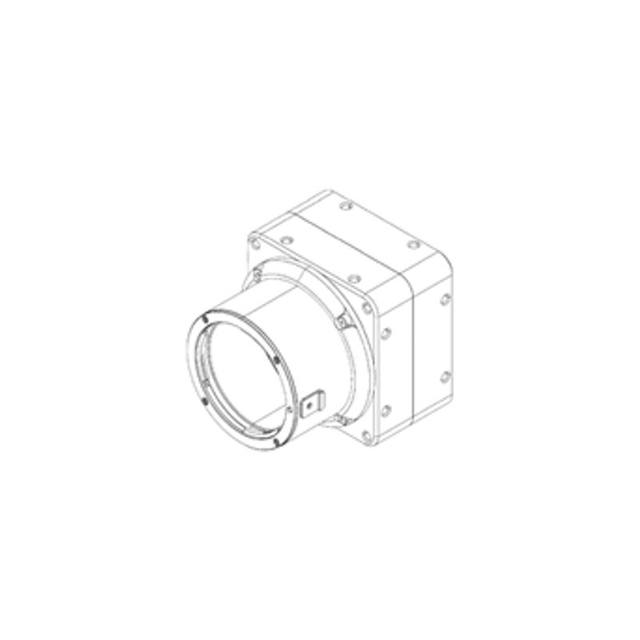
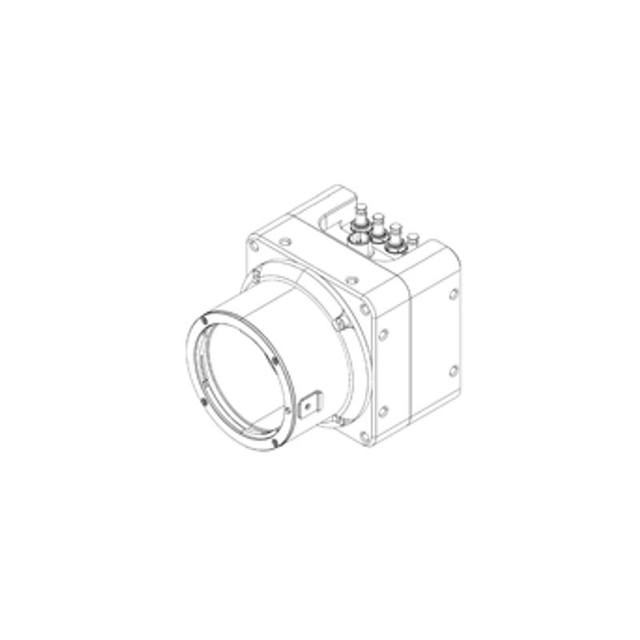
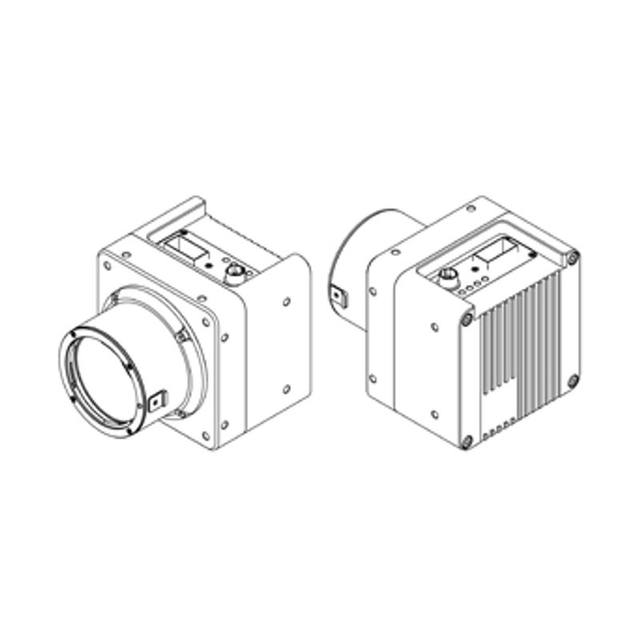
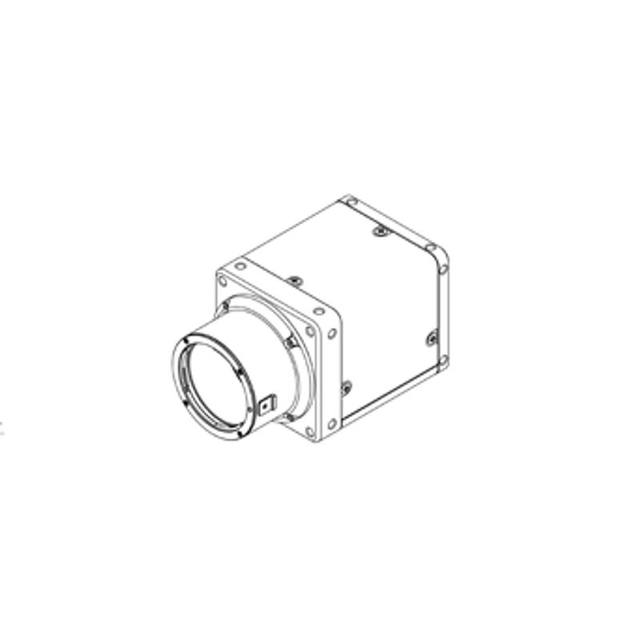
The Basler F-S35-5028-45M-S-SD is a manual-iris, fixed-focal-length F-mount lens with a 50.5 mm focal length (nominal 50 mm) and F2.8–F22 aperture range, covering a 32 mm image circle for Super 35 format sensors. It is optimized for sensors up to 45 MP at 3.2 µm pixel pitch, delivering MTF center performance above 31% at 155 LP/mm and MTF corner above 25% at F2.8 polychromatic. The lens features a 0.22–2 m focus range, M67x0.75 filter thread, ~625 g weight, and 100.3 mm overall length, with separate focus and iris lock screws. The product is discontinued but was available in Basler's Standard line for CXP-12 boost cameras with ON Semiconductor XGS sensors.
The Basler F-S35-5028-45M-S-SD is a 50 mm (50.5 mm actual) fixed-focal-length F-mount lens engineered specifically for the Super 35 format, covering a 32 mm image circle. Its optical resolution ceiling of 45 MP at a 3.2 µm pixel pitch means it can fully exploit high-density sensors such as the ON Semiconductor XGS series found in Basler's CXP-12 boost camera line without becoming the resolving bottleneck. The aperture range of F/2.8 to F/22 gives installers meaningful control over depth of field and light throughput: wide open at F/2.8 the lens delivers polychromatic MTF centre performance above 31% at 155 LP/mm, and corner performance above 25% at the same spatial frequency, which is respectable uniformity across a large sensor diagonal and matters when defects near the image corner must be detected with the same confidence as those in the centre.
The focus range of 220 mm to 2000 mm (minimum object distance 220 mm) sets the practical deployment envelope. At the short end a 50 mm focal length on a Super 35 sensor yields a relatively tight field of view that suits medium-scale inspection — circuit board panels, pharmaceutical blister packs, automotive stampings — rather than very wide overview imaging. The manual iris and separate focus lock screws mean that once a production line is dialled in, both settings can be mechanically secured against vibration drift, an important operational detail in conveyor-side installations. The M67×0.75 filter thread enables bandpass or polarising filters to be added without adapters, which is relevant when lighting conditions must be tightly controlled for surface or contrast enhancement.
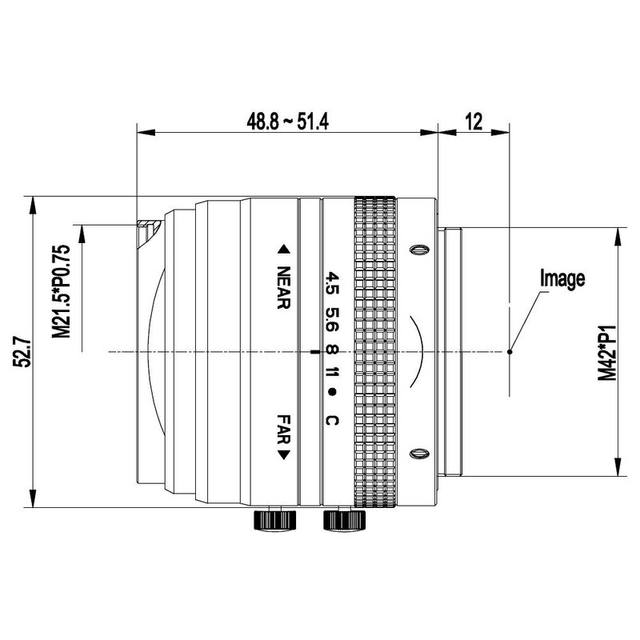
Mechanically, the lens is 100.3 mm long and weighs 625 g — substantial enough that camera mounting rigidity must be accounted for in the machine frame design, particularly if the assembly will face sustained vibration. The F-mount interface is a bayonet standard with a defined flange focal distance, so back-focus adjustment is deterministic and repeatable when swapping units. Operating temperature is rated at -10 to +50 °C, covering typical factory and cleanroom environments. Because the lens is non-telecentric, parallax error accumulates when the object plane is not perpendicular to the optical axis or when height variation is present; this is an important caveat for dimensional measurement applications where part thickness variation could introduce measurement bias if not compensated in software or by careful fixture design.
Best for
High-resolution surface inspection on large-format sensors (45 MP class, Super 35) where the 50 mm focal length and 32 mm image circle provide a medium field of view with fine pixel-level detail — suited to PCB panel inspection, flat-panel display cosmetic checks, and semiconductor wafer macro-defect imaging.
Pharmaceutical and packaging line inspection where the ability to lock focus and iris mechanically after setup reduces drift-related re-qualification events, and where the M67 filter thread simplifies integration of polarising filters to suppress specular glare on glossy blister or film surfaces.
Automotive body and stamping inspection paired with a CXP-12 boost camera, where the high resolving power at 155 LP/mm centre and large image circle allow a single camera station to cover a wide panel area without stitching, and where the F/2.8 aperture provides enough light-gathering headroom for short-duration strobe illumination.
Dimensional measurement of medium-sized parts (working distances 220–2000 mm) where a calibrated, locked-down 50 mm prime lens provides stable, repeatable magnification without zoom-induced focal length drift, and where 45 MP resolution delivers sub-pixel interpolation accuracy for feature gauging.
High-megapixel line-replacement applications where an existing F-mount camera infrastructure must be upgraded to a 45 MP sensor without redesigning the optical bench — the standard F-mount bayonet and known flange focal distance simplify the transition.
Selection notes
Sensor format compatibility is the primary gating criterion: the 32 mm Super 35 image circle means this lens is matched to Super 35 format sensors. Smaller sensors (APS-C, 1-inch, 2/3-inch) will be under-filled and waste resolution; larger sensors will vignette at the corners. Confirm your sensor diagonal against the 32 mm image circle before committing.
Pixel pitch must be at or above 3.2 µm to avoid the lens being the resolving bottleneck. Sensors with smaller pixels (e.g. 2.5 µm pitch at equivalent megapixel counts) will not be fully resolved by this optic and a higher-specification lens would be required. The stated 45 MP / 3.2 µm optimisation is the design point, not a hard ceiling for coarser-pitch sensors.
The lens is non-telecentric: object-plane tilt or part height variation will cause lateral displacement of features in the image (parallax). For dimensional measurement applications requiring better than ~0.1% accuracy across the field, part fixtures should constrain height variation, or telecentric optics should be considered instead.
At 625 g and 100.3 mm length, the lens places a significant moment load on the camera body. Camera mounts must be rated for the combined cantilevered mass, and the machine frame must be assessed for resonance if cyclic vibration is present. Use of a separate lens support bracket is advisable in high-vibration environments.
This product is listed as discontinued by Basler. Before designing it into a new production line, verify stock availability and confirm whether Basler's current lens portfolio offers a supported successor with equivalent or improved specifications, to avoid mid-production obsolescence risk.
Specifications: General
Brand
Basler
Specifications: Optical
Focal length
50 mm
Lens mount
F-mount
Aperture (f-number)
F2.8–F22
Image circle / max sensor
32 mm (Super 35 format)
Optical resolution
45 MP
Working distance
220–2000 mm
Telecentric
No
Specifications: Environment
Operating temperature
-10 to +50 °C
Specifications: Mechanical
Weight
625 g
Applications this camera is commonly selected for. Open one to see the full recommended hardware and approach.
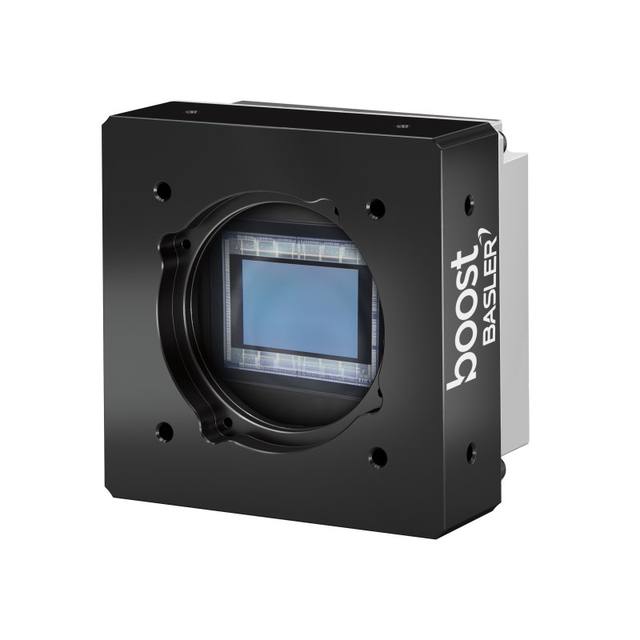
Matched automatically by: camera mount fits the lens mount · camera sensor is covered by the lens image circle — this lens: F-mount · 32 mm (Super 35 format) image circle.
Get a first image quickly with the pylon Viewer, then move into the pylon SDK for your application. These cameras are GenICam/GenTL-compliant, so any compliant vision software can drive them as well.
Download and install the pylon Camera Software Suite for your OS from Basler. This provides the pylon Viewer, the GenTL transport-layer producers and the pylon SDK (C/C++/.NET/Python). On Windows the installer adds the needed drivers; on Linux follow the included setup notes for USB and network permissions.
2. Connect the camera and check the link
Cable the camera to its matching interface: GigE Vision to a GigE port (use a quality cable and, ideally, a dedicated NIC with jumbo frames enabled), USB3 Vision to a USB 3.x port with the supplied cable, or CoaXPress to the frame grabber. Provide power where required (PoE, USB bus power, or PoCXP). Open the pylon Viewer and confirm the camera appears in the device list; for GigE, make sure the camera and NIC are on the same subnet.
3. Grab a first image and set exposure, gain and pixel format
Select the camera in the pylon Viewer and start a continuous grab. Adjust exposure time and gain until the image is well exposed (avoid clipped highlights), set the pixel format (e.g. Mono8 or a Bayer/RGB format), and focus the lens. Use a test pattern if the lens or scene is not ready yet.
4. Configure triggering and acquisition
Decide between free-run and triggered acquisition. For synchronized capture, set the trigger source (software or a hardware line on the I/O connector), trigger mode and any debounce or exposure mode, then verify timing. Note the parameter names you change in the Viewer feature tree, as you will reuse them in code.
5. Move to the SDK or a GenICam-compliant library
Recreate your settings in code with the pylon SDK (C, C++, .NET or Python) to open the device, apply the same features and pull frames into your pipeline; pylon vTools and pylon AI can add processing blocks. Because the cameras are GenICam/GenTL standard, third-party vision libraries work too. Once the image stream is stable, you can route frames to a deep-learning inspection such as Rosepetal for automated defect detection.
Frequently asked questions
The lens is optimised for sensors up to 45 MP at a 3.2 µm pixel pitch. At that pixel pitch the MTF centre exceeds 31% at 155 LP/mm polychromatic, which is sufficient to support pixel-level contrast at the Nyquist frequency of a 3.2 µm pixel. Using sensors with significantly smaller pixels at the same megapixel count would require a higher-resolution lens.
The minimum focus distance (minimum object distance) is 220 mm, measured from the lens front. The focus range extends to 2000 mm. Scenes closer than 220 mm cannot be brought into focus and would require a different optical configuration or close-up extension rings, which would alter the calibrated working distance.
Mechanically yes — the F-mount bayonet will mate — but the 32 mm image circle is much larger than required by a 4/3-inch or smaller sensor. The lens will function, and the centre of the image circle will be well-covered, but you would be using a small fraction of the available resolution and paying a significant weight and cost premium for no optical benefit. The lens is sized for Super 35 format sensors.
No. The F-S35-5028-45M-S-SD has a manual iris with an aperture range of F/2.8 to F/22, and manual focus. Both have dedicated lock screws. There is no electronic or motorised control interface. Iris and focus must be set physically during installation and locked in place for production use.
The lens has an M67×0.75 filter thread. Standard 67 mm threaded machine-vision filters — bandpass, polarising, neutral density — in the M67×0.75 pitch will thread directly onto the lens without adapters.