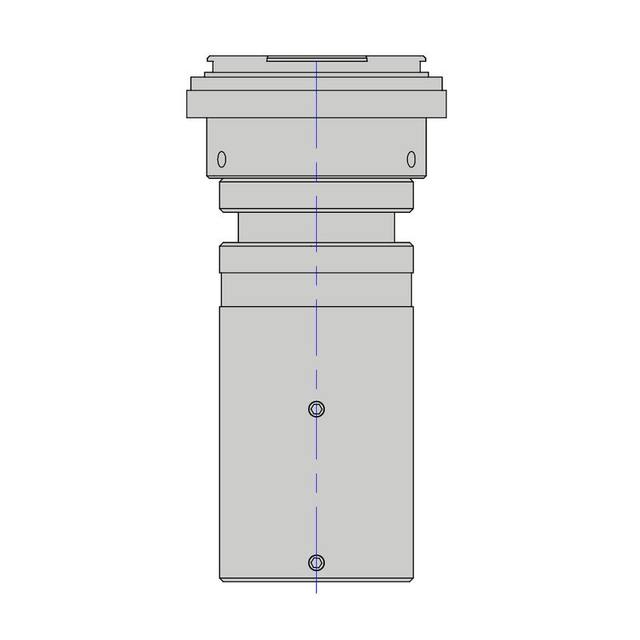
The iRAYPLE F30-2045-M42 is a single-field, fixed focal length lens designed by Huaray Technology (iRAYPLE) for large-format industrial machine vision applications. It features a 20 mm focal length, an aperture range of F/4.5 to F/11, and covers a 30 mm image circle, making it suitable for large sensors up to 30 mm diagonal. The M42 x P1 screw mount, manual focus (198.7–998.7 mm range), and manual iris control provide straightforward integration into fixed industrial setups. Its spectral sensitivity covers the visible range (0.4–0.75 µm) only.
The iRAYPLE F30-2045-M42 is a fixed focal length, large-format machine vision lens built around a 20 mm focal length and an M42 x P1 screw mount. Its Ø30 mm image circle is the defining characteristic: the lens can fully illuminate any sensor whose diagonal does not exceed 30 mm without vignetting, accommodating large-format industrial sensors commonly found in high-resolution area-scan cameras. The aperture range of F/4.5 to F/11 spans a modest but practical window for industrial use — F/4.5 provides the maximum light collection the design allows, while stopping down toward F/11 trades brightness for improved depth of field and typically reduced field curvature at the image periphery, a useful trade-off when inspecting surfaces that are not perfectly flat. Spectral coverage is limited to the visible band (0.4–0.75 µm), meaning this lens is optimised for standard industrial cameras without UV or near-IR sensitivity requirements; pairing with NIR-heavy illumination sources would be outside its design envelope.
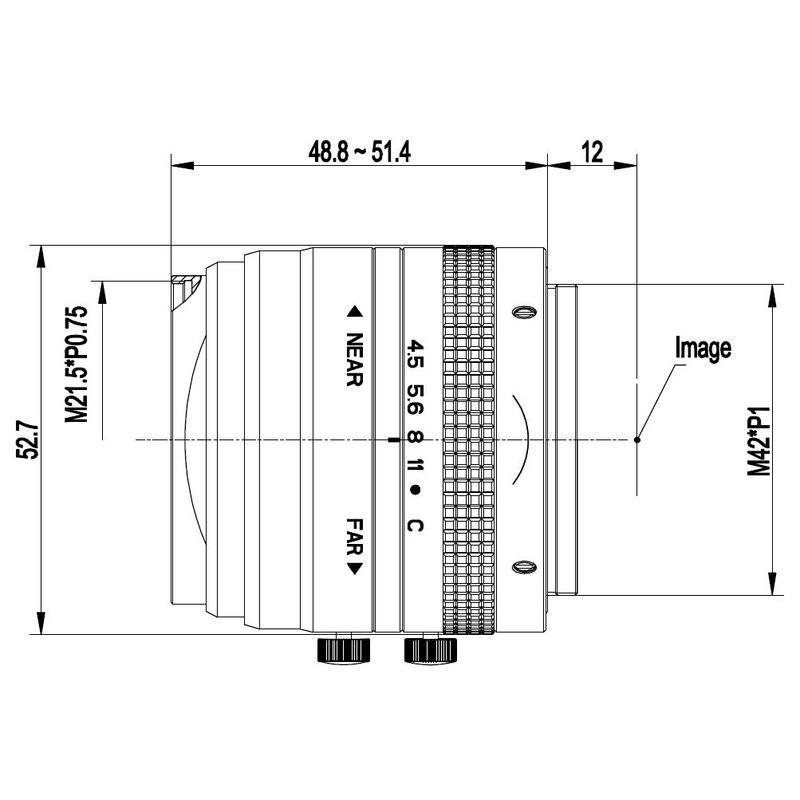
The working distance range of 198.7–998.7 mm defines the standoff envelope available to an installer. At roughly 200 mm minimum, the lens provides enough physical clearance for most in-line conveyor or fixture-mounted setups without requiring complex baffling or close-range adapters. The 20 mm focal length on a large-format sensor produces a wide field of view at these distances — useful when a single camera must cover a broad inspection zone, for example a full PCB panel, a packaging label, or a wide automotive stamping. Physical dimensions of 51.4 × 52.7 mm and an M42 thread keep integration straightforward in standard lens tubes and housings. Manual focus and manual iris mean that once the system is aligned and locked, there are no electronically adjustable elements to drift or fail; this suits fixed, repeatable installations rather than applications requiring frequent refocusing or automated iris response. The operating temperature range of -20 to +50 °C covers most factory environments from cold storage conveyors to warm foundry lines.
This lens is not telecentric, which is an important design-in consideration for dimensional measurement tasks. A non-telecentric lens introduces perspective error that increases with object-to-focus-plane distance variation — if height variation across the target is significant, apparent width or position will shift. For applications where this matters (gauging, critical dimensional checks), the depth of field and scene geometry must be managed carefully, and telecentric alternatives may be more appropriate. Where perspective error is acceptable — surface inspection, OCR, defect detection, packaging verification — the 20 mm / Ø30 mm combination delivers wide angular coverage and large-sensor compatibility that would be difficult to achieve with a telecentric design at comparable cost. Installers specifying this lens should confirm that their camera's sensor diagonal does not exceed 30 mm and that the target working distance falls between 198.7 and 998.7 mm; both constraints come directly from the optical design and cannot be exceeded without degrading image quality.
Best for
Wide-field surface inspection of large PCB panels or flat substrates using large-format sensors with up to 30 mm diagonal, where the Ø30 mm image circle covers the full sensor without vignetting and the 20 mm focal length produces a broad field at 300–600 mm working distance.
Packaging label and print inspection on production lines where a single camera must cover a wide label at moderate standoff (200–800 mm) and visible-spectrum illumination is standard.
Automotive stamping and sheet-metal defect detection requiring large sensor coverage and a wide field of view, benefiting from the 20 mm focal length and -20 to +50 °C operating range across heated or cooled plant sections.
Industrial OCR/OCV on packaging or product marking where high-resolution large-format sensors are paired with wide-field optics to read characters across a full product face in one shot.
Electronics assembly verification and defect inspection where a large-format camera captures a complete board or tray at once, reducing the number of camera positions needed for coverage.
Selection notes
Confirm your camera sensor diagonal is 30 mm or less before specifying this lens. Sensors with a diagonal larger than 30 mm will show vignetting at the corners; the image circle is a hard optical limit, not a guideline.
This lens covers the visible spectrum (0.4–0.75 µm) only. If your lighting scheme relies on near-infrared wavelengths (850 nm, 940 nm) or your camera uses NIR sensitivity, this lens is outside its specified range and focus shift or resolution loss should be expected.
Because focus and aperture are both manual, this lens is suited to fixed, locked-down installations. If your application requires remote aperture control for variable ambient light, or autofocus capability, a different lens family with motorised iris or focus will be required.
The lens is not telecentric, so any object-height variation across the field will introduce magnification error. For purely dimensional gauging tasks with tight tolerances, quantify the permissible height variation and the resulting perspective error before committing to this optic; a telecentric lens may be more appropriate.
Working distance must remain between 198.7 mm and 998.7 mm for the lens to achieve focus. Installations that require a standoff shorter than approximately 200 mm — for example, very compact in-line fixtures — will need a different optical design or a close-focus adapter, which may reduce the usable image circle.
Specifications: General
Brand
iRAYPLE
Specifications: Optical
Focal length
20 mm
Lens mount
M42 x P1
Aperture (f-number)
F/4.5 – F/11
Image circle / max sensor
Ø 30 mm
Working distance
198.7 – 998.7 mm
Telecentric
No
Specifications: Environment
Operating temperature
-20 to +50 °C
Specifications: Mechanical
Dimensions
51.4 × 52.7 mm
Applications this camera is commonly selected for. Open one to see the full recommended hardware and approach.
Matched automatically by: camera mount fits the lens mount · camera sensor is covered by the lens image circle — this lens: M42 x P1 · Ø 30 mm image circle.
By category
All 21High-speed cameras 9High-resolution cameras 7Area scan cameras 5
Follow these steps to bring up your iRAYPLE camera, capture a first image, and move from the viewer to your own application. The flow is the same across the A, AE, AX and L series; only the physical interface differs.
Download and install the iRAYPLE machine-vision SDK together with its viewer client for your operating system. The installer provides the camera drivers, the GenTL producer, and the viewer you will use for first light. For GigE Vision models, also install or enable the bundled filter/performance driver on the network adapter to maximize throughput.
2. Connect the camera to the correct interface
Wire the camera to its matching host interface: a dedicated Gigabit (or 10 GigE) NIC for GigE Vision models, a USB3 Vision port with a quality cable for USB3 models, or a frame grabber for CoaXPress models. Power the camera (PoE, USB bus power, or PoCXP / external supply as applicable). For GigE Vision, put the NIC and camera on the same subnet and, where supported, enable jumbo frames.
3. Detect and open the camera in the viewer
Launch the iRAYPLE viewer, run device enumeration, and select your camera from the discovered list. Open it to load the device feature tree (GenICam node map). If a GigE camera is found but cannot be opened, correct the IP configuration so the camera and NIC are in the same address range.
4. Set exposure, gain and trigger, then grab a first image
Start with continuous (free-run) acquisition under stable lighting. Adjust exposure time and gain for a well-exposed, low-noise image, set the pixel format (e.g. Mono8 or a Bayer/RGB format), and tune white balance on color models. Once the live image looks correct, switch trigger mode to hardware or software trigger to synchronize capture with your process, and verify a single triggered frame.
5. Move from the viewer to the SDK or a GenICam library
With imaging confirmed, reproduce the same settings in code using the SDK's C/C++ or Python API: enumerate, open, configure the relevant GenICam features, register a frame callback or grab loop, and convert frames to your pipeline's buffer format. Since the cameras are GenICam/GenTL-compliant, you can alternatively drive them from a third-party GenICam vision library. From here a stable image stream can feed a deep-learning inspection step such as Rosepetal for automated quality control.
Frequently asked questions
The lens specifies a Ø30 mm image circle, so any sensor whose diagonal is 30 mm or less is fully covered. Sensors with a larger diagonal will see darkened or soft corners.
No. The spectral sensitivity range is specified as 0.4–0.75 µm, covering the visible band only. NIR wavelengths above 750 nm are outside the design envelope; using NIR illumination may result in focus shift and reduced resolution because the lens is not corrected for those wavelengths.
The minimum working distance is 198.7 mm. The manual focus range extends from 198.7 mm to 998.7 mm; objects closer than 198.7 mm cannot be brought into sharp focus using the lens's built-in focus adjustment. Extension tubes could in principle shift the focus range closer, but this is outside the specified performance envelope.
No. Both focus and iris are manual adjustments. There is no electronic or motorised iris control on this lens. The aperture is set manually between F/4.5 and F/11 and locked in place for the duration of the installation.
The lens is 51.4 mm in diameter and 52.7 mm long, with an M42 x P1 screw mount (42 mm diameter, 1 mm thread pitch). This is a standard industrial and metrology mount; compatible M42 adapters, lens tubes, and camera mounts are widely available from major machine vision hardware suppliers.