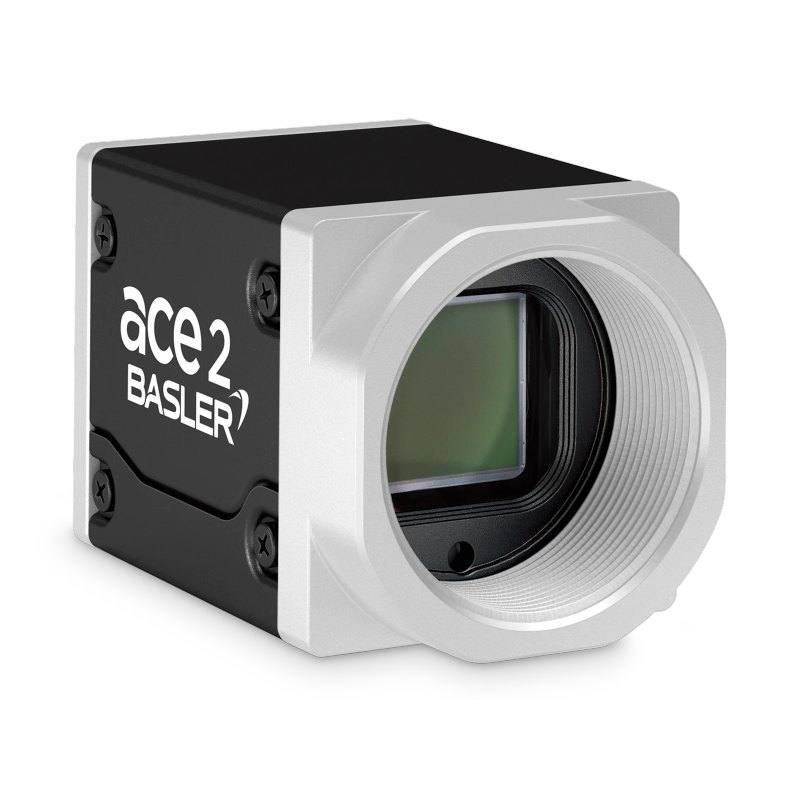
The a2A2448-210cm is part of the Basler ace 2 V series and uses the Sony IMX537-AAMJ-C progressive scan CMOS sensor at 2448 x 2048 pixels (5.1 MP) with a 2.74 µm pixel pitch. It achieves a maximum frame rate of 212.2 fps over a single CoaXPress 2.0 (CXP-12) link at up to 12.5 Gbps. The camera features a global shutter, C-mount, and is powered via Power over CoaXPress (PoCXP) at 24 VDC consuming approximately 4.6 W. Its compact 29 x 29 mm cross-section and IP30 rating make it well-suited for demanding high-speed machine vision applications.
The Basler a2A2448-210cm is built around Sony's IMX537-AAMJ-C Pregius S progressive-scan CMOS sensor that resolves 2448 × 2048 pixels (5.1 MP) with a 2.74 µm pixel pitch across a 1/1.8" optical format (6.71 × 5.61 mm active area, 8.8 mm diagonal). Global shutter means every pixel integrates simultaneously, so fast-moving parts, vibrating conveyors, or rotating shafts produce zero spatial distortion — a critical requirement whenever you are measuring or comparing edges rather than simply detecting presence. At 212.2 fps the camera streams the full 5.1 MP frame continuously, giving an installer the combination of high spatial resolution and high temporal resolution that is usually forced into a trade-off on slower interfaces. The 2.74 µm pixel pitch is small enough to support high spatial-frequency MTF from a well-corrected lens, while the Sony Pregius S generation delivers low read noise and good dynamic range, making the camera capable of resolving fine surface texture or print detail even with the short exposures that high-speed operation demands.
The interface is a single CoaXPress 2.0 (CXP-12) link running at up to 12.5 Gbps. One coaxial cable carries bidirectional control, trigger signals, and image data simultaneously, while Power over CoaXPress (PoCXP) at 24 VDC eliminates a separate power cable — the camera draws only 4.6 W. This single-cable architecture is a strong advantage in confined machine enclosures and on moving axes where cable bulk and connector count must be minimised. The camera speaks GenICam over CXP-12, so it integrates with any compliant frame grabber and SDK without vendor-specific driver layers. The C-mount accepts the very wide ecosystem of industrial C-mount lenses; with a 1/1.8" sensor the image circle requirement is 8.8 mm diagonal, which is satisfied by any lens rated for 1" or larger format — giving the specifier broad latitude on focal length and aperture choices.
The body measures 29 × 29 mm in cross-section and 50.2 mm in length, weighing 76 g. This compact, square form factor fits into tight robot-arm brackets, inline conveyor heads, and multi-camera arrays without the stacking clearance problems of larger housings. The IP30 rating protects against solid particle ingress sufficient for typical factory environments; installations in washdown zones or heavy coolant mist would require an additional sealed enclosure. Operating temperature spans -10 to +50 °C, covering most industrial floor conditions without active cooling. Triggering is handled through the CXP link itself (hardware trigger over the coaxial cable), keeping the trigger path short and deterministic. For lighting, the global shutter pairs naturally with strobe lighting: because all pixels open together, a pulsed LED strobe can freeze motion and boost effective illuminance without the rolling-artifact smear that plagues rolling-shutter designs. Installers should size the strobe pulse width to match the minimum exposure time achievable at the desired frame rate.
Best for
High-speed surface and defect inspection on fast-moving webs or discrete parts — 212 fps at 5.1 MP provides enough frames to catch intermittent defects without sacrificing spatial resolution to cover the inspection area.
Dimensional measurement and gauging of components on moving conveyors, where the global shutter prevents the geometric distortion that would otherwise corrupt edge-based measurements.
Semiconductor and electronics PCB inspection lines requiring both fine-feature resolution (2.74 µm pixel pitch supports tight MTF at the sensor) and high throughput to keep pace with modern pick-and-place or reflow rates.
Pharmaceutical and packaging traceability — reading 1D/2D codes and performing OCR/OCV on labels, blister packs, or vials at line speed, where the monochrome sensor maximises contrast for printed and laser-marked marks.
Battery cell and electrode inspection in EV manufacturing, where wide-area, high-frame-rate imaging is needed to detect coating defects, tab alignment errors, or surface contamination at production rates.
Selection notes
Frame grabber requirement: CXP-12 is not a host-native interface. The system design must include a compatible CXP-12 frame grabber (single-link, 12.5 Gbps) installed in the host PC. Confirm the grabber vendor's GenICam driver is validated for this camera before finalising the BOM.
Lens image circle: the 1/1.8" sensor (8.8 mm diagonal) requires a C-mount lens rated for at least 1" format. Using a lens rated only for 1/2" or 2/3" will produce vignetting at the corners and degrade effective resolution across the full 2448 × 2048 array.
Storage and bandwidth budget: at 212.2 fps with 5.1 MP × 8-bit monochrome, the raw pixel throughput is approximately 1.06 Gpx/s (~1.06 GB/s before overhead). Downstream processing, storage, or network infrastructure must be sized accordingly; on-grabber FPGA pre-processing or ROI cropping can reduce the burden if full-frame continuous streaming is not required.
IP30 enclosure planning: the camera's IP30 rating covers incidental solid-particle contact but provides no liquid ingress protection. In wet or mist-heavy environments (coolant, cleaning sprays) a sealed camera housing or protective barrier glass must be added to the mechanical design.
Strobe lighting compatibility: the global shutter is optimised for pulsed strobe operation. Specify a strobe controller that can synchronise pulse width to the camera's exposure signal (available via the CXP trigger/I/O interface) to ensure consistent illumination across all 212 fps frames and avoid flicker artefacts from ambient or continuous LED sources.
Specifications: General
Brand
Basler
Camera type
Area Scan
Specifications: Sensor
Resolution
5.1 MP
Horizontal resolution
2448 × 2048 px
Mono / color
Monochrome
Sensor manufacturer
Sony Pregius S
Sensor model
Sony IMX537-AAMJ-C
Shutter
Global Shutter
Sensor size
1/1.8" (6.71 × 5.61 mm, diagonal 8.8 mm)
Pixel size
2.74 × 2.74 µm
Specifications: Performance
FPS
212.2
Specifications: Interface
Interface
CoaXPress CXP-12 (2.5–12.5 Gbps)
Protocols
GenICam, CoaXPress 2.0
Specifications: Optics
Mount
C-mount
Specifications: Electrical
Power
Power over CoaXPress (PoCXP) 24 VDC
Power consumption
4.6 W
Specifications: Environment
IP rating
IP30
Operating temperature
-10 to +50 °C
Specifications: Mechanical
Dimensions
29 × 29 mm cross-section, 50.2 mm total length
Weight
76 g
Housing material
Box-style
Applications this camera is commonly selected for. Open one to see the full recommended hardware and approach.
Matched automatically by: lens mount fits the camera mount · lens image circle covers the camera sensor — this camera: C-mount · 1/1.8" (6.71 × 5.61 mm, diagonal 8.8 mm) sensor.
By category
All 220C-mount lenses 155Telecentric lenses 62F-mount / large-format lenses 3
By brand
All 220iRAYPLE 66Omron / Sentech 66Basler 59Datalogic / Datasensing 29
Get a first image quickly with the pylon Viewer, then move into the pylon SDK for your application. These cameras are GenICam/GenTL-compliant, so any compliant vision software can drive them as well.
Download and install the pylon Camera Software Suite for your OS from Basler. This provides the pylon Viewer, the GenTL transport-layer producers and the pylon SDK (C/C++/.NET/Python). On Windows the installer adds the needed drivers; on Linux follow the included setup notes for USB and network permissions.
2. Connect the camera and check the link
Cable the camera to its matching interface: GigE Vision to a GigE port (use a quality cable and, ideally, a dedicated NIC with jumbo frames enabled), USB3 Vision to a USB 3.x port with the supplied cable, or CoaXPress to the frame grabber. Provide power where required (PoE, USB bus power, or PoCXP). Open the pylon Viewer and confirm the camera appears in the device list; for GigE, make sure the camera and NIC are on the same subnet.
3. Grab a first image and set exposure, gain and pixel format
Select the camera in the pylon Viewer and start a continuous grab. Adjust exposure time and gain until the image is well exposed (avoid clipped highlights), set the pixel format (e.g. Mono8 or a Bayer/RGB format), and focus the lens. Use a test pattern if the lens or scene is not ready yet.
4. Configure triggering and acquisition
Decide between free-run and triggered acquisition. For synchronized capture, set the trigger source (software or a hardware line on the I/O connector), trigger mode and any debounce or exposure mode, then verify timing. Note the parameter names you change in the Viewer feature tree, as you will reuse them in code.
5. Move to the SDK or a GenICam-compliant library
Recreate your settings in code with the pylon SDK (C, C++, .NET or Python) to open the device, apply the same features and pull frames into your pipeline; pylon vTools and pylon AI can add processing blocks. Because the cameras are GenICam/GenTL standard, third-party vision libraries work too. Once the image stream is stable, you can route frames to a deep-learning inspection such as Rosepetal for automated defect detection.
Frequently asked questions
212.2 fps is the maximum full-resolution frame rate over a single CXP-12 link at 12.5 Gbps and is a sustained, continuous rate — not a burst limit. Sustained throughput is bounded by the 12.5 Gbps link and the host grabber's DMA pipeline, so continuous operation at full rate is achievable provided the frame grabber and storage subsystem are specified to match.
The camera uses a single CXP-12 CoaXPress 2.0 link. CoaXPress is inherently a coaxial interface designed for long industrial cable runs; practical length depends on the cable grade and the frame grabber's receiver specification. PoCXP delivers 24 VDC power over the same cable, so no separate power run is needed. Consult the frame grabber vendor's CoaXPress 2.0 cable specification for the supported length at 12.5 Gbps with your chosen cable type.
Monochrome sensors capture luminance only, which is a deliberate advantage for machine vision: they are more sensitive (no Bayer CFA transmission loss), produce sharper edges, and integrate well with monochromatic or narrowband illumination (e.g., UV, IR, or single-colour LED). Colour discrimination requires either a colour camera or optical bandpass filters paired with this mono sensor; the traceability, OCR, surface inspection, and dimensional measurement tasks listed in the application profile are all well-served by monochrome.
The camera uses a C-mount. The active sensor area is 6.71 × 5.61 mm with an 8.8 mm diagonal (1/1.8" format). Any C-mount lens with an image circle rated for 1" or larger will cover the full sensor without vignetting. Standard industrial C-mount lenses for 1", 4/3", or larger formats are all compatible.
The camera is powered exclusively via Power over CoaXPress (PoCXP) at 24 VDC, drawing approximately 4.6 W. No separate power connector or cable is required — power is sourced from the frame grabber's PoCXP output through the same coaxial cable that carries image data and control signals. Verify that the chosen frame grabber is capable of supplying PoCXP at 24 VDC before finalising the design.