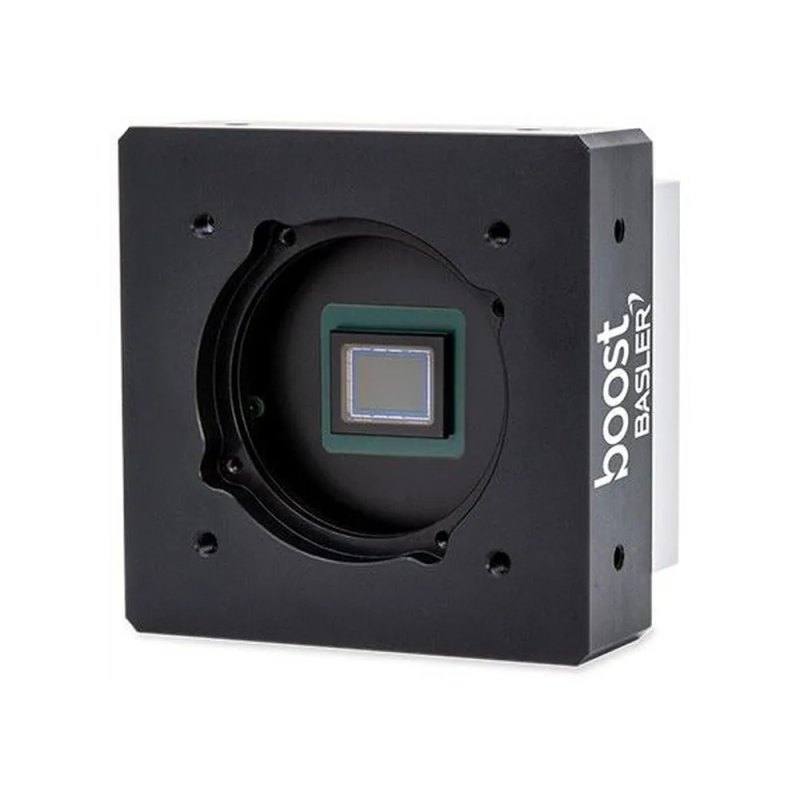
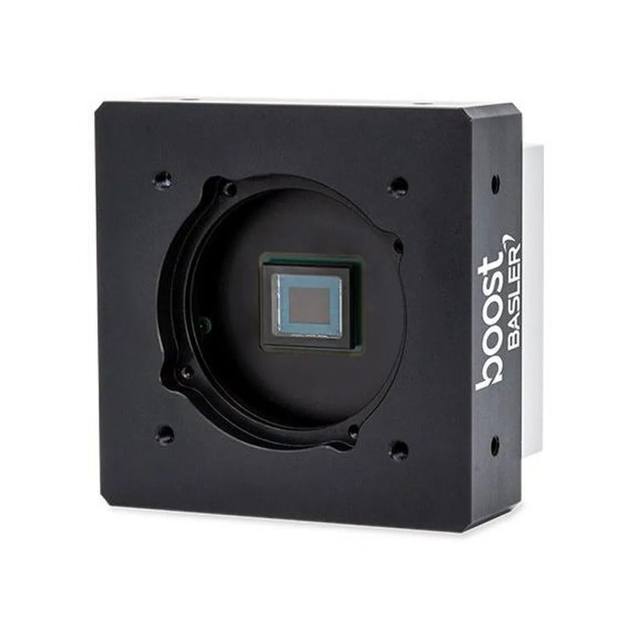
The boA2832-190cm belongs to Basler's boost series and features a 2832 x 2840 pixel Sony IMX536 progressive scan CMOS sensor with a 2/3" format and 2.74 µm pixel pitch. It uses a dual CXP-12 interface (2x 12.5 Gbps channels via Micro-BNC/HD-BNC connectors) to achieve up to 190.44 fps at full resolution. The camera supports 8, 10, and 12-bit output depth, offers hardware/software triggering, and is powered via Power over CoaXPress (PoCXP) or 24 VDC auxiliary input, consuming approximately 10.5 W. It is compliant with CoaXPress 2.0, GenICam, CE, FCC, RoHS, and IP30 rated.
Brand
Basler
Camera type
Area Scan
Interface
CoaXPress CXP-12 (2x CXP-12, 2x Micro-BNC/HD-BNC)
Resolution
8 MP
Horizontal resolution
2832 x 2840 px
Mono / color
Monochrome
Sensor manufacturer
Sony Pregius S
Sensor model
Sony IMX536-AAMJ-C
Shutter
Global Shutter
FPS
190.44 fps (max)
Mount
C-mount (also F-mount, M42x0.75, M42x1 with adapters)
The boA2832-190cm belongs to Basler's boost series and is built around Sony's IMX536 Pregius S global shutter CMOS sensor. It delivers 2832 x 2840 pixels (nominally 8 MP) across a 2/3" optical format — a 7.8 x 7.8 mm active area with a 2.74 µm pixel pitch. Global shutter capture exposes every pixel simultaneously, eliminating the rolling-shutter skew that corrupts measurements of moving parts and making the camera reliable on conveyor-fed lines and rotary indexers alike without mechanical strobe synchronisation tricks. The 2.74 µm pitch keeps the sensor format compact while the 8 MP pixel count provides spatial density well suited to reading fine-pitch 2D matrix codes, measuring narrow PCB traces, or resolving sub-millimetre surface defects across a moderately wide field. Pixel depth is selectable at 8, 10, or 12 bits, giving integrators a straightforward trade between throughput and grey-level precision — 12-bit output is particularly useful in pharmaceutical or semiconductor inspection where subtle optical density differences must be reliably separated.
The dual CoaXPress 2.0 interface is the defining system-design decision. Two CXP-12 channels, each running at 12.5 Gbps, are routed over Micro-BNC or HD-BNC coaxial connectors, sustaining 190.44 fps at the full 2832 x 2840 resolution. CXP coax carries data, camera control, hardware trigger, and Power over CoaXPress (PoCXP, 24 VDC) on the same cable run, so the camera can be powered directly from the frame grabber card — the auxiliary 18.6–26 VDC I/O connector is available as a fallback. Total power draw is 10.5 W, modest for a sensor and interface combination delivering this bandwidth. GenICam compliance means the camera integrates with any CXP-capable frame grabber and standard vision software stacks without vendor-specific drivers beyond the grabber itself. The camera body measures 45 x 80 x 80 mm and weighs 442 g, placing it in the compact end of high-speed, high-resolution area-scan cameras — practical for integration on robot wrists, gantry end-effectors, and crowded multi-camera fixture heads. The C-mount thread is native; adapters extend compatibility to F-mount, M42x0.75, and M42x1 lenses. Operating temperature spans 0–50 °C and the IP30 rating covers typical enclosed factory environments. Hardware and software triggering are both supported for synchronisation with PLCs, encoders, or strobe controllers, and the 190 fps frame rate gives generous headroom to oversample fast-moving targets.
Best for
High-throughput surface and defect inspection on electronics PCBs or display panels where 8 MP resolution must be sustained at line speed — the 190.44 fps global-shutter capture and 2/3" 8 MP sensor resolve fine-pitch features without motion blur.
Pharmaceutical blister-pack or label inspection requiring 12-bit monochrome grey-level depth to detect subtle print-contrast and surface defects, combined with CXP cabling that accommodates large filling-line enclosures.
Precision dimensional gauging of mechanical or electronic components on indexed or continuous-motion stages, where the global shutter captures distortion-free images and the 2832 x 2840 pixel grid provides sub-pixel interpolation headroom when paired with a well-corrected C-mount lens.
Automotive body or battery-cell surface inspection at high speed, exploiting the 190 fps throughput to maintain cycle-time compliance on fast robotic cells while keeping the camera footprint (45 x 80 x 80 mm, 442 g) compatible with mounting on a SCARA or 6-axis arm.
Semiconductor or flat-panel inspection systems using multi-camera CoaXPress frame grabbers, where PoCXP simplifies wiring and the GenICam-compliant interface allows deterministic multi-camera synchronisation through a shared hardware trigger.
Selection notes
CoaXPress 2.0 requires a compatible frame grabber card — verify your grabber supports dual CXP-12 ports and the full 2x 12.5 Gbps aggregate bandwidth before specifying this camera; CXP-6 or single-port CXP-12 grabbers will either not connect or will cap throughput below the camera's maximum.
The native C-mount is designed for the 2/3" (11 mm diagonal) image circle; confirm any C-mount lens is rated for 2/3" or larger format — using a lens specified only to 1/2" will vignette the corners of the 7.8 x 7.8 mm sensor.
At 2.74 µm pixel pitch, lens resolving power is the limiting factor for spatial accuracy: choose an industrial-grade C-mount lens with MTF performance resolved to at least 182 lp/mm (the Nyquist limit at this pitch) at the working f-stop to avoid the lens becoming the bottleneck before the sensor.
The IP30 rating protects against solid object ingress but provides no moisture or dust sealing — if the installation environment has coolant mist, airborne particles, or wash-down cycles, a sealed housing or protective enclosure is required.
Power budget: PoCXP (24 VDC via Micro-BNC) is convenient but confirm the frame grabber's per-port PoCXP current budget covers the 10.5 W draw; if not, use the auxiliary 18.6–26 VDC I/O connector instead.
Specifications: General
Brand
Basler
Camera type
Area Scan
Specifications: Sensor
Resolution
8 MP
Horizontal resolution
2832 x 2840 px
Mono / color
Monochrome
Sensor manufacturer
Sony Pregius S
Sensor model
Sony IMX536-AAMJ-C
Shutter
Global Shutter
Sensor size
2/3" (11 mm diagonal, 7.8 x 7.8 mm)
Pixel size
2.74 µm x 2.74 µm
Specifications: Performance
FPS
190.44 fps (max)
Specifications: Interface
Interface
CoaXPress CXP-12 (2x CXP-12, 2x Micro-BNC/HD-BNC)
Protocols
GenICam, CoaXPress 2.0
Specifications: Optics
Mount
C-mount (also F-mount, M42x0.75, M42x1 with adapters)
Specifications: Electrical
Power
PoCXP (24 VDC via Micro-BNC) or 18.6–26 VDC via I/O connector
Power consumption
10.5 W
Specifications: Environment
IP rating
IP30
Operating temperature
0–50 °C
Specifications: Mechanical
Dimensions
45 x 80 x 80 mm
Weight
442 g
Applications this camera is commonly selected for. Open one to see the full recommended hardware and approach.
Matched automatically by: lens mount fits the camera mount · lens image circle covers the camera sensor — this camera: C-mount (also F-mount, M42x0.75, M42x1 with adapters) · 2/3" (11 mm diagonal, 7.8 x 7.8 mm) sensor.
By category
All 198C-mount lenses 135Telecentric lenses 60F-mount / large-format lenses 3
By brand
All 198Omron / Sentech 66Basler 59iRAYPLE 48Datalogic / Datasensing 25
Get a first image quickly with the pylon Viewer, then move into the pylon SDK for your application. These cameras are GenICam/GenTL-compliant, so any compliant vision software can drive them as well.
Download and install the pylon Camera Software Suite for your OS from Basler. This provides the pylon Viewer, the GenTL transport-layer producers and the pylon SDK (C/C++/.NET/Python). On Windows the installer adds the needed drivers; on Linux follow the included setup notes for USB and network permissions.
2. Connect the camera and check the link
Cable the camera to its matching interface: GigE Vision to a GigE port (use a quality cable and, ideally, a dedicated NIC with jumbo frames enabled), USB3 Vision to a USB 3.x port with the supplied cable, or CoaXPress to the frame grabber. Provide power where required (PoE, USB bus power, or PoCXP). Open the pylon Viewer and confirm the camera appears in the device list; for GigE, make sure the camera and NIC are on the same subnet.
3. Grab a first image and set exposure, gain and pixel format
Select the camera in the pylon Viewer and start a continuous grab. Adjust exposure time and gain until the image is well exposed (avoid clipped highlights), set the pixel format (e.g. Mono8 or a Bayer/RGB format), and focus the lens. Use a test pattern if the lens or scene is not ready yet.
4. Configure triggering and acquisition
Decide between free-run and triggered acquisition. For synchronized capture, set the trigger source (software or a hardware line on the I/O connector), trigger mode and any debounce or exposure mode, then verify timing. Note the parameter names you change in the Viewer feature tree, as you will reuse them in code.
5. Move to the SDK or a GenICam-compliant library
Recreate your settings in code with the pylon SDK (C, C++, .NET or Python) to open the device, apply the same features and pull frames into your pipeline; pylon vTools and pylon AI can add processing blocks. Because the cameras are GenICam/GenTL standard, third-party vision libraries work too. Once the image stream is stable, you can route frames to a deep-learning inspection such as Rosepetal for automated defect detection.
Frequently asked questions
The camera requires a frame grabber with two CXP-12 ports (each at 12.5 Gbps) to operate at full 190.44 fps. Single-port or CXP-6 grabbers will either not connect or will cap throughput; check the grabber's CoaXPress 2.0 certification and dual-port support before purchasing.
Yes — Power over CoaXPress (PoCXP) delivers 24 VDC through the Micro-BNC coaxial cables from the frame grabber, so no separate power cable is needed if the grabber's PoCXP budget covers the 10.5 W draw. An auxiliary 18.6–26 VDC input on the I/O connector is available as an alternative.
Global shutter eliminates rolling-shutter geometric distortion on moving targets, but the electronic exposure time still governs motion blur — for very high conveyor speeds, a short exposure (and therefore adequate illumination or a strobe) is still required to freeze motion. The shutter type prevents warping artefacts; it does not replace lighting.
The camera outputs 8, 10, or 12-bit pixel data. Use 12-bit when the inspection algorithm depends on fine grey-level discrimination — pharmaceutical print-contrast checks or subtle surface-finish variation — noting that 12-bit roughly doubles the data volume versus 8-bit and may reduce achievable frame rate depending on the grabber's DMA bandwidth.
The camera body is natively C-mount for the 2/3" sensor. Mechanical adapters extend compatibility to F-mount, M42x0.75, and M42x1 thread lenses, which is useful when repurposing photographic or older industrial optics — confirm adequate image-circle coverage for 2/3" (11 mm diagonal) for each adapter option.