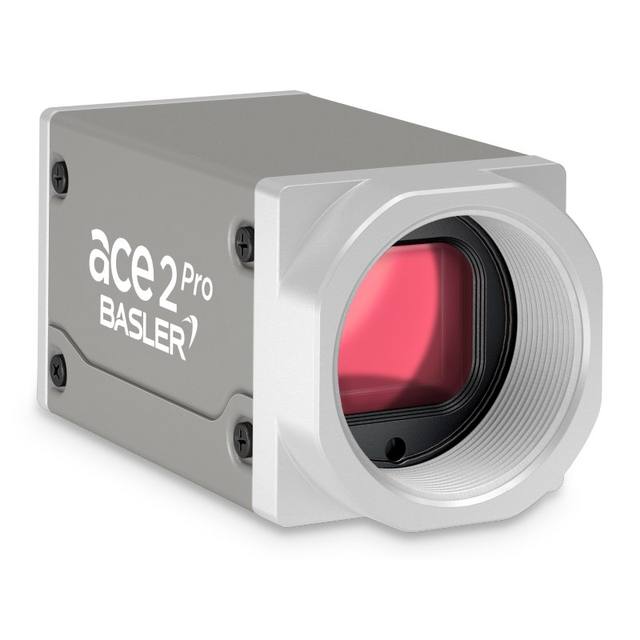
iRAYPLE AX5F57MX250E / AX5F57CX250E (65MP CXP-6 Large Area Scan)
AX5F57MX250E
The AX5F57MX250E (mono) and AX5F57CX250E (colour) are high-resolution area scan cameras using the 2.3-inch Gpixel GMAX3265 65 MP (9344x7000, 3.2 um pixel) global-shutter CMOS sensor, delivering 31 fps at full resolution over a 12-bit output. They connect via a CXP-6 CoaXPress interface providing 4 x 6.25 Gbps theoretical bandwidth and conform to the CoaXPress protocol and GenICam standard. The cameras support PoCXP and DC 24V power, hardware trigger and free-run modes, pixel-by-pixel flat-field correction (FFC), ROI and multiple image-data output formats, with an M58 x 0.75 lens mount. The sensor offers up to ~66 dB dynamic range at 31 fps with low read noise (<2e-).
Brand
iRAYPLE
Camera type
Area scan
Interface
CoaXPress CXP-6 (4 x 6.25 Gbps)
Resolution
~65 MP (65.4 MP)
Horizontal resolution
9344 x 7000 px
Mono / color
Monochrome (MX250E) / Colour (CX250E)
Sensor manufacturer
Gpixel
Sensor model
Gpixel GMAX3265
Shutter
Global shutter
FPS
31 fps at full resolution
Mount
M58 x 0.75
Sensor size
2.3" per Gpixel official (37.4 mm diagonal, 29.9 x 22.4 mm) — some vendors cite 2.2"
The iRAYPLE AX5F57MX250E (monochrome) and its AX5F57CX250E colour sibling are large-format area scan cameras built on the Gpixel GMAX3265, a 2.3-inch (37.4 mm diagonal, 29.9 x 22.4 mm) global-shutter CMOS sensor that resolves 9344 x 7000 px for roughly 65 MP (65.4 MP). The global shutter is the headline trait for an installer: every one of those 65 million pixels is exposed simultaneously, so fast-moving parts, indexing conveyors and vibration-prone stages are captured without the skew or smear that a rolling shutter introduces. At 31 fps across the full frame, the camera streams an enormous amount of data each second, which is exactly why it uses a CoaXPress CXP-6 interface (4 x 6.25 Gbps theoretical) rather than GigE or USB3 — at this resolution and frame rate no slower link can keep up. The 12-bit output and a sensor dynamic range of up to ~66 dB with low read noise (<2e-) mean subtle contrast differences survive digitisation, which matters when you are separating a near-invisible scratch or a low-contrast print defect from its background.
The 3.2 um pixel on a 2.3-inch optical format is the key number for optics and field-of-view planning. Large pixels on a large sensor give you high resolving power without forcing the pixels so small that diffraction and lens MTF become the limiting factor, but they also demand a lens that actually covers the 37.4 mm image circle and resolves to 3.2 um — ordinary C-mount glass will not do it, which is why the camera uses an M58 x 0.75 mount intended for large-format machine-vision lenses. Treat the lens as a first-class part of the budget here: a sensor this large and this fine is only as good as the optic and the working distance you pair with it. Because the sensor is monochrome on the MX250E, you get the full pixel count working on luminance and the best raw resolution and sensitivity; the CX250E colour version trades some spatial resolution to a Bayer pattern in exchange for colour discrimination, so choose the variant by whether your defect signature is geometric/contrast-based or genuinely colour-dependent.
On the integration side the camera conforms to the CoaXPress protocol and the GenICam standard, so it drops into standard frame-grabber and machine-vision software stacks with familiar feature access. Power is flexible: it accepts Power-over-CoaXPress (PoCXP) so a single coax can carry both image data and power, or a separate DC 24V supply where your cabinet already provides it. For motion-synchronised inspection it supports both hardware-trigger and free-run modes, letting you fire each acquisition from an encoder or photoelectric sensor and freeze the part precisely with a strobed light. The on-camera feature set — pixel-by-pixel flat-field correction (FFC), region-of-interest (ROI) windowing and multiple image-data output formats — is practically important: FFC flattens lens shading and sensor non-uniformity that become very visible at 65 MP, while ROI lets you trade resolution for higher effective frame rate on the area you actually care about.
Best for
High-resolution surface and defect inspection on large parts (panels, sheets, webs) where a single frame must resolve fine scratches, dents or print flaws at ~3.2 um pixel pitch
Electronics, semiconductor and battery inspection that needs to cover a wide field while still resolving micro-features, using global shutter to freeze indexed or moving product
Dimensional measurement and metrology where the 65 MP frame and large 2.3-inch sensor give the pixel density to gauge features accurately across a big field of view
Industrial OCR/OCV and print verification where 12-bit, low-noise monochrome capture (MX250E) separates low-contrast marks from their substrate
Colour-dependent inspection on the CX250E variant, where defect or grade decisions depend on hue rather than purely geometry or contrast
Selection notes
Plan the imaging link first: at 9344 x 7000 and 31 fps you need a CoaXPress CXP-6 frame grabber with four 6.25 Gbps lanes — confirm your grabber and cabling support the full 4-lane bandwidth, or the camera will not reach full-resolution frame rate
Budget for the optics deliberately: the M58 x 0.75 mount and 37.4 mm image circle require a large-format lens that covers the full sensor and resolves to the 3.2 um pixel, so plan working distance and magnification around lens coverage, not just sensor size
Choose the variant by defect signature: MX250E (mono) gives maximum spatial resolution and sensitivity for contrast- and geometry-based defects, while CX250E (colour) is the right call only when the decision genuinely depends on colour
Decide power and cabling early: PoCXP lets a single coax deliver data and power for a cleaner install, but the DC 24V input is there if your cabinet already supplies one or runs exceed PoCXP limits
Use ROI and FFC as design tools, not afterthoughts: windowing to a smaller ROI raises effective frame rate when you do not need all 65 MP, and per-pixel flat-field correction is essential to tame lens shading and sensor non-uniformity at this resolution
Engineer the lighting and trigger together: with global shutter and hardware-trigger mode you can strobe a light and fire from an encoder or sensor to freeze moving product cleanly, which is the practical way to exploit 31 fps on a line
Specifications: General
Brand
iRAYPLE
Camera type
Area scan
Specifications: Sensor
Resolution
~65 MP (65.4 MP)
Horizontal resolution
9344 x 7000 px
Mono / color
Monochrome (MX250E) / Colour (CX250E)
Sensor manufacturer
Gpixel
Sensor model
Gpixel GMAX3265
Shutter
Global shutter
Sensor size
2.3" per Gpixel official (37.4 mm diagonal, 29.9 x 22.4 mm) — some vendors cite 2.2"
Pixel size
3.2 um x 3.2 um
Specifications: Performance
FPS
31 fps at full resolution
Specifications: Interface
Interface
CoaXPress CXP-6 (4 x 6.25 Gbps)
Protocols
CoaXPress protocol and GenICam standard
Specifications: Optics
Mount
M58 x 0.75
Specifications: Electrical
Power
PoCXP and DC 24V
Applications this camera is commonly selected for. Open one to see the full recommended hardware and approach.
Matched automatically by: lens mount fits the camera mount · lens image circle covers the camera sensor — this camera: M58 x 0.75 · 2.3" per Gpixel official (37.4 mm diagonal, 29.9 x 22.4 mm) — some vendors cite 2.2" sensor.
Follow these steps to bring up your iRAYPLE camera, capture a first image, and move from the viewer to your own application. The flow is the same across the A, AE, AX and L series; only the physical interface differs.
Download and install the iRAYPLE machine-vision SDK together with its viewer client for your operating system. The installer provides the camera drivers, the GenTL producer, and the viewer you will use for first light. For GigE Vision models, also install or enable the bundled filter/performance driver on the network adapter to maximize throughput.
2. Connect the camera to the correct interface
Wire the camera to its matching host interface: a dedicated Gigabit (or 10 GigE) NIC for GigE Vision models, a USB3 Vision port with a quality cable for USB3 models, or a frame grabber for CoaXPress models. Power the camera (PoE, USB bus power, or PoCXP / external supply as applicable). For GigE Vision, put the NIC and camera on the same subnet and, where supported, enable jumbo frames.
3. Detect and open the camera in the viewer
Launch the iRAYPLE viewer, run device enumeration, and select your camera from the discovered list. Open it to load the device feature tree (GenICam node map). If a GigE camera is found but cannot be opened, correct the IP configuration so the camera and NIC are in the same address range.
4. Set exposure, gain and trigger, then grab a first image
Start with continuous (free-run) acquisition under stable lighting. Adjust exposure time and gain for a well-exposed, low-noise image, set the pixel format (e.g. Mono8 or a Bayer/RGB format), and tune white balance on color models. Once the live image looks correct, switch trigger mode to hardware or software trigger to synchronize capture with your process, and verify a single triggered frame.
5. Move from the viewer to the SDK or a GenICam library
With imaging confirmed, reproduce the same settings in code using the SDK's C/C++ or Python API: enumerate, open, configure the relevant GenICam features, register a frame callback or grab loop, and convert frames to your pipeline's buffer format. Since the cameras are GenICam/GenTL-compliant, you can alternatively drive them from a third-party GenICam vision library. From here a stable image stream can feed a deep-learning inspection step such as Rosepetal for automated quality control.
Frequently asked questions
It captures 9344 x 7000 px (about 65 MP, 65.4 MP) at 31 fps at full resolution, with a 12-bit output. Using region-of-interest (ROI) windowing you can trade pixel count for a higher effective frame rate on a smaller area.
It uses the Gpixel GMAX3265, a 2.3-inch (37.4 mm diagonal, 29.9 x 22.4 mm) global-shutter CMOS sensor with a 3.2 um pixel. The global shutter exposes all pixels simultaneously, so moving parts are captured without skew or smear.
It connects over CoaXPress CXP-6 with four 6.25 Gbps lanes (theoretical), conforming to the CoaXPress protocol and GenICam standard. You will need a matching CXP-6 frame grabber; the high resolution and frame rate are why a slower GigE or USB3 link is not used.
It has an M58 x 0.75 mount for large-format lenses. A standard C-mount lens is not suitable: the lens must cover the 2.3-inch sensor's 37.4 mm image circle and resolve to the 3.2 um pixel.
It accepts Power-over-CoaXPress (PoCXP) so one coax can carry data and power, or a separate DC 24V supply. It supports hardware-trigger mode for synchronising acquisition to an encoder or sensor, as well as free-run mode.
The AX5F57MX250E is monochrome and the AX5F57CX250E is colour, on the same GMAX3265 sensor at 31 fps. Mono gives the full pixel count on luminance for best resolution and sensitivity; colour adds hue discrimination via a Bayer pattern for colour-dependent inspection.