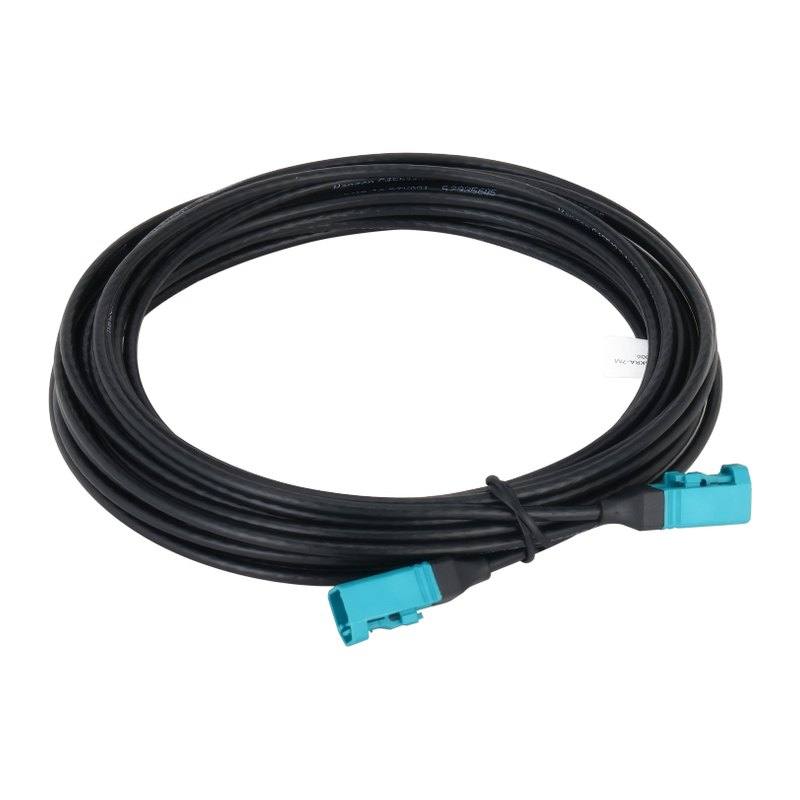
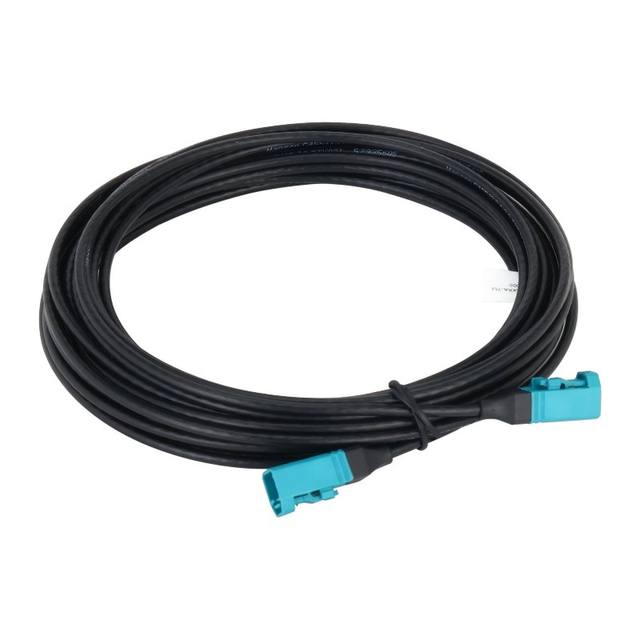
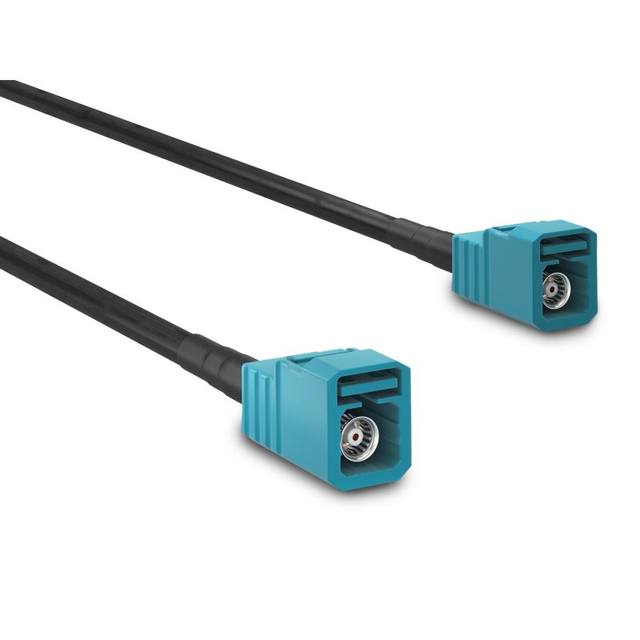
iRAYPLE C01-FAKRA-FAKRA-FC — FAKRA coaxial Cable; End A Fakra-Z code, End B Fakra-Z code; lengths 3–15 m (3, 5, 7, 10, 15 m); structure AWG19+PE+B; Ø 5.0 mm; PVC jacket; min. bending radius 50 mm; drag-chain rated (5 million cycles); operating -20 °C to +80 °C.
Brand
iRAYPLE
Cable type
FAKRA coaxial Cable
Cable length
3–15 m (3, 5, 7, 10, 15 m)
Connector A
Fakra-Z code
Connector B
Fakra-Z code
High-flex / drag chain
Yes — dynamic scene (drag chain), 5 million cycles
The drag-chain FAKRA cable is a different build, not a reinforced copy of the static one: an AWG19 coax construction at 5.0 mm diameter, against the 2.8 mm RG174 coax of the static 3 m and 10 m lengths, and a minimum bending radius of 50 mm instead of 25 mm. That bulk buys a 5 million cycle rating in lengths of 3, 5, 7, 10 and 15 m.
Five million cycles is a finite budget, and a cycle rating is set under the manufacturer's test conditions, so use it as a planning guide rather than a guarantee. As an example, one cycle every 2 s running continuously uses 5,000,000 × 2 s ÷ 86,400 s/day ≈ 116 days, whereas one cycle every 10 s lasts about 579 days. On a fast axis, treat the cable as a service part, avoid unplugging the Fakra-Z connectors (≥100 mating cycles) during routine work, and anchor the cable so the chain, not the plug, takes the strain.
Best for
A FAKRA camera that travels on an axis, where its single coax must follow the motion through an energy chain.
Replacing a static FAKRA lead on an axis that was never meant to move: the Fakra-Z connectors are the same, and this build carries the drag-chain rating.
Moving links of 5 m and 7 m, lengths the static C01-FAKRA-FAKRA does not offer, since it comes in 3, 10 and 15 m.
Selection notes
The 5.0 mm jacket is much thicker than the static cable's 2.8 mm, so check chain cross-section and fill.
Use a chain with an inner bend radius of at least 50 mm.
If the cable is fixed, the static version is thinner (2.8 mm at 3 m and 10 m) and bends to 25 mm.
Both ends are Fakra-Z code: make sure the camera and the receiving unit use that code, and that the receiving unit is built for your camera's FAKRA link.
Specifications: General
Brand
iRAYPLE
Cable type
FAKRA coaxial Cable
Compatible with
industrial cameras equipped with FAKRA interfaces
Specifications: Interface
Connector A
Fakra-Z code
Connector B
Fakra-Z code
Specifications: Electrical
Supply voltage
30 VDC
Specifications: Environment
Operating temperature
-20 °C to +80 °C
Specifications: Mechanical
Cable length
3–15 m (3, 5, 7, 10, 15 m)
High-flex / drag chain
Yes — dynamic scene (drag chain), 5 million cycles
This product groups every purchasable order code that shares the same sensing method, range and output. Cable length, connector type and operation mode (Light-ON/Dark-ON, NO/NC) vary by order code below.
Follow these steps to bring up your iRAYPLE camera, capture a first image, and move from the viewer to your own application. The flow is the same across the A, AE, AX and L series; only the physical interface differs.
Download and install the iRAYPLE machine-vision SDK together with its viewer client for your operating system. The installer provides the camera drivers, the GenTL producer, and the viewer you will use for first light. For GigE Vision models, also install or enable the bundled filter/performance driver on the network adapter to maximize throughput.
2. Connect the camera to the correct interface
Wire the camera to its matching host interface: a dedicated Gigabit (or 10 GigE) NIC for GigE Vision models, a USB3 Vision port with a quality cable for USB3 models, or a frame grabber for CoaXPress models. Power the camera (PoE, USB bus power, or PoCXP / external supply as applicable). For GigE Vision, put the NIC and camera on the same subnet and, where supported, enable jumbo frames.
3. Detect and open the camera in the viewer
Launch the iRAYPLE viewer, run device enumeration, and select your camera from the discovered list. Open it to load the device feature tree (GenICam node map). If a GigE camera is found but cannot be opened, correct the IP configuration so the camera and NIC are in the same address range.
4. Set exposure, gain and trigger, then grab a first image
Start with continuous (free-run) acquisition under stable lighting. Adjust exposure time and gain for a well-exposed, low-noise image, set the pixel format (e.g. Mono8 or a Bayer/RGB format), and tune white balance on color models. Once the live image looks correct, switch trigger mode to hardware or software trigger to synchronize capture with your process, and verify a single triggered frame.
5. Move from the viewer to the SDK or a GenICam library
With imaging confirmed, reproduce the same settings in code using the SDK's C/C++ or Python API: enumerate, open, configure the relevant GenICam features, register a frame callback or grab loop, and convert frames to your pipeline's buffer format. Since the cameras are GenICam/GenTL-compliant, you can alternatively drive them from a third-party GenICam vision library. From here a stable image stream can feed a deep-learning inspection step such as Rosepetal for automated quality control.
Frequently asked questions
5 million drag-chain cycles. The connectors are rated for ≥100 mating cycles.
15 m (3, 5, 7, 10 or 15 m), the same maximum as the static version.