Skip to content
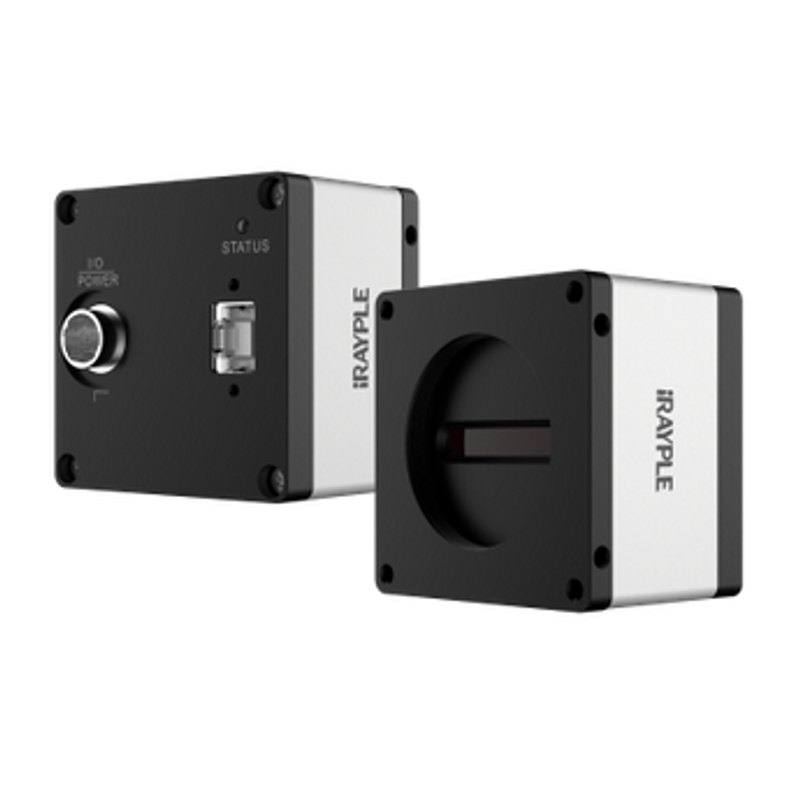
iRAYPLE L5027MG140E / L5027MG400E / L5027CG140E (2K mono/colour, 49-59kHz, GigE) machine vision camera
  • Rosepetal compatible
  • Recommended by AIS Vision

iRAYPLE L5027 Series 2K GigE Line Scan Camera (L5027MG140E / MG400E / CG140E)

L5027MG140E

The iRAYPLE (Huaray) L5027 family are 2K-resolution line scan cameras built on global-shutter CMOS sensors with 12-bit depth and a Gigabit Ethernet (GigE Vision V2.0 / GenICam) interface. L5027MG140E is a 2048x1 mono camera at 49 kHz with 14x14 um pixels and M42x1 mount, while L5027CG140E is the 2048x2 colour version (49 kHz, BayerRG output) on the same M42 body. L5027MG400E is a 2048x4 mono camera on a Gpixel sensor reaching 59 kHz with 7x7 um pixels, C-Mount, and 2TDI/4TDI support. All variants use a DC12-24V wide-range supply via a 12-pin Hirose connector and support ROI, FPN/PRNU correction, gamma, LUT and software/hardware/free-run triggering.

Brand
iRAYPLE
Camera type
Line scan
Interface
GigE (Gigabit Ethernet)
Horizontal resolution
2048 px (2K)
Mono / color
Mono (L5027MG140E, L5027MG400E) / Color (L5027CG140E)
Sensor manufacturer
Gpixel CMOS (L5027MG400E); CMOS (L5027MG140E / CG140E)
Sensor model
2K line CMOS (Gpixel on L5027MG400E)
Shutter
Global shutter
Line rate
49 kHz (140E variants) / 59 kHz (L5027MG400E)
Mount
M42 x 1 (L5027MG140E / CG140E); C-Mount (L5027MG400E)
Pixel size
14 x 14 um (140E variants) / 7 x 7 um (L5027MG400E)
Power
DC 12~24V wide-range supply (via 12-pin Hirose connector)

Technical overview

The iRAYPLE (Huaray) L5027 family are 2K (2048-pixel) line scan cameras, meaning they image a single row at a time and build a full picture as the part moves under them on a conveyor, web, or rotary stage. Because they capture one line per exposure rather than a 2D frame, throughput is expressed as a line rate rather than fps: the 140E variants run at 49 kHz and the L5027MG400E reaches 59 kHz. At those rates you can resolve fine surface structure on continuously moving product without the smear or stitching seams of repeated area-scan frames, which is exactly why the line of business here is surface and defect inspection on web-fed material. All variants use a global-shutter CMOS sensor with 12-bit depth, so each pixel in the line integrates over the same window - important when synchronising exposure to an encoder pulse on fast motion.

The interface is the defining integration choice: Gigabit Ethernet running GigE Vision V2.0 over GenICam. That buys you long, cheap, field-terminable cabling and standardised software access, but a single GigE link caps aggregate bandwidth, so line rate, pixel depth (12-bit), and bytes-per-line together set your real-world ceiling - ROI windowing on the 2048-pixel line is the lever to trade width for speed. Triggering is flexible: software, hardware, and free-run modes are all supported, and in practice surface inspection runs hardware-triggered from a shaft encoder so each captured line maps to a fixed travel distance regardless of belt speed variation. Onboard ROI, FPN/PRNU correction, gamma, and LUT let you flatten sensor and illumination non-uniformity in the camera before data ever hits the network - valuable on long lines where a bright/dark column would otherwise read as a false defect streak.

The variants split cleanly by sensor, optics, and mount. L5027MG140E (mono) and L5027CG140E (colour, BayerRG output) share a 2048-pixel line, large 14x14 um pixels, an M42x1 mount, and 49 kHz - the big pixels favour sensitivity and signal-to-noise, suiting lower-light or fast lines where you cannot flood the scene with light. The L5027MG400E is a different sensor: a Gpixel-based 2048-pixel line on 7x7 um pixels with C-Mount, 59 kHz, and 2TDI/4TDI multi-line accumulation, which trades pixel area for finer geometric sampling and uses TDI staging to recover sensitivity at the higher rate. All three are compact (62 x 62 x 43.5 mm, 245 g), draw 4.5 W from a wide-range DC 12-24V supply over a 12-pin Hirose connector, and are rated -30 to +50 C, so they drop into hot or cold production environments without special enclosures.

Best for

  • Continuous surface inspection of web or sheet material where the product moves past a fixed camera line at speed, on printing and packaging lines
  • Defect and AI-based defect detection on metal, battery, and packaging surfaces using encoder-triggered line capture for consistent spatial sampling
  • Industrial OCR/OCV and code traceability on moving product, reading printed text and marks line-by-line as parts transport through the station
  • Colour print and surface quality inspection using the L5027CG140E (BayerRG) variant where chromatic defects or registration must be caught
  • High-line-rate fine-feature inspection in electronics and fine print using the L5027MG400E Gpixel variant with 7 um pixels and 2/4 TDI for sensitivity at 59 kHz

Selection notes

  • Choose the variant by sensor, pixel pitch, and mount: 14x14 um M42 (MG140E/CG140E) for sensitivity and easier lighting at 49 kHz, versus the Gpixel-based 7x7 um C-Mount (MG400E) for finer sampling and 59 kHz with TDI - they are not optically interchangeable, so lens and mount must be specified together.
  • Budget GigE bandwidth deliberately: a single Gigabit link constrains line-rate x active-pixels x bit-depth, so plan to window the 2048-pixel ROI or accept depth/rate trade-offs rather than assuming full 2048 x 12-bit at max line rate over one link.
  • Design the trigger chain around a shaft encoder: line scan needs the line rate locked to web travel to keep pixels square and avoid stretch/compression, so confirm encoder resolution and the hardware trigger input on the 12-pin Hirose before mechanical layout.
  • Plan lighting as a bright, uniform line aligned to the sensor row - line scan demands high-intensity illumination concentrated on the scanned line; the larger 14 um pixels ease this, while the 7 um MG400E leans on its 2TDI/4TDI accumulation to compensate.
  • Account for power and connector: DC 12-24V wide-range at 4.5 W via 12-pin Hirose, and use the onboard FPN/PRNU correction and LUT during commissioning to remove column-wise non-uniformity that would otherwise appear as persistent streaks in long scans.

Specifications: General
BrandiRAYPLE
Camera typeLine scan

Specifications: Sensor
Horizontal resolution2048 px (2K)
Mono / colorMono (L5027MG140E, L5027MG400E) / Color (L5027CG140E)
Sensor manufacturerGpixel CMOS (L5027MG400E); CMOS (L5027MG140E / CG140E)
Sensor model2K line CMOS (Gpixel on L5027MG400E)
ShutterGlobal shutter
Pixel size14 x 14 um (140E variants) / 7 x 7 um (L5027MG400E)

Specifications: Performance
Line rate49 kHz (140E variants) / 59 kHz (L5027MG400E)

Specifications: Interface
InterfaceGigE (Gigabit Ethernet)
ProtocolsGigE Vision V2.0, GenICam

Specifications: Optics
MountM42 x 1 (L5027MG140E / CG140E); C-Mount (L5027MG400E)

Specifications: Electrical
PowerDC 12~24V wide-range supply (via 12-pin Hirose connector)
Power consumption4.5 W

Specifications: Environment
Operating temperature-30 to +50 C

Specifications: Mechanical
Dimensions62 x 62 x 43.5 mm
Weight245 g

Frequently asked questions

Related technical guides

Rosepetal · AI

Test this camera with Rosepetal

Validate your visual inspection with AI: send us sample images and we evaluate the case on your hardware.

AIS Vision · Integration

We validate camera + lens + lighting

AIS Vision defines and tests the optimal combination of camera, optics and lighting for your application before you buy.