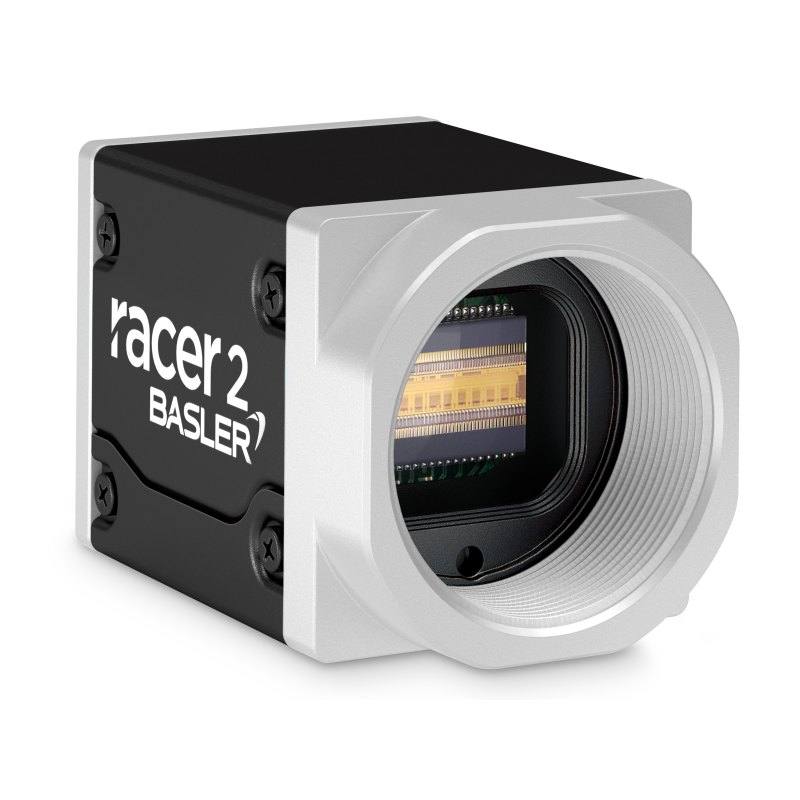
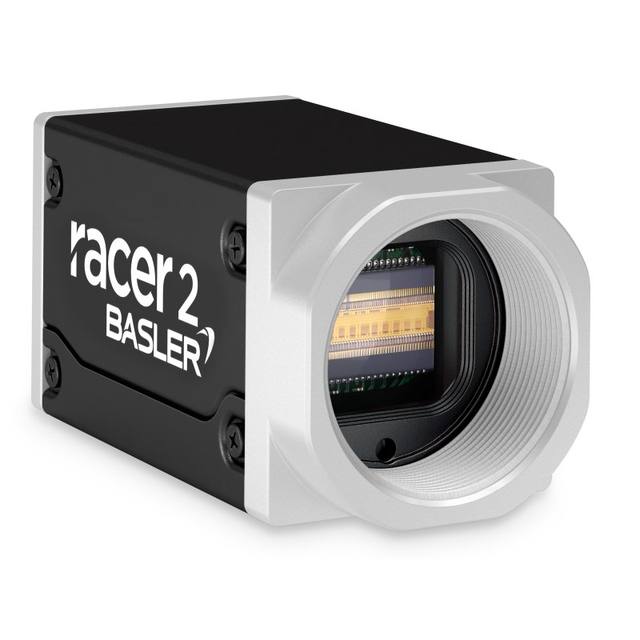
The Basler racer 2 S r2L2048-172cm is a monochrome line scan camera built on the Gpixel GL3504 CMOS line sensor (2048 x 1 pixels, 7 x 7 um pixels, 14.34 mm line length) reaching a maximum line rate of 172.7 kHz in free-run mode. It uses a single CXP-12 CoaXPress 2.0 link delivering up to 12.5 Gbps and is powered over CoaXPress (PoCXP) at 24 VDC, consuming approximately 3.1 W typical. The camera ships in a slim 29 x 29 mm C-mount industrial housing weighing under 85 g with GenICam/CoaXPress 2.0 compliance and an IP30 rating. It targets cost-sensitive, high-speed line scan inspection applications.
The Basler racer 2 S r2L2048-172cm is a monochrome line scan camera, meaning it captures a single row of 2048 pixels at a time and builds a continuous image as the object (or the camera) moves past it. The imaging core is a Gpixel GL3504 CMOS line sensor with 7 x 7 um pixels across a 14.34 mm line length, and the headline figure is a maximum line rate of 172.7 kHz in free-run mode. In practice that combination means the camera assembles a 2048-pixel-wide swath up to roughly 172,700 times per second, so it is built for fast-moving continuous webs and conveyors where every millimeter of travel needs to be resolved without motion blur. Being monochrome, it trades color discrimination for full sensitivity and resolution per pixel, which is the right choice for surface texture, edge, and defect detection rather than color sorting.
The interface is the defining architectural decision here: a single CXP-12 CoaXPress 2.0 link delivering up to 12.5 Gbps over one coax cable. CoaXPress is what makes the high line rate usable in the field, because it sustains the required bandwidth over a robust single-cable run while also carrying power and trigger/control signaling back to the camera. The camera is powered over that same coax via PoCXP at 24 VDC and draws only about 3.1 W typical, so a single cable to a CoaXPress frame grabber handles data, control, and power together. GenICam and CoaXPress 2.0 compliance mean it drops into standard frame-grabber-based acquisition software using a common feature interface, which keeps integration predictable for engineers already running a CoaXPress pipeline.
Mechanically and operationally, this is a compact, easy-to-mount line scan head. It uses a C-mount, ships in a slim 48.9 x 29 x 29 mm housing, and weighs about 85 g, so it fits in tight inspection stations and on moving gantries without dominating the mechanical design. The line sensor uses a global shutter, exposing the whole row simultaneously, and the rated operating temperature of -10 to 50 degC suits typical factory-floor environments. The IP30 rating indicates protection against small solid objects but not against dust ingress or liquids, so it expects a relatively clean enclosure or cabinet rather than open washdown areas. The C-mount means lens selection and the line trigger become the two levers that determine real-world image quality and geometric accuracy.
Best for
High-speed continuous web inspection of printed material, where the 172.7 kHz line rate keeps pace with fast-moving substrate
Surface inspection of metal, sheet, and rolled goods for scratches, dents, and texture defects using full monochrome sensitivity
AI-based defect detection on conveyors and webs, feeding consistent 2048-pixel monochrome line images into inspection models
Print quality and registration checks in packaging lines where motion blur must be eliminated at speed
Electronics and battery web/strip inspection where a slim 29 x 29 mm head must fit a compact, cost-sensitive station
Selection notes
This is a CoaXPress camera, not GigE or USB3: you must budget for a CXP-12 (CoaXPress 2.0) frame grabber and a coax cable run rated for the 12.5 Gbps link. There is no host-side networking shortcut.
Line scan imaging requires synchronized motion. Plan an encoder-driven line trigger so the 2048-pixel rows are spaced uniformly with web/conveyor speed; free-run at 172.7 kHz only gives correct geometry when travel speed is constant.
Resolution across the part is fixed at 2048 pixels over the 14.34 mm sensor line. Your achievable resolution and field width are set entirely by lens magnification and working distance on the C-mount, so size the optics to the part width and required pixels-per-mm.
It is monochrome, so plan illumination wavelength and geometry for contrast rather than relying on color; high line rates demand bright, stable line lighting (often high-intensity bar lights) to expose each row adequately.
IP30 and a -10 to 50 degC range mean it is intended for protected cabinet or enclosed-station mounting; for dusty, wet, or washdown lines you will need a protective housing. Power planning is simple since PoCXP supplies 24 VDC over the same coax at about 3.1 W.
Specifications: General
Brand
Basler
Camera type
Line scan
Specifications: Sensor
Horizontal resolution
2048 px (2k)
Mono / color
Mono
Sensor manufacturer
Gpixel
Sensor model
Gpixel GL3504
Shutter
Global shutter
Sensor size
14.34 mm line length (1 in)
Pixel size
7 x 7 um
Specifications: Performance
Line rate
172.7 kHz (max, free-run)
Specifications: Interface
Interface
CoaXPress, 1x CXP-12 (up to 12.5 Gbps)
Protocols
GenICam, CoaXPress 2.0
Specifications: Optics
Mount
C-mount
Specifications: Electrical
Power
pocxp (Power over CoaXPress (PoCXP), 24 VDC)
Power consumption
3.1 W
Specifications: Environment
IP rating
IP30
Operating temperature
-10 to 50 degC
Specifications: Mechanical
Dimensions
48.9 x 29 x 29 mm
Weight
85 g
Applications this camera is commonly selected for. Open one to see the full recommended hardware and approach.
Matched automatically by: lens mount fits the camera mount · lens image circle covers the camera sensor — this camera: C-mount · 14.34 mm line length (1 in) sensor.
By category
All 90C-mount lenses 66Telecentric lenses 24
By brand
All 90Basler 34iRAYPLE 26Omron / Sentech 24Datalogic / Datasensing 6
Get a first image quickly with the pylon Viewer, then move into the pylon SDK for your application. These cameras are GenICam/GenTL-compliant, so any compliant vision software can drive them as well.
Download and install the pylon Camera Software Suite for your OS from Basler. This provides the pylon Viewer, the GenTL transport-layer producers and the pylon SDK (C/C++/.NET/Python). On Windows the installer adds the needed drivers; on Linux follow the included setup notes for USB and network permissions.
2. Connect the camera and check the link
Cable the camera to its matching interface: GigE Vision to a GigE port (use a quality cable and, ideally, a dedicated NIC with jumbo frames enabled), USB3 Vision to a USB 3.x port with the supplied cable, or CoaXPress to the frame grabber. Provide power where required (PoE, USB bus power, or PoCXP). Open the pylon Viewer and confirm the camera appears in the device list; for GigE, make sure the camera and NIC are on the same subnet.
3. Grab a first image and set exposure, gain and pixel format
Select the camera in the pylon Viewer and start a continuous grab. Adjust exposure time and gain until the image is well exposed (avoid clipped highlights), set the pixel format (e.g. Mono8 or a Bayer/RGB format), and focus the lens. Use a test pattern if the lens or scene is not ready yet.
4. Configure triggering and acquisition
Decide between free-run and triggered acquisition. For synchronized capture, set the trigger source (software or a hardware line on the I/O connector), trigger mode and any debounce or exposure mode, then verify timing. Note the parameter names you change in the Viewer feature tree, as you will reuse them in code.
5. Move to the SDK or a GenICam-compliant library
Recreate your settings in code with the pylon SDK (C, C++, .NET or Python) to open the device, apply the same features and pull frames into your pipeline; pylon vTools and pylon AI can add processing blocks. Because the cameras are GenICam/GenTL standard, third-party vision libraries work too. Once the image stream is stable, you can route frames to a deep-learning inspection such as Rosepetal for automated defect detection.
Frequently asked questions
It uses a single CXP-12 CoaXPress 2.0 link delivering up to 12.5 Gbps, so it requires a CoaXPress frame grabber and a coax cable. It is GenICam and CoaXPress 2.0 compliant for standard integration.
The Gpixel GL3504 sensor reaches a maximum line rate of 172.7 kHz in free-run mode, capturing a 2048-pixel row up to about 172,700 times per second.
It is a monochrome (mono) camera, which maximizes per-pixel sensitivity and resolution for surface, defect, and edge inspection rather than color discrimination.
It is powered over CoaXPress (PoCXP) at 24 VDC over the same coax cable that carries data and control, with a typical consumption of about 3.1 W.
It has a C-mount in a compact 48.9 x 29 x 29 mm housing weighing about 85 g, with an IP30 rating and an operating temperature range of -10 to 50 degC, suiting protected indoor or cabinet-mounted stations.