
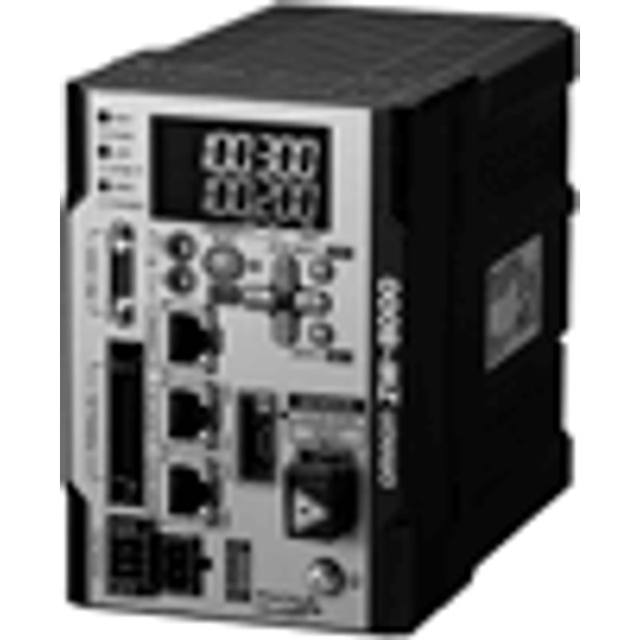
Omron / SentechOmron / Sentech ZW-8000T / ZW-7000T / ZW-5000T Confocal Fiber Displacement Sensor ControllersZW-8000T
- Rosepetal compatible
- Recommended by AIS Vision
On request
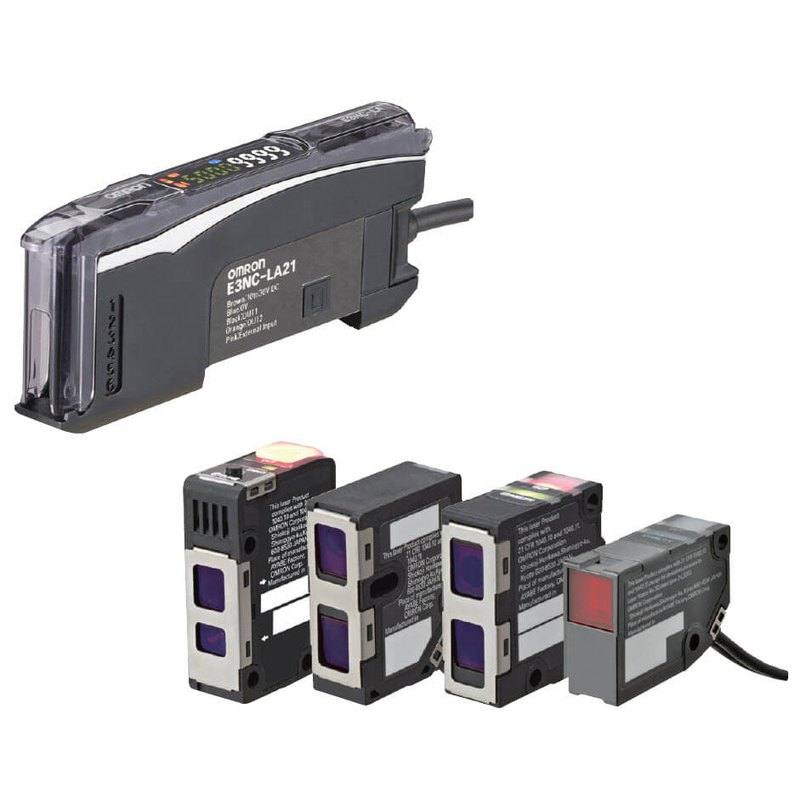
E3NC-LA21
The E3NC-L amplifiers (E3NC-LA21/LA51/LA7/LA9/LA24/LA54/LA0) drive E3NC-LH through-beam/retro-reflective/diffuse laser heads for high-speed presence detection with response times down to 80 us, while the E3NC-S amplifiers (E3NC-SA21/SA51/SA7/SA9/SA24/SA54/SA0) drive E3NC-SH CMOS laser heads for distance-settable measurement with response times down to 1.5 ms. All heads use a Class 1 visible red semiconductor laser at 660 nm. Amplifiers are available with NPN open-collector outputs (LA21/LA7/LA24, SA21/SA7/SA24) or PNP open-collector outputs (LA51/LA9/LA54, SA51/SA9/SA54), with 2-output+1-input or 1-output+1-input configurations and pre-wired (2 m), wire-saving-connector or M8-connector connection. The LA0/SA0 networking models carry no discrete I/O and instead connect to an E3NW communications unit for EtherCAT, CC-Link or CompoNet fieldbus integration, with up to 30 amplifier units chainable per group.
The Omron E3NC-L / E3NC-S range covers the amplifier units of the E3NC Smart Laser Sensor system rather than the optical heads themselves, so what you are specifying here is the signal-processing, display and output side of a two-part laser sensor. The amplifiers split into two families with very different jobs. E3NC-L amplifiers (LA21/LA51/LA7/LA9/LA24/LA54/LA0) drive E3NC-LH presence heads in through-beam, retro-reflective and diffuse-reflective configurations, and they are built for speed: selectable response modes run down to 80 microseconds, with 250 us, 1 ms and 16 ms steps available to trade speed for stability. E3NC-S amplifiers (SA21/SA51/SA7/SA9/SA24/SA54/SA0) instead drive E3NC-SH CMOS heads using laser triangulation, giving a distance-settable measurement output with response times of 1.5 ms, 5 ms, 10 ms or 50 ms. In both cases the light source is a Class 1 visible red semiconductor laser at 660 nm, certified to JIS/IEC/EN/FDA/GB-T, which means the beam is eye-safe for normal use and the visible spot makes alignment straightforward without extra eye-protection procedures.
| Brand | Omron / Sentech |
|---|---|
| Sensor type | Laser distance / presence sensor amplifier (E3NC Smart Laser Sensor) |
| Response time | E3NC-L: 80 us / 250 us / 1 ms / 16 ms; E3NC-S: 1.5 ms / 5 ms / 10 ms / 50 ms (selectable response modes) |
|---|
| Communication | Networking models E3NC-LA0 / E3NC-SA0 connect via E3NW communications unit: EtherCAT (E3NW-ECT), CC-Link (E3NW-CCL) or CompoNet (E3NW-CRT) |
|---|---|
| Connection | Pre-wired 2 m cable (LA21/LA51/SA21/SA51), wire-saving connector (LA7/LA9/SA7/SA9) or M8 connector (LA24/LA54/SA24/SA54) |
| Supply voltage | 10 to 30 VDC (including 10% ripple p-p) |
|---|---|
| Power consumption | 1560 W |
| Operating temperature | Operating -25 to 55 °C (groups of 1-2 units; derated to -25 to 40 °C for 17-30 units); storage -30 to 70 °C |
|---|---|
| IP rating | IP50 (amplifier unit); paired sensor heads rated IEC IP67 |
| Sensing method | Laser triangulation (E3NC-S CMOS heads) / through-beam, retro-reflective and diffuse-reflective (E3NC-L heads) |
|---|---|
| Light source | Visible semiconductor red laser diode, 660 nm, Class 1 (JIS/IEC/EN/FDA/GB-T) |
| Output type | NPN open-collector (LA21/LA7/LA24, SA21/SA7/SA24) or PNP open-collector (LA51/LA9/LA54, SA51/SA9/SA54); 30 VDC max, 100 mA max load |
|---|
| Housing material | Case and cover: Polycarbonate (PC); cable: PVC (vinyl chloride) |
|---|---|
| Weight | Approx. 75 g (pre-wired amplifier unit only); approx. 115 g packed |
A practical guide to selecting discrete sensors that trigger cameras, index parts and gate inspection on a vision station. Covers sensing principle, range, target, PNP/NPN/IO-Link outputs, response time and IP rating, plus wiring the trigger to the camera.
A practical guide to laser displacement and distance sensors: how triangulation, confocal and time-of-flight measure distance, height and profile, how resolution trades against range and target reflectivity, and when a dedicated measurement sensor beats a vision system.
A practical guide to the core photoelectric sensing principles, through-beam, retroreflective, diffuse and background suppression, covering range, reliability, target and surface dependence, light source choice, output options and how to pick the right one for your application.
AIS Vision · Integration
AIS Vision defines and tests the optimal combination of camera, optics and lighting for your application before you buy.