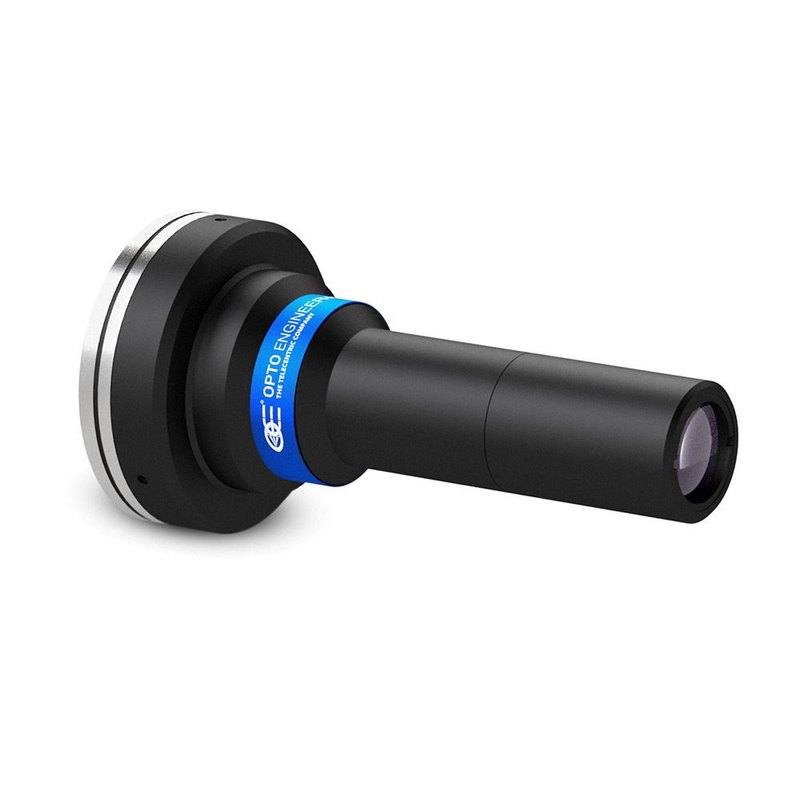
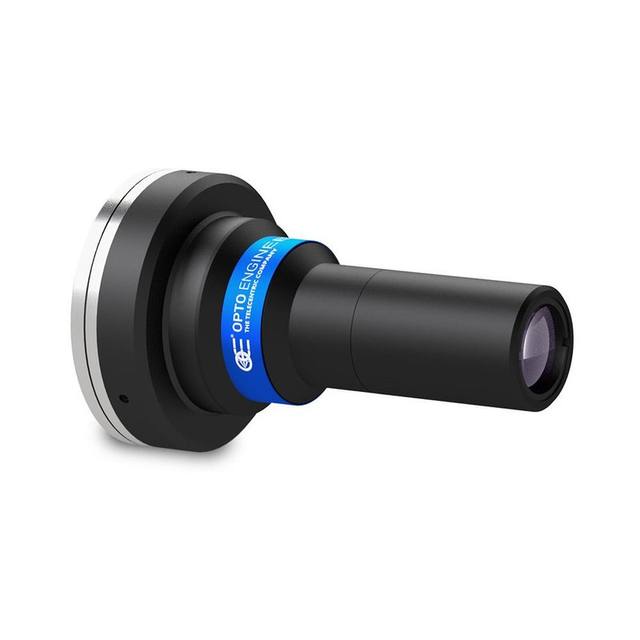
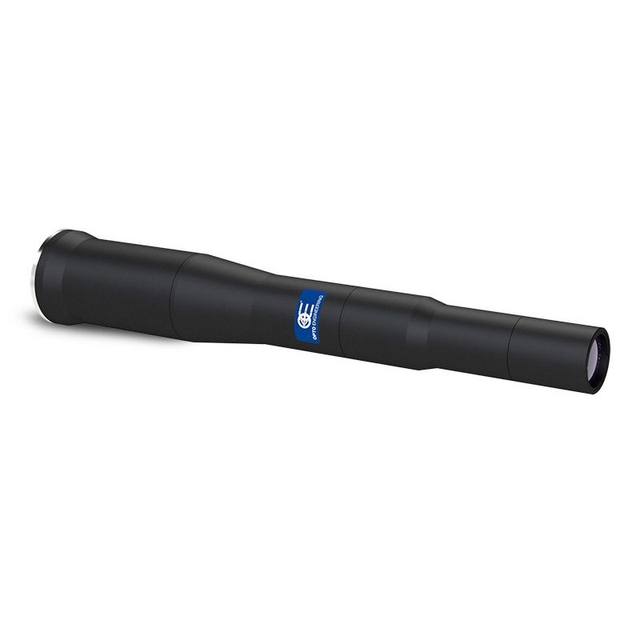
The Opto Engineering TC4MHRP004-F is a high resolution telecentric lens from the TC4MHR series, made for sensors up to 4/3″. Its image circle is Ø 22.0 mm (max sensor 4/3″), it works at 4.000× magnification with a working distance of 56.0 mm, and it runs at a working f-number of wF/# 18. The F-mount connects it to an F-mount camera body. At 4.000× the lens images a small patch of the part onto the sensor, so it is aimed at close inspection of fine features.
The telecentric design keeps the chief rays close to parallel with the optical axis, which keeps magnification steady when the part shifts in depth within the working range. Distortion is typically below 0.08 %, with a maximum of 0.10 %, and telecentricity is typically below 0.08 deg, with a maximum of 0.10 deg. When the lens is used for gauging small features, those figures should go into the measurement uncertainty budget, since they bound how far image geometry and scale can drift across the field.
The working distance is 56.0 mm, so the fixture, the lighting and any enclosure have to fit within that clearance. The wF/# 18 aperture is closed, which gives depth of field but reduces the light reaching the sensor; the illumination needs to be bright and stable enough to keep exposure short when the part moves.
Best for
Close-up inspection of small components at 4.000× and a 56.0 mm working distance
Dimensional gauging of fine features where telecentric imaging keeps the scale steady across the field
Inspection with 4/3″ sensor cameras that need a Ø 22.0 mm image circle
F-mount camera setups for fixed-position feature checks
Selection notes
Confirm that the camera body is F-mount before ordering.
Hold the object at 56.0 mm from the lens with a fixed fixture or stop so magnification stays at 4.000×.
Check that the sensor fits inside the Ø 22.0 mm image circle, which covers sensors up to 4/3″.
Leave room for lighting inside the 56.0 mm working distance and plan bright, stable light for the closed wF/# 18 aperture.
Specifications: General
Brand
Opto Engineering
Specifications: Optical
Lens mount
F-mount
Image circle / max sensor
Ø 22.0 mm (max sensor 4/3″)
Magnification
4.000×
Working distance
56.0 mm
Telecentric
Yes
Applications this product is commonly selected for. Open one to see the full recommended hardware and approach.
Matched automatically by: camera mount fits the lens mount · camera sensor is covered by the lens image circle — this lens: F-mount · Ø 22.0 mm (max sensor 4/3″) image circle.