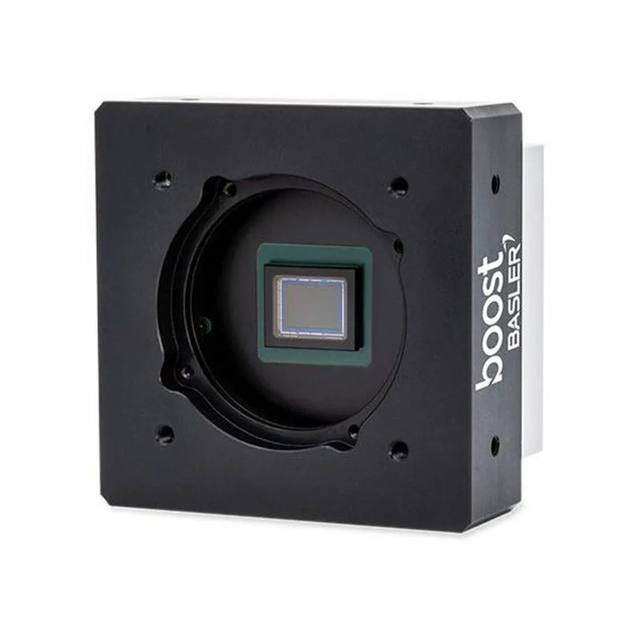
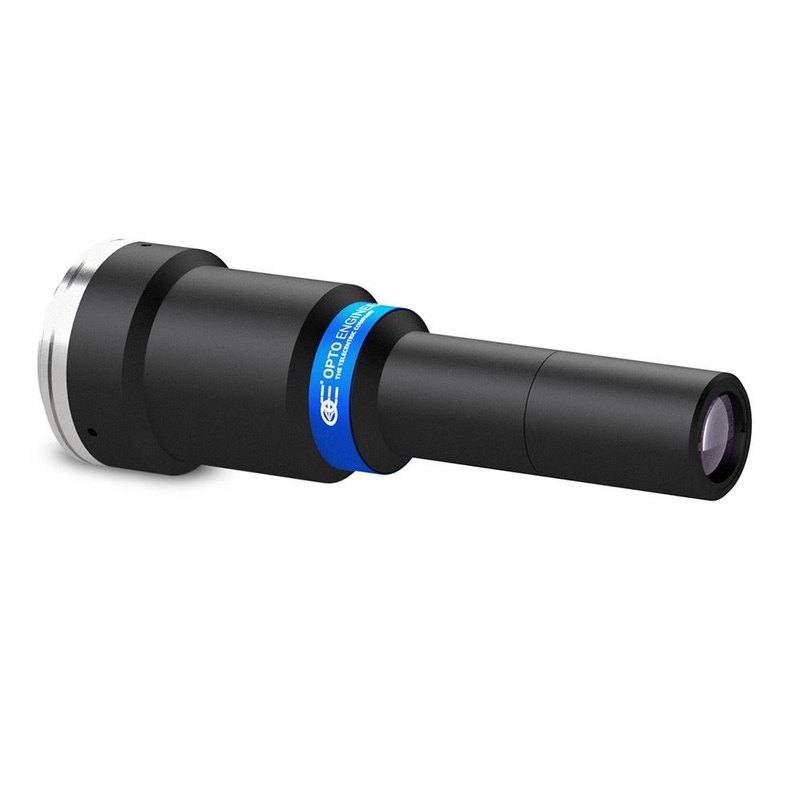
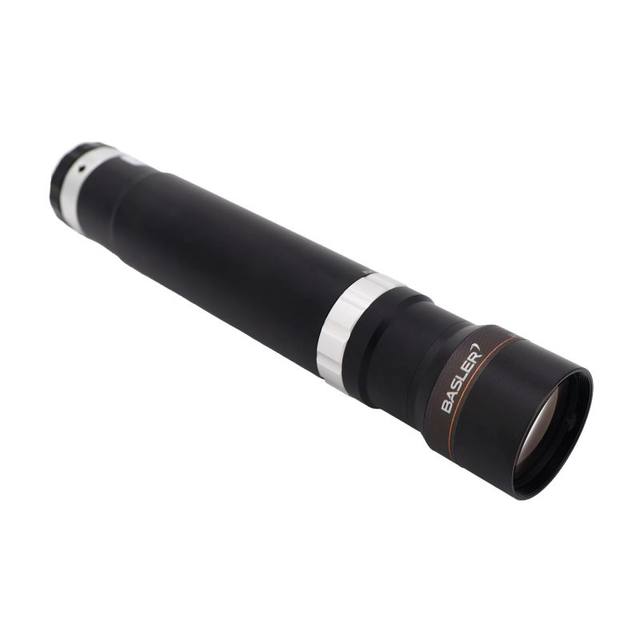
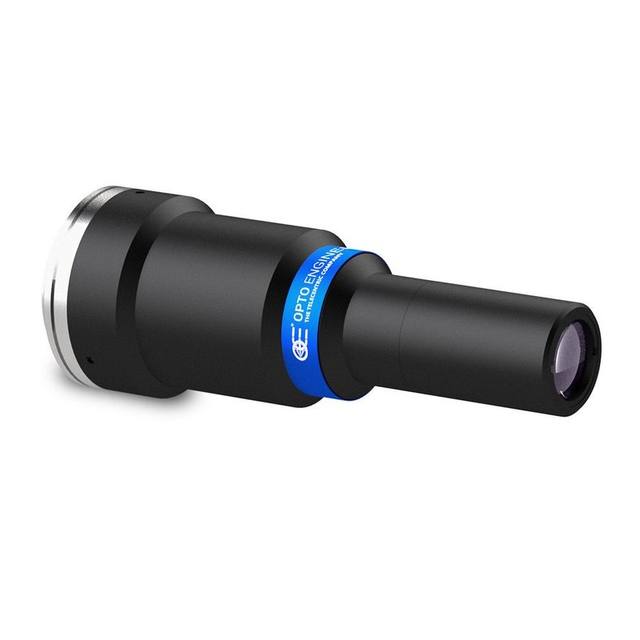
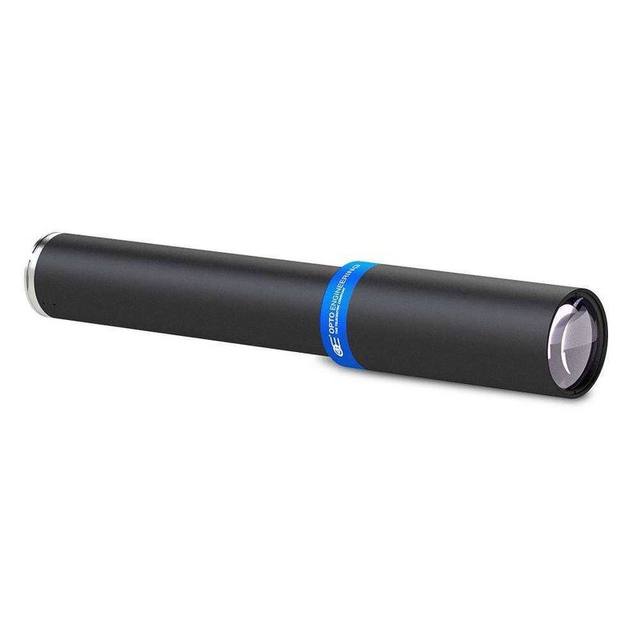
The Opto Engineering TC4MHRP004-J is a high resolution telecentric lens from the TC4MHR series, designed for 4/3″ sensors. It provides an image circle of Ø 22.0 mm (max sensor 4/3″), works at 4.000× magnification with a working distance of 56.0 mm, and has a working f-number of wF/# 18. The mount is M42x1 FD 12, so the camera body needs to accept that mount. At 4.000× the lens maps a small area of the part onto the sensor, which makes it a close-inspection lens for fine features.
Telecentric optics keep the chief rays nearly parallel to the optical axis, so magnification stays put when the part moves nearer to or further from the lens. Typical distortion is below 0.08 %, with a maximum of 0.10 %, and typical telecentricity is below 0.08 deg, with a maximum of 0.10 deg. For gauging, these numbers define how far the image geometry and scale can wander across the field, so they should feed the measurement uncertainty calculation.
A 56.0 mm working distance places the object close to the lens, so the fixture, the illumination and any enclosure need to fit in that space. The closed wF/# 18 aperture gives depth of field but reduces the light reaching the sensor, so the lighting should be bright and stable enough to keep exposure short while the part is in motion.
Best for
Close-up inspection of small parts at 4.000× magnification
Fine-feature gauging where telecentric optics keep scale constant across the field
Inspection with 4/3″ sensor cameras using a Ø 22.0 mm image circle
Fixed-position checks on fixtures with an M42x1 FD 12 mounted camera
Selection notes
Confirm that the camera body accepts an M42x1 FD 12 mount before ordering.
Keep the object at 56.0 mm from the lens with a fixed fixture so the 4.000× scale holds.
Make sure the sensor fits within the Ø 22.0 mm image circle (max sensor 4/3″).
Plan bright, stable illumination for wF/# 18 and leave room for the light source inside the 56.0 mm working distance.
Specifications: General
Brand
Opto Engineering
Specifications: Optical
Lens mount
M42x1 FD 12
Image circle / max sensor
Ø 22.0 mm (max sensor 4/3″)
Magnification
4.000×
Working distance
56.0 mm
Telecentric
Yes
Applications this product is commonly selected for. Open one to see the full recommended hardware and approach.
Matched automatically by: camera mount fits the lens mount · camera sensor is covered by the lens image circle — this lens: M42x1 FD 12 · Ø 22.0 mm (max sensor 4/3″) image circle.
By category
All 4High-resolution cameras 2High-speed cameras 2