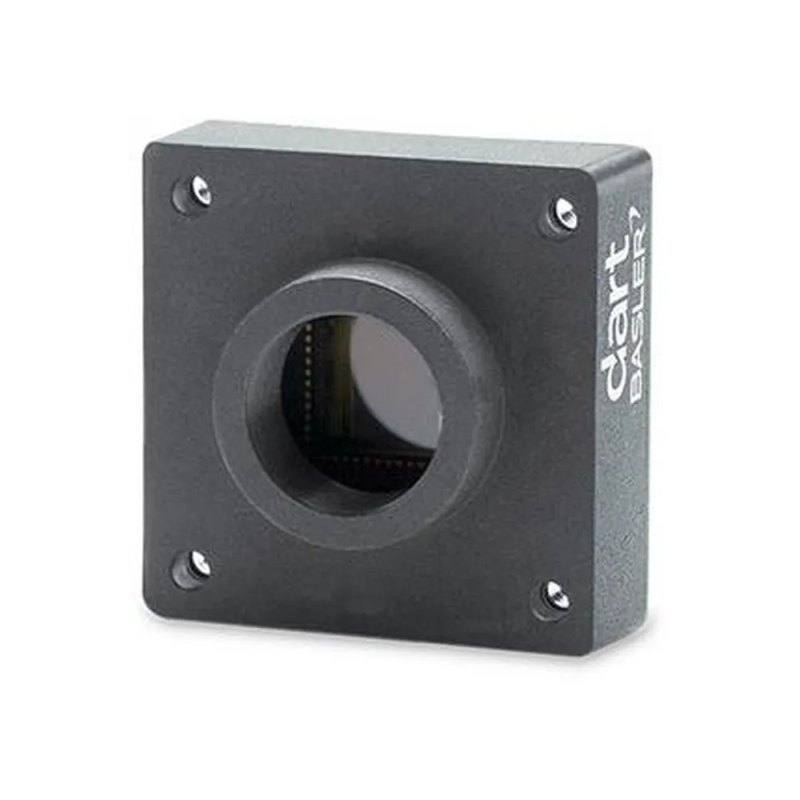
The daA2500-60mc is part of Basler's dart E product family, using the BCON for MIPI interface standard for direct integration into embedded systems. It is built around the onsemi AR0521 progressive scan CMOS sensor with a 1/2.5" optical format and 2.2 µm pixel pitch. The camera is available as a bare board (no-mount) or with an S-mount lens holder, and is powered directly via the BCON for MIPI interface at 5 V DC. It supports GenICam 2.4 (including PFNC 1.1 and SFNC 2.1) and provides programmable exposure, free-run, and software trigger synchronization modes.
The Basler daA2500-60mc is a 5 MP color area-scan camera module built around the onsemi AR0521 progressive scan CMOS sensor, which spans a 1/2.5" optical format (5.7 mm × 4.28 mm active area, 7.13 mm diagonal) with 2.2 µm pixel pitch. At full 2560 × 1920 px resolution it sustains 60 fps, a combination that gives embedded vision designers both the spatial detail needed for fine-feature inspection and the frame rate headroom to handle fast-moving targets or rapid sequential captures without dropping frames. The 2.2 µm pixel pitch is compact, so lens selection and scene illumination must be deliberate: adequate light levels are essential to avoid motion blur on the rolling shutter readout, and S-mount (M12) lenses with an image circle covering the 7.13 mm diagonal must be selected to avoid corner vignetting.
The BCON for MIPI (CSI-2) interface is the defining system integration characteristic of this module. Unlike USB3 Vision or GigE Vision cameras, BCON for MIPI connects directly into a MIPI CSI-2 receiver — a peripheral present natively on most embedded SoCs including NVIDIA Jetson, Raspberry Pi Compute Modules, NXP i.MX, and similar platforms — eliminating the need for a discrete frame-grabber or protocol bridge. Power delivery (5 V DC) and data travel over the same BCON connector, keeping wiring minimal on a compact board measuring only 5.3 × 27 × 27 mm and weighing 5 g. At 0.6 W consumption the module imposes negligible thermal load, which matters in sealed or passively cooled embedded enclosures. GenICam 2.4 compliance (PFNC 1.1 and SFNC 2.1) means standard control libraries can manage programmable exposure, free-run streaming, and software trigger synchronization without proprietary SDK lock-in.
Being a rolling shutter sensor, the daA2500-60mc reads pixel rows sequentially rather than simultaneously, which introduces spatial distortion ('jello effect') on fast lateral motion. System designers must mitigate this by using strobe illumination that freezes motion within the sensor's row-readout period, by mechanically arresting the part under inspection, or by limiting use to scenes where targets are stationary during capture. The operating temperature range of 0–75 °C and board-level (no enclosed housing) form factor mean thermal management and EMI shielding are the integrator's responsibility. The availability in both bare-board (no-mount) and S-mount configurations gives layout flexibility: the bare-board variant suits custom PCB carrier designs where the lens assembly is mechanically separate, while the S-mount option allows standard S-mount (M12) lenses to be threaded directly onto the module.
Best for
Embedded robotic guidance systems — the module's MIPI CSI-2 interface connects natively to Jetson, i.MX, or similar SoC platforms used in articulated arms and SCARA robots, delivering 5 MP colour frames at 60 fps for real-time pose estimation and bin-picking.
Compact packaging and label inspection stations — the 2560 × 1920 px resolution provides sufficient pixel density to resolve date codes, lot numbers, and print defects on product packaging when the field of view is kept tight, while 60 fps supports moderate conveyor speeds.
Medical device and electronics PCB assembly verification — the module's small 27 × 27 mm footprint and 0.6 W power draw make it suitable for integration inside constrained inspection heads or over-conveyor gantries where thermal and space budgets are limited.
OEM embedded vision products and smart sensors — system builders developing their own vision appliances benefit from the GenICam 2.4-compliant interface, board-level integration, and low unit weight (5 g) when designing cost- and space-optimised OEM products for traceability and code reading.
Logistics and automated sorting — colour imaging at 60 fps allows differentiation of product variants by colour marking, label colour, or packaging colour on sorting lines, with the high frame rate reducing the risk of missed detections at moderate belt speeds.
Selection notes
Rolling shutter requires motion control or strobe lighting: the AR0521 sensor reads rows sequentially, so any lateral motion during readout will produce skew artefacts. Plan for a strobe light source synchronised via software trigger, or ensure parts are mechanically stopped before capture.
Lens selection must cover the 7.13 mm image circle: the 1/2.5" sensor diagonal demands S-mount (M12) lenses rated for at least 1/2.5" format. Using lenses designed for smaller sensors will produce heavy corner shading and resolution loss at the periphery.
MIPI CSI-2 host required — this is not a GigE or USB camera: the BCON for MIPI interface connects only to SoCs or FPGAs with a CSI-2 receiver. PC-based vision systems without a CSI-2 input cannot use this module without a dedicated MIPI capture card or bridge hardware.
Thermal and EMI management are the integrator's responsibility: the bare board has no housing, so the designer must provide mechanical mounting, heat dissipation (the 0.6 W is low but localised), and electromagnetic shielding appropriate for the target environment and certification requirements.
Illumination and optics must compensate for the 2.2 µm pixel pitch: small pixels are more sensitive to diffraction limiting and require higher-quality lenses to resolve fine detail. Ensure the chosen lens's MTF is sufficient for the inspection task at the sensor's spatial resolution.
Specifications: General
Brand
Basler
Camera type
Area Scan
Specifications: Sensor
Resolution
5 MP
Horizontal resolution
2560 × 1920 px
Mono / color
Color
Sensor manufacturer
onsemi
Sensor model
onsemi AR0521
Shutter
Rolling Shutter
Sensor size
1/2.5" (5.7 mm × 4.28 mm, diagonal 7.13 mm)
Pixel size
2.2 µm × 2.2 µm
Specifications: Performance
FPS
60 fps
Specifications: Interface
Interface
BCON for MIPI (CSI-2)
Protocols
GenICam 2.4 (PFNC 1.1, SFNC 2.1)
Specifications: Optics
Mount
S-Mount (also available No-Mount / bare board)
Specifications: Electrical
Power
5 V DC via BCON for MIPI interface
Power consumption
0.6 W
Supply voltage
5 V DC
Specifications: Environment
Operating temperature
0 – 75 °C
Specifications: Mechanical
Dimensions
5.3 × 27 × 27 mm
Weight
5 g
Housing material
Board Level
Applications this camera is commonly selected for. Open one to see the full recommended hardware and approach.
We could not derive compatible lenses from the available data for this camera.
Matched automatically by: lens mount fits the camera mount · lens image circle covers the camera sensor — this camera: S-Mount (also available No-Mount / bare board) · 1/2.5" (5.7 mm × 4.28 mm, diagonal 7.13 mm) sensor.
Get a first image quickly with the pylon Viewer, then move into the pylon SDK for your application. These cameras are GenICam/GenTL-compliant, so any compliant vision software can drive them as well.
Download and install the pylon Camera Software Suite for your OS from Basler. This provides the pylon Viewer, the GenTL transport-layer producers and the pylon SDK (C/C++/.NET/Python). On Windows the installer adds the needed drivers; on Linux follow the included setup notes for USB and network permissions.
2. Connect the camera and check the link
Cable the camera to its matching interface: GigE Vision to a GigE port (use a quality cable and, ideally, a dedicated NIC with jumbo frames enabled), USB3 Vision to a USB 3.x port with the supplied cable, or CoaXPress to the frame grabber. Provide power where required (PoE, USB bus power, or PoCXP). Open the pylon Viewer and confirm the camera appears in the device list; for GigE, make sure the camera and NIC are on the same subnet.
3. Grab a first image and set exposure, gain and pixel format
Select the camera in the pylon Viewer and start a continuous grab. Adjust exposure time and gain until the image is well exposed (avoid clipped highlights), set the pixel format (e.g. Mono8 or a Bayer/RGB format), and focus the lens. Use a test pattern if the lens or scene is not ready yet.
4. Configure triggering and acquisition
Decide between free-run and triggered acquisition. For synchronized capture, set the trigger source (software or a hardware line on the I/O connector), trigger mode and any debounce or exposure mode, then verify timing. Note the parameter names you change in the Viewer feature tree, as you will reuse them in code.
5. Move to the SDK or a GenICam-compliant library
Recreate your settings in code with the pylon SDK (C, C++, .NET or Python) to open the device, apply the same features and pull frames into your pipeline; pylon vTools and pylon AI can add processing blocks. Because the cameras are GenICam/GenTL standard, third-party vision libraries work too. Once the image stream is stable, you can route frames to a deep-learning inspection such as Rosepetal for automated defect detection.
Frequently asked questions
The camera uses the BCON for MIPI interface, which implements CSI-2 signalling. It connects directly to any SoC or embedded compute module that exposes a MIPI CSI-2 receiver — examples include NVIDIA Jetson modules, Raspberry Pi Compute Modules, and NXP i.MX-family processors. It is not compatible with standard USB or GigE Vision PC host controllers.
The daA2500-60mc delivers 60 fps at the full 2560 × 1920 px (5 MP) resolution. This figure is specified for the BCON for MIPI interface and the onsemi AR0521 sensor combination.
Rolling shutter can introduce spatial distortion when targets move laterally during frame readout. The recommended mitigation is to use a strobe light source triggered via software trigger to freeze motion within the readout window, or to ensure the inspected part is mechanically stationary during capture. The camera supports both free-run and software trigger synchronisation modes.
The daA2500-60mc is available with an S-mount (M12) lens holder, or as a bare board with no mount for custom lens integration. Any lens fitted must cover the 1/2.5" sensor format (7.13 mm diagonal image circle) to avoid vignetting at the corners of the 2560 × 1920 px image.
Power is supplied at 5 V DC through the BCON for MIPI interface connector — no separate power cable is required. The module consumes 0.6 W, making it suitable for battery-powered or passively cooled embedded systems with tight power budgets.