Skip to content
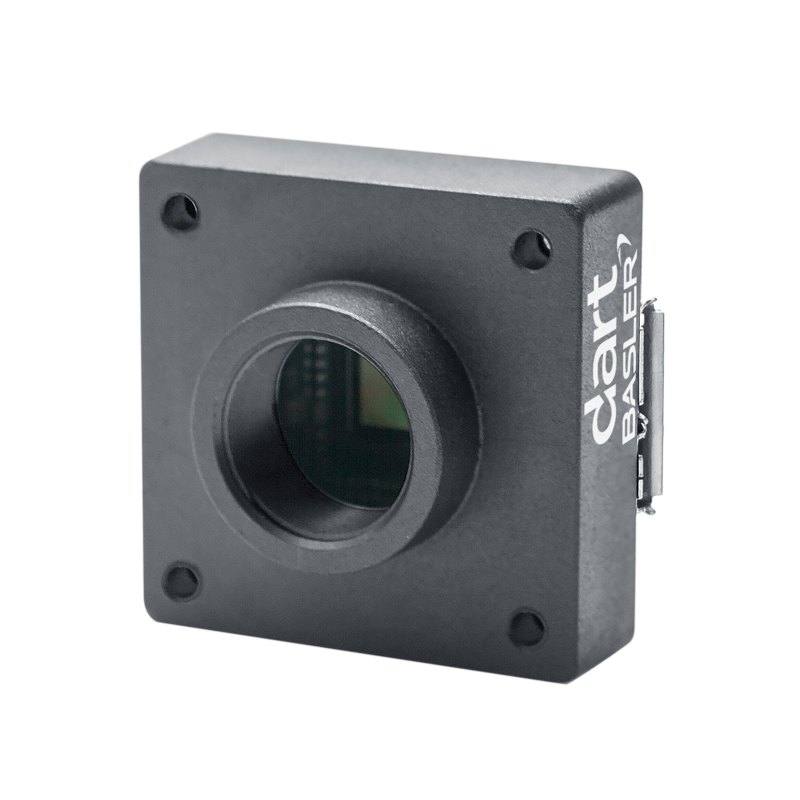
Basler daA3840-45um machine vision camera
  • Rosepetal compatible
  • Recommended by AIS Vision

Basler dart daA3840-45um

daA3840-45um

The Basler dart daA3840-45um is a compact board-level area scan camera built around the 1/1.8" Sony IMX334 progressive-scan CMOS rolling-shutter sensor, delivering 3840 x 2160 (8.3 MP) monochrome images. It connects over a USB 3.0 (SuperSpeed, nominal max 5 Gbit/s) interface compliant with USB3 Vision and GenICam, achieving up to 44.9 fps with the device link throughput limit disabled (18.7 fps at default settings). The 2.0 x 2.0 um pixel sensor is bus-powered (~1.7-1.8 W at 5 VDC) and the camera is offered as a bare board or with S-mount and CS-mount fronts. Its small footprint and low weight make it well suited to embedded and space-constrained machine vision integration.

Brand
Basler
Camera type
Area scan
Interface
USB 3.0 (USB3 Vision, SuperSpeed up to 5 Gbit/s)
Resolution
8.3 MP
Horizontal resolution
3840 x 2160 px (default), 3860 x 2178 full
Mono / color
Monochrome
Sensor manufacturer
sony_starvis (display: Sony STARVIS (IMX334))
Sensor model
Sony IMX334 (IMX334LLR-C)
Shutter
Rolling shutter
FPS
Up to 44.9 fps (18.7 fps default)
Mount
S-mount / CS-mount / bare board
Sensor size
1/1.8" (7.68 x 4.32 mm, 8.86 mm diagonal)

Technical overview

The Basler dart daA3840-45um is a board-level area scan camera built around the 1/1.8" Sony IMX334 STARVIS CMOS sensor, delivering a native 3840 x 2160 (8.3 MP) monochrome image. With a 2.0 x 2.0 um pixel on a 7.68 x 4.32 mm active area, this is a high-pixel-count sensor packed into a small format, which means it resolves fine detail per frame but asks a lot of the optics: you need a lens that can actually resolve down to the 2 um pixel pitch across the 8.86 mm diagonal, or the extra megapixels are wasted. The monochrome configuration trades color discrimination for higher effective sensitivity and full per-pixel resolution, making it a natural fit for detail- and contrast-driven tasks such as surface and defect inspection, dimensional measurement, and OCR/OCV, where you control contrast with dedicated lighting and, where helpful, optical filters rather than relying on color.

The sensor uses a rolling shutter, not a global shutter. That distinction governs how you deploy this camera: rolling-shutter readout exposes the sensor row by row, so fast lateral motion can shear or skew, and you typically pair it with continuous (or carefully matched strobed) illumination and either static/indexed parts or modest line speeds rather than freezing fast continuous travel. For stationary or step-and-repeat inspection stations, electronics and PCB imaging, print verification, and measurement, the rolling shutter is a non-issue and you get the benefit of the dense, sensitive sensor. The frame rate is a key planning number: the camera reaches up to 44.9 fps only with the device link throughput limit disabled, and runs 18.7 fps at default settings, so your achievable throughput depends on how much of the USB 3.0 bandwidth budget you actually allocate.

Connectivity is USB 3.0 (SuperSpeed, nominal 5 Gbit/s) compliant with USB3 Vision and GenICam 2.x, which makes the camera plug-and-play with standard machine-vision software stacks and keeps cabling simple over short, single-camera runs. It is USB bus-powered at roughly 1.7 W from 5 VDC, so there is no separate power supply or I/O brick to wire in. Physically it is tiny and light: a 20 x 29 x 29 mm body at 15 g, available as a bare board or with S-mount or CS-mount fronts. That footprint, weight, and the lens-mount flexibility are the headline reasons to pick the dart line: it is designed to be embedded inside compact equipment, mounted on moving stages or robot tooling, or designed directly onto a carrier board where a full housed C-mount camera will not fit. The 0 to 50 degC operating range covers typical indoor industrial and benchtop enclosures.

Best for

  • High-resolution surface and defect inspection of stationary or step-and-repeat parts, where the 8.3 MP monochrome sensor and dense 2 um pixels resolve fine flaws
  • Dimensional measurement and gauging stations that need many pixels across the field of view from a compact, fixed-mounted camera
  • Industrial OCR/OCV and print verification on electronics, packaging, and printed media, where monochrome contrast plus controlled lighting reads text and marks
  • Space-constrained and embedded vision builds (compact instruments, desktop systems, robot end-of-arm tooling) that exploit the 20 x 29 x 29 mm, 15 g board-level form factor
  • Single-camera USB3 Vision setups on short cable runs where USB bus power (~1.7 W, 5 VDC) simplifies wiring and avoids a separate supply

Selection notes

  • Confirm your lens can resolve the 2.0 um pixel pitch over the 1/1.8" (8.86 mm diagonal) format; an under-resolving lens will not deliver the full 8.3 MP detail. S-mount and CS-mount fronts (or bare board) are offered, so match the front option to your lens ecosystem.
  • Budget the frame rate against bandwidth: 44.9 fps requires disabling the device link throughput limit, while default settings yield 18.7 fps. Size your USB 3.0 host controller and link accordingly, and plan single-camera-per-bus where you need the full rate.
  • This is a rolling-shutter sensor. For fast continuously moving parts, expect motion skew; favor static, indexed, or slow-motion imaging, and pair with continuous or matched illumination rather than short freeze-motion strobes intended for global-shutter cameras.
  • Monochrome only: you get full per-pixel resolution and good sensitivity but no color information, so engineer contrast with wavelength-targeted lighting and optical filters if your defect or feature depends on color.
  • USB 3.0 favors short cable runs and a single camera near the host; for long distances, many synchronized cameras, or harsher cabling environments, evaluate a GigE or CoaXPress alternative instead. Confirm the 0 to 50 degC operating range and the ~1.7 W bus-power draw fit your enclosure and host's USB power budget.

Specifications: General
BrandBasler
Camera typeArea scan

Specifications: Sensor
Resolution8.3 MP
Horizontal resolution3840 x 2160 px (default), 3860 x 2178 full
Mono / colorMonochrome
Sensor manufacturersony_starvis (display: Sony STARVIS (IMX334))
Sensor modelSony IMX334 (IMX334LLR-C)
ShutterRolling shutter
Sensor size1/1.8" (7.68 x 4.32 mm, 8.86 mm diagonal)
Pixel size2.0 x 2.0 um

Specifications: Performance
FPSUp to 44.9 fps (18.7 fps default)

Specifications: Interface
InterfaceUSB 3.0 (USB3 Vision, SuperSpeed up to 5 Gbit/s)
ProtocolsUSB3 Vision, GenICam 2.x

Specifications: Optics
MountS-mount / CS-mount / bare board

Specifications: Electrical
PowerUSB bus-powered, ~1.7 W @ 5 VDC
Power consumption1.7 W
Supply voltage5 VDC

Specifications: Environment
Operating temperature0 to 50 degC

Specifications: Mechanical
Dimensions20 x 29 x 29 mm
Weight15 g

Frequently asked questions

Related technical guides

Rosepetal · AI

Test this camera with Rosepetal

Validate your visual inspection with AI: send us sample images and we evaluate the case on your hardware.

AIS Vision · Integration

We validate camera + lens + lighting

AIS Vision defines and tests the optimal combination of camera, optics and lighting for your application before you buy.