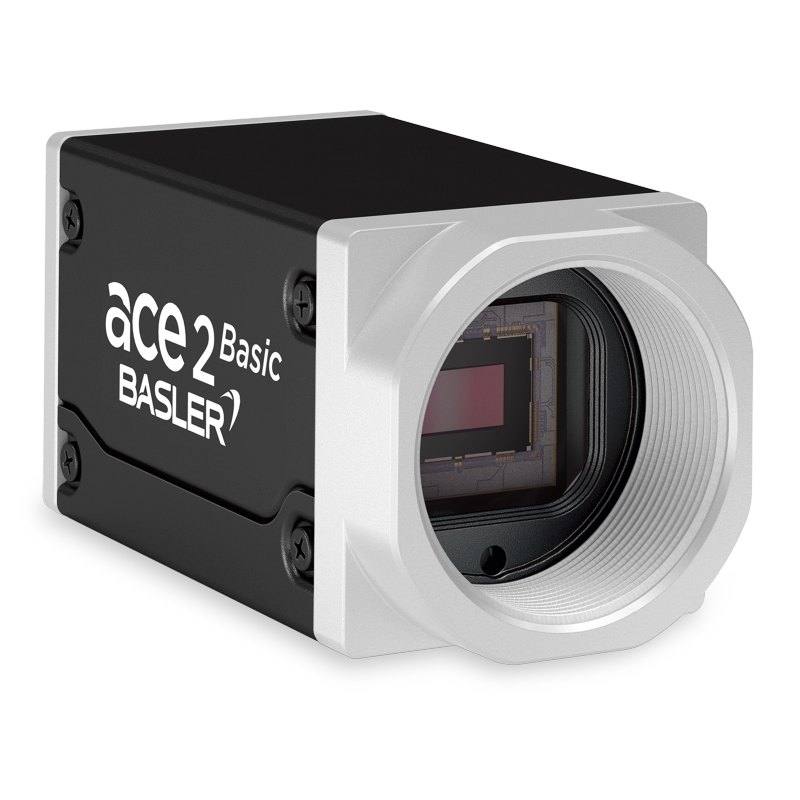
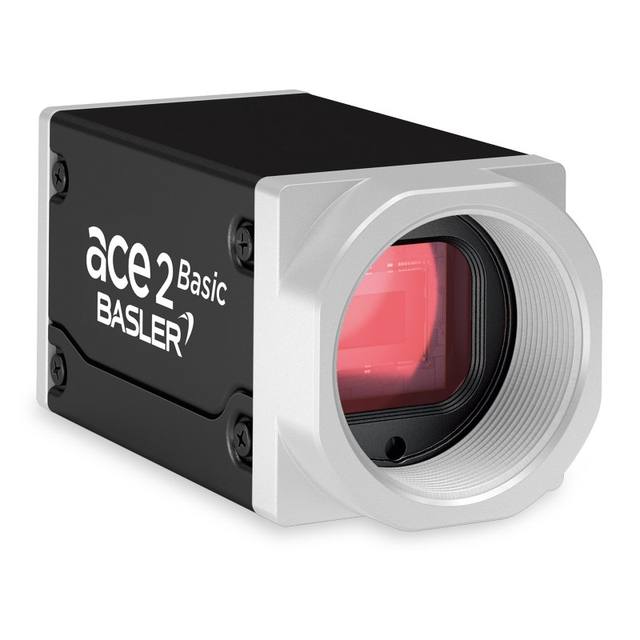
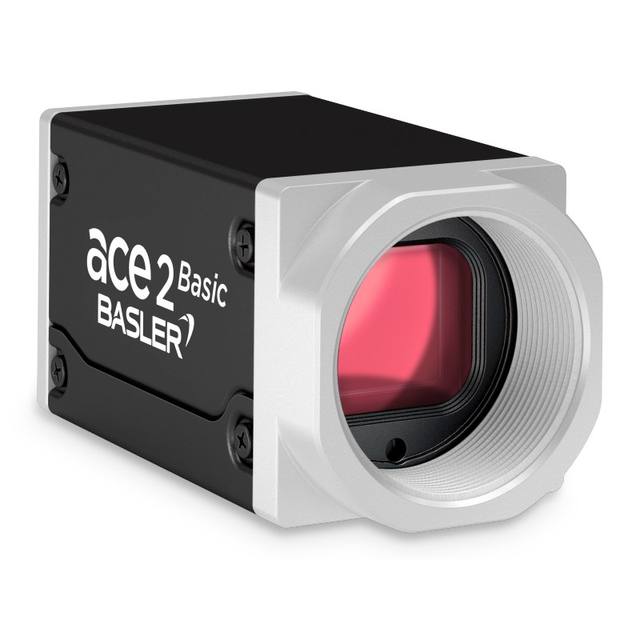
The Basler ace 2 a2A2440-98g5mBAS is an industrial area scan camera built around the 2/3" Sony IMX250 (IMX250LLR-C) global-shutter CMOS sensor with a native resolution of 2448 x 2048 pixels (5 MP) and 3.45 x 3.45 um pixels. It connects over a multi-rate Ethernet interface supporting up to 5 Gigabit (5GigE / NBASE-T) and reaches up to ~98 fps at full resolution. The camera is GigE Vision and GenICam compliant, uses a C-mount, draws roughly 5.5 W, and is powered via 12-24 VDC through its M8 6-pin I/O connector (no PoE). It offers 8/10/12-bit pixel depth, 1 opto-coupled input and 2 GPIO lines, and carries an IP30 housing rating.
The Basler ace 2 a2A2440-98g5mBAS is built around the 2/3-inch Sony IMX250 (IMX250LLR-C) Pregius global-shutter CMOS sensor, delivering 2448 x 2048 pixels (5 MP) on a 3.45 um square pixel pitch. The global shutter is the defining trait: every pixel is exposed simultaneously, so fast-moving parts on a conveyor or rotating index table are captured without the skew or smear a rolling shutter would introduce. That makes this a natural fit for line-rate inspection and any task where the part is in motion at the moment of capture. At full 5 MP resolution the camera runs up to roughly 98 fps, giving real headroom for high-throughput stations or for trading frame rate against resolution via region-of-interest cropping. Because the sensor is monochrome, all 5 MP go to pure luminance detail with no Bayer interpolation, which maximizes effective spatial resolution and edge sharpness for measurement, surface defect detection, and code reading where color is not the discriminating feature.
Connectivity is handled over a multi-rate Ethernet interface supporting 100M/1G/2.5G/5G (5GigE / NBASE-T), and the camera is GigE Vision and GenICam compliant. The 5 Gigabit link is what lets the 5 MP sensor stream near its ~98 fps ceiling over a single standard CAT-class cable while still supporting cable runs far longer than USB3 allows, and NBASE-T means it negotiates down gracefully to 1G infrastructure if a switch or NIC cannot sustain 5G. GigE Vision plus GenICam keeps the camera vendor-neutral at the software layer, so it drops into pylon or any third-party GenICam-compliant library. Note that this model is not PoE: it is powered separately at 12-24 VDC (rated supply 10.8-30 VDC) through the M8 6-pin I/O connector, drawing about 5.5 W, so the network cable carries data only and a separate power/IO harness must be planned into the panel layout.
Optically and mechanically the camera uses a C-mount and the 2/3-inch (11.1 mm diagonal) format, so it pairs with widely available C-mount lenses; the 3.45 um pixel means the lens needs to resolve fine detail to avoid being the limiting element, so a lens rated for at least 5 MP on a 2/3-inch sensor is the sensible match. The compact 62.2 x 29 x 29 mm, 105 g body fits tight fixtures and robot end-of-arm mounting. For I/O and synchronization the camera provides 1 opto-coupled input and 2 GPIO lines, which is enough to take an encoder or photo-eye trigger and to drive a strobe or signal a result, with selectable 8/10/12-bit pixel formats letting you trade bandwidth against grayscale precision. The IP30 housing and -10 to 50 degC operating range place it in clean, enclosed cabinet or in-line environments rather than washdown or harsh outdoor duty, where an additional enclosure would be required.
Best for
High-speed surface and defect inspection of parts moving on a conveyor or index table, where the global shutter freezes motion at full 5 MP without smear
Dimensional measurement and gauging that needs sharp, distortion-free edges from a monochrome 5 MP sensor and a quality C-mount lens
Reading and verifying 1D/2D codes and printed text (OCR/OCV) for traceability where monochrome resolution maximizes contrast and legibility
Robot-guidance and pick stations using the small, light 105 g body on an end-of-arm or fixed gantry mount with encoder/photo-eye triggering
Throughput-driven electronics, packaging, and semiconductor lines that need the ~98 fps 5GigE stream over longer cable runs than USB3 permits
Selection notes
Plan power and I/O separately from the network: this model is not PoE, so it needs 12-24 VDC (10.8-30 VDC rated, ~5.5 W) delivered through the M8 6-pin connector in addition to the Ethernet data cable
Verify the host can sustain 5GigE: a 2.5G/5G-capable NIC or switch and adequate cabling are needed to reach ~98 fps at full resolution; on 1G infrastructure NBASE-T negotiates down but throughput and frame rate drop accordingly
Match the lens to the sensor: choose a C-mount lens that covers the 2/3-inch (11.1 mm) format and resolves the 3.45 um pixel, ideally rated for 5 MP, or the optics will cap real-world sharpness
Confirm color is not required: this is a monochrome model, so applications that depend on color discrimination need a different variant; for grayscale tasks the mono sensor gives more usable resolution
Check the environment against IP30 and -10 to 50 degC: the housing suits clean enclosed or in-cabinet installs, not washdown or dusty/wet areas, which would need a protective enclosure
Budget I/O lines deliberately: 1 opto-coupled input plus 2 GPIO is enough for one hardware trigger and a strobe/result line, so consolidate triggering if more signals are needed
Matched automatically by: lens mount fits the camera mount · lens image circle covers the camera sensor — this camera: C-mount · 2/3" (11.1 mm diagonal) sensor.
By category
All 198C-mount lenses 135Telecentric lenses 60F-mount / large-format lenses 3
By brand
All 198Omron / Sentech 66Basler 59iRAYPLE 48Datalogic / Datasensing 25
Get a first image quickly with the pylon Viewer, then move into the pylon SDK for your application. These cameras are GenICam/GenTL-compliant, so any compliant vision software can drive them as well.
Download and install the pylon Camera Software Suite for your OS from Basler. This provides the pylon Viewer, the GenTL transport-layer producers and the pylon SDK (C/C++/.NET/Python). On Windows the installer adds the needed drivers; on Linux follow the included setup notes for USB and network permissions.
2. Connect the camera and check the link
Cable the camera to its matching interface: GigE Vision to a GigE port (use a quality cable and, ideally, a dedicated NIC with jumbo frames enabled), USB3 Vision to a USB 3.x port with the supplied cable, or CoaXPress to the frame grabber. Provide power where required (PoE, USB bus power, or PoCXP). Open the pylon Viewer and confirm the camera appears in the device list; for GigE, make sure the camera and NIC are on the same subnet.
3. Grab a first image and set exposure, gain and pixel format
Select the camera in the pylon Viewer and start a continuous grab. Adjust exposure time and gain until the image is well exposed (avoid clipped highlights), set the pixel format (e.g. Mono8 or a Bayer/RGB format), and focus the lens. Use a test pattern if the lens or scene is not ready yet.
4. Configure triggering and acquisition
Decide between free-run and triggered acquisition. For synchronized capture, set the trigger source (software or a hardware line on the I/O connector), trigger mode and any debounce or exposure mode, then verify timing. Note the parameter names you change in the Viewer feature tree, as you will reuse them in code.
5. Move to the SDK or a GenICam-compliant library
Recreate your settings in code with the pylon SDK (C, C++, .NET or Python) to open the device, apply the same features and pull frames into your pipeline; pylon vTools and pylon AI can add processing blocks. Because the cameras are GenICam/GenTL standard, third-party vision libraries work too. Once the image stream is stable, you can route frames to a deep-learning inspection such as Rosepetal for automated defect detection.
Frequently asked questions
It is monochrome. It uses the Sony IMX250LLR-C mono sensor, so all 2448 x 2048 (5 MP) pixels capture pure grayscale detail with no color filter, which is ideal for measurement, surface inspection, and code reading.
No. This model is not PoE. It must be powered at 12-24 VDC (rated 10.8-30 VDC), drawing about 5.5 W, through its M8 6-pin I/O connector, while the Ethernet cable carries data only.
The camera delivers 2448 x 2048 pixels (5 MP) at up to roughly 98 fps at full resolution over its 5GigE interface. Cropping to a smaller region of interest can push frame rate higher.
It connects over a multi-rate Ethernet interface supporting 100M/1G/2.5G/5G (5GigE / NBASE-T) and is GigE Vision and GenICam compliant, so it works with pylon or any GenICam-compliant software.
It uses a C-mount and a 2/3-inch sensor (11.1 mm diagonal) with 3.45 um pixels. Pair it with a C-mount lens that covers the 2/3-inch format and resolves 5 MP for best sharpness.
Yes. It has a global shutter, so the entire frame is exposed at once and parts in motion are captured without the skew or smear that a rolling shutter would produce, making it suited to conveyor and index-table inspection.