

- Rosepetal compatible
- Recommended by AIS Vision
On request
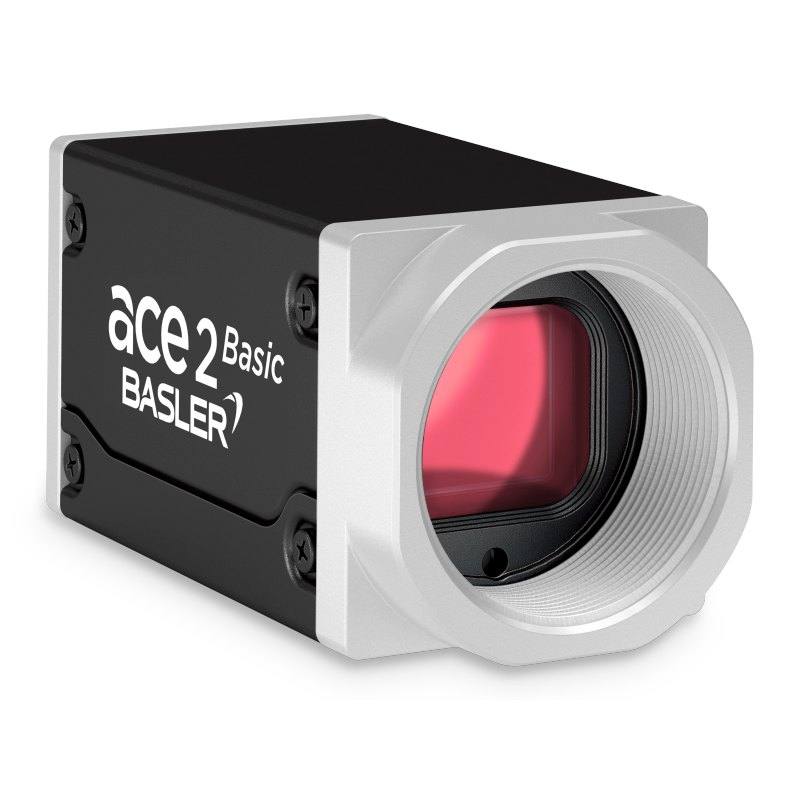
a2A2464-23gc
The Basler a2A2464-23gcBAS is a GigE Vision 2.0 industrial area scan camera in the ace 2 R Basic family, built around the 2/3", 5 MP (2448 x 2048 px) OmniVision OG05C global shutter CMOS sensor with 3.45 um square pixels. The NIR-enhanced color sensor captures both visible and near-infrared light and delivers up to 23 fps at full resolution with 8/10/12-bit pixel depth. It uses a C-mount, an RJ45 GigE interface, and supports Power over Ethernet or 12-24 VDC supply, with a compact 55.5 x 29 x 29 mm box housing weighing 100 g. The camera supports free-run, hardware, and software triggering plus PTP for multi-camera synchronization, and is operated via the Basler pylon Software Suite.
The Basler ace 2 R a2A2464-23gc is a 5 MP (2448 x 2048 px) color area scan camera built on the 2/3" OmniVision OG05C global shutter CMOS sensor with 3.45 um square pixels. The global shutter is the defining trait here: every pixel is exposed simultaneously, so fast-moving parts on a conveyor or robot end-effector are frozen without the skew or smear a rolling shutter would introduce. At 23 fps across the full 5 MP frame, the camera is well matched to throughput-driven inspection where you need both resolution and motion-safe captures rather than raw speed alone. The 2/3" optical format (8.45 x 7.07 mm, 11.02 mm diagonal) combined with 3.45 um pixels gives a balanced trade-off between field of view and spatial detail, suitable for catching small defects, fine print, or measurement features across a typical inspection window.
| Brand | Basler |
|---|---|
| Camera type | Area scan |
| Resolution | 5 MP |
|---|---|
| Horizontal resolution | 2448 x 2048 px |
| Mono / color | Color (NIR-enhanced, visible + NIR) |
| Sensor model | OmniVision OG05C |
| Shutter | Global shutter |
| Sensor size | 2/3" optical format (8.45 mm x 7.07 mm, 11.02 mm diagonal) |
| Pixel size | 3.45 um x 3.45 um |
| FPS | 23 fps at full resolution |
|---|
| Interface | GigE (Fast Ethernet 100 Mbit/s and Gigabit Ethernet 1000 Mbit/s, PoE) |
|---|---|
| Protocols | GigE Vision 2.0, GenICam |
| Mount | C-mount |
|---|
| Power | PoE or 12-24 VDC |
|---|---|
| Power consumption | 2.7 W |
| IP rating | IP30 |
|---|---|
| Operating temperature | -10 to 60 °C |
| Housing material | Box |
|---|---|
| Dimensions | 55.5 x 29 x 29 mm |
| Weight | 100 g |
A practical, application-first method for selecting an industrial camera: derive resolution from field of view and smallest detail, then match shutter, speed, interface, lens and lighting.
How global and rolling shutters differ, why rolling shutter distorts moving objects, and when each is the right choice for industrial inspection.
A practical decision guide to the three dominant machine-vision interfaces: bandwidth, cable length, multi-camera support, PoE, latency, frame grabber needs and cost.

Rosepetal · AI
Validate your visual inspection with AI: send us sample images and we evaluate the case on your hardware.
AIS Vision · Integration
AIS Vision defines and tests the optimal combination of camera, optics and lighting for your application before you buy.










