Skip to content
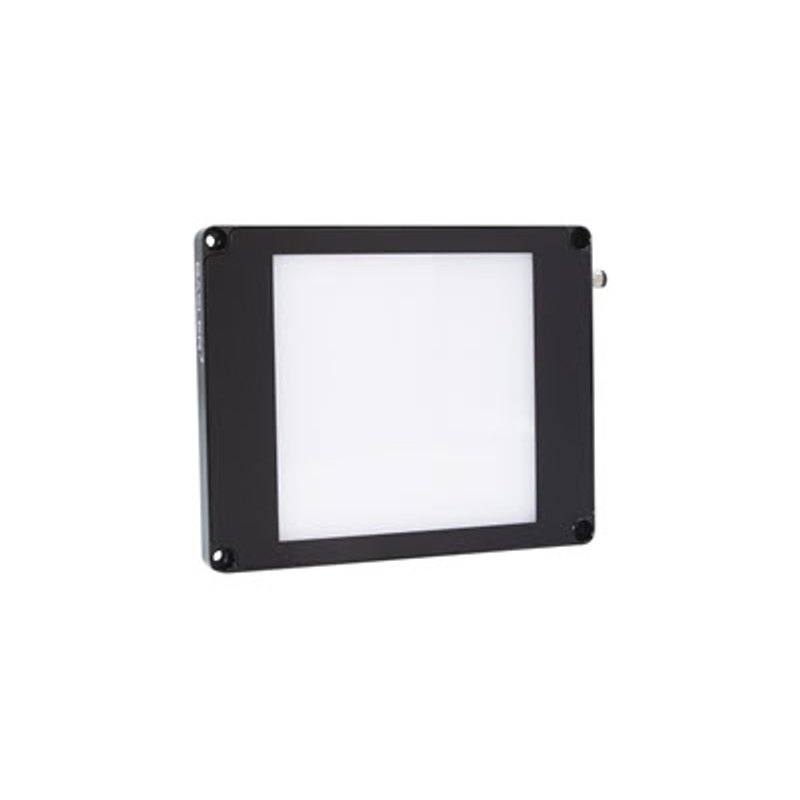
Basler Standard Light Back-200x200-x (White / Red / Blue / IR) machine vision lighting
  • Rosepetal compatible
  • Recommended by AIS Vision

Basler Standard Light Back-200x200

Standard Light Back-200x200-x

The Basler Standard Light Back-200x200-x is a flat LED backlight with a 200x200 mm illuminated area housed in a 220x250x12 mm black anodized aluminum enclosure with a PMMA diffuser cover. It features an integrated LED controller supporting both continuous and strobe operation (minimum flash time 100 µs), with supply at 24 VDC ±10% and 22 W power consumption. The unit operates at IP54 protection, weighs 1100 g, and connects via a 4-pin M8 connector; it is compatible with the Basler SLP Strobe Controller but can also run standalone. Four wavelength variants are offered: White (5000 K color temperature), Red (625 nm), Blue (465 nm), and IR (850 nm).

Brand
Basler
Lighting type
Backlight
Illuminated area
200x200 mm
Available wavelengths
White (5000 K), Red (625 nm), Blue (465 nm), IR (850 nm)
Color / wavelength
White / Red / Blue / IR
Color temperature
5000 K (White variant)
Mode
Continuous and strobe (min. 100 µs flash time)
Controller required
No (integrated controller; optional Basler SLP Strobe Controller)
Diffuser
Yes (PMMA light cover)
Power consumption
22 W
Supply voltage
24 VDC ±10%
Connection
M8 socket, 4-pin male

Technical overview

The Basler Standard Light Back-200x200 is a flat LED backlight delivering a 200x200 mm homogeneous illuminated area from a 220x250x12 mm black anodized aluminum enclosure with a PMMA diffuser cover. The PMMA diffuser redistributes point-source LED output into a spatially uniform exit surface, which is the defining requirement for silhouette-based imaging: every pixel along an object's edge receives the same photon flux, so the camera sees a sharp, high-contrast boundary rather than a gradient that would shift with ambient variation or LED aging. At 22 W from a 24 VDC ±10% supply the unit runs cool enough for the standard 10–30 °C operating envelope, while optional heat dissipation extends headroom to 45 °C — relevant in enclosed machine enclosures running multi-shift schedules. The black anodized aluminum housing resists corrosion and doubles as a heat spreader, and IP54 ingress protection makes the unit tolerant of dust and splash in typical assembly and packaging lines without requiring full washdown provisions.

Wavelength selection is a first-order decision that determines what the backlight actually reveals. The White variant at 5000 K works with standard color or monochrome cameras and is the broadest starting point for dimensional gauging of opaque or translucent parts. The Red variant at 625 nm pairs naturally with silicon-sensor cameras, which have peak quantum efficiency close to that wavelength, maximizing signal-to-noise and allowing shorter exposure times for the same illuminance. The Blue variant at 465 nm exploits the absorption difference of many materials — red plastics, copper, and certain inks become opaque under blue light, sharpening edges that would appear soft under white illumination. The IR variant at 850 nm penetrates thin packaging films and certain translucent resins that scatter visible light, enabling measurement of an object silhouette inside a wrapper — a common requirement in pharmaceutical blister-pack inspection and food portion verification. All four variants share identical mechanical, electrical, and controller interfaces, so a line can be qualified on one wavelength and re-tooled to another without changing mounts, cabling, or control logic.

The integrated LED controller eliminates the need for a separate strobe driver in many deployments: the unit connects directly to a camera trigger or PLC output via its M8 4-pin connector and generates flash pulses as short as 100 µs. Strobe operation reduces average thermal load compared with continuous mode, which is relevant for duty-cycle budgeting in enclosed enclosures. Working distance is specified from 1 mm up to 100 mm, placing the part either in contact with or very close to the diffuser face — which keeps the effective illuminated cone tight, reduces stray light reaching the lens from the sides, and is consistent with the telecentric or short-focal-length lenses typically used for dimensional metrology. For applications requiring synchronized multi-axis strobing or more precise timing control beyond standalone capability, the unit connects to the Basler SLP Strobe Controller via the same M8 4-pin interface, preserving installation simplicity while adding flexibility.

Best for

  • Dimensional measurement of machined or molded parts where a sharp silhouette edge is required for sub-pixel gauging — the 200x200 mm illuminated area accommodates components up to roughly the size of a mobile phone or automotive connector housing in a single frame
  • Outline inspection of stamped metal blanks, punched PCB substrates, or cut gaskets, where the IR or Blue variants can increase edge contrast for parts whose material absorbs or transmits poorly under white light
  • Packaging completeness checks — verifying blister-pack fill, tablet presence, or label absence — particularly using the IR variant to image through translucent overwrap films
  • Barcode, DataMatrix, and OCR verification on labels or directly marked parts, where backlit silhouette confirms label placement and extent before a separate reflected-light reader decodes content
  • High-speed inline gauging on conveyors where the 100 µs minimum strobe time freezes motion and the integrated controller simplifies wiring to a single M8 cable from camera trigger to light

Selection notes

  • Working distance discipline is critical: the recommended 1–100 mm range means the backlight must be mounted within 100 mm of the part, so mechanical fixturing needs to allow close approach — confirm clearance for the 220x250 mm housing footprint before designing the cell
  • Wavelength must be chosen against the specific material: translucent plastics or films generally call for IR (850 nm) to build opacity; copper-colored or red-tinted parts benefit from Blue (465 nm) absorption; monochrome cameras optimized for NIR should be paired with IR or Red variants to maximize quantum efficiency
  • The integrated controller supports standalone operation from a 24 VDC supply and a direct trigger input, which covers most installations; only add the Basler SLP Strobe Controller if you need coordinated multi-light sequencing or precise timing control beyond what the onboard driver provides
  • IP54 is adequate for dust and splash but not for washdown: in food or pharma lines with CIP/SIP cleaning cycles, verify that cleaning agents and pressure are within IP54 limits or specify an alternative enclosure — the unit is not rated for full immersion or high-pressure wash
  • Thermal management at sustained high duty cycles requires attention: standard operation is rated to 30 °C ambient; if the enclosure temperature regularly exceeds that, plan for conductive coupling of the aluminum housing to the machine frame or a forced-air path rather than relying on convection alone

Specifications: General
BrandBasler
Lighting typeBacklight

Specifications: Interface
ConnectionM8 socket, 4-pin male

Specifications: Optical
Available wavelengthsWhite (5000 K), Red (625 nm), Blue (465 nm), IR (850 nm)
Color / wavelengthWhite / Red / Blue / IR
Color temperature5000 K (White variant)
DiffuserYes (PMMA light cover)
Working distance1–100 mm (recommended)

Specifications: Electrical
ModeContinuous and strobe (min. 100 µs flash time)
Controller requiredNo (integrated controller; optional Basler SLP Strobe Controller)
Power consumption22 W
Supply voltage24 VDC ±10%

Specifications: Environment
IP ratingIP54
Operating temperature10–30 °C standard; up to 45 °C with heat dissipation

Specifications: Geometry
Illuminated area200x200 mm

Specifications: Mechanical
Dimensions220 x 250 x 12 mm (H x W x D)
Weight1100 g
Housing materialBlack anodized aluminum with PMMA light cover

Frequently asked questions

Related technical guides

Rosepetal · AI

Test this camera with Rosepetal

Validate your visual inspection with AI: send us sample images and we evaluate the case on your hardware.

AIS Vision · Integration

We validate camera + lens + lighting

AIS Vision defines and tests the optimal combination of camera, optics and lighting for your application before you buy.