Skip to content
Omron / Sentech FLV-FB200200 machine vision lighting
  • Rosepetal compatible
  • Recommended by AIS Vision

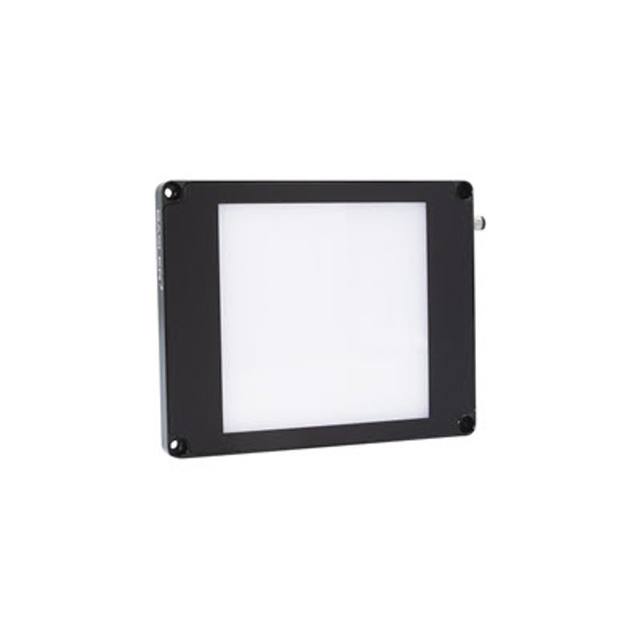
Omron / Sentech FLV-FB200200 Edge Type Backlight 200×200

FLV-FB200200

The FLV-FB200200 is an ultrathin (10mm depth) edge-lit LED backlight panel in Omron's FLV series, designed to provide highly uniform, shadowless illumination for machine vision applications emphasizing workpiece outlines and contours. The 200×200mm housing encloses a 164×164mm active emitting surface constructed from aluminum and PMMA diffuser material. It is available in three wavelength variants: white (7.3W), red 625nm (5.5W), and blue 460nm (7.3W), with a weight of approximately 710g. The unit requires a dedicated Omron FLV lighting controller (FLV-TCC4, FLV-TCC1, FLV-TCC3HB, or FLV-ATC1024 series) and connects via a 3.5mm diameter, 0.8m cable with a proprietary tab-lock connector.

Brand
Omron / Sentech
Lighting type
Backlight (Edge-lit)
Color / wavelength
White / Red (625nm) / Blue (460nm)
Available wavelengths
White, Red (Typ. 625nm), Blue (Typ. 460nm)
Illuminated area
164 × 164 mm emitting surface
Power consumption
7.3W (White/Blue); 5.5W (Red)
Diffuser
Yes (PMMA diffusion plate)
Controller required
Yes — FLV-TCC4 / FLV-TCC1 / FLV-TCC3HB / FLV-ATC1024
IP rating
IP20 (IEC 60529)
Dimensions
200 × 200 × 10.7 mm (W × H × D)
Weight
Approx. 710 g
Operating temperature
0 to +50°C (operating); −15 to +60°C (storage)

Technical overview

The FLV-FB200200 is an edge-lit LED backlight panel measuring 200 x 200 mm overall with a 164 x 164 mm active emitting surface — a useful distinction for fixture designers who must align part travel or conveyor apertures to the actual illuminated zone rather than the outer housing. At just 10.7 mm deep and approximately 710 g, the panel integrates directly into tight under-conveyor or between-stage installations where a conventional direct-lit panel would add too much stack height. The PMMA diffusion plate is the key optical component: edge-injected LED light is scattered uniformly across the panel face, eliminating the hotspot gradients and shadow bands that would otherwise obscure fine contour details. The result is a flat, diffuse field that forces workpiece edges to register as sharp, high-contrast silhouettes against a bright background — the geometry that makes dimensional gauging, outline verification, and through-hole detection reliable and repeatable.

Three wavelength variants are stocked — white, red (625 nm), and blue (460 nm) — and the choice has direct consequence for contrast and camera pairing. White backlighting maximizes luminance versatility and works with both monochrome and color cameras across a broad range of part materials. The red 625 nm variant, drawing only 5.5 W versus 7.3 W for the other colors, targets applications where a monochrome camera is used with a matching bandpass filter to reject ambient light; the lower power draw also favors high-duty-cycle or continuous-on usage. The blue 460 nm option is particularly effective at revealing edge detail on translucent or lightly pigmented plastic parts, where longer wavelengths can bleed through thin sections and soften the silhouette boundary. All variants require one of the Omron FLV controller series (FLV-TCC4, FLV-TCC1, FLV-TCC3HB, or FLV-ATC1024) connected via the proprietary tab-lock cable; the controller provides both power regulation and strobe triggering, so no separate driver circuitry is needed at the panel end.

For installation planning, the IP20 enclosure rating confirms the panel is intended for controlled indoor environments free of coolant mist, wash-down, or significant airborne particulate — typical of electronics assembly, pharmaceutical blister-pack, and precision metal-parts inspection lines. The operating range of 0 to +50 °C covers standard factory floors, and the compact aluminum housing dissipates the modest thermal load (7.3 W maximum) passively without forced airflow. The 0.8 m proprietary cable is long enough to reach a controller mounted outside a light-tight enclosure but short enough that cable routing must be planned: extensions are not simply arbitrary-length third-party cables, so controller placement relative to the panel should be confirmed before fixturing is finalized.

Best for

  • Dimensional gauging and pass/fail outline inspection of mechanical components — connectors, stamped metal parts, turned fasteners — where the 164 x 164 mm emitting area accommodates small to medium part families in a single field of view.
  • Presence and through-hole detection on PCBs and electronic sub-assemblies, where the uniform flat field highlights missing pins, misaligned leads, or absent components as dark features against a bright background.
  • Blister-pack and tablet-count inspection in pharmaceutical lines, where the backlight silhouettes each blister cavity clearly and the blue variant can enhance contrast on semi-translucent packaging films.
  • Contour and completeness verification of plastic-molded or die-cast parts in automotive supply chains, where the red variant paired with a narrowband filter suppresses overhead fluorescent interference and stabilizes inspection under variable ambient conditions.
  • Label and cap placement inspection on small packaging — bottles, vials, cartridges — where the workpiece silhouette provides a reliable registration reference before a second illumination pass inspects surface print or code quality.

Selection notes

  • Confirm your field of view fits within the 164 x 164 mm emitting surface, not the 200 x 200 mm housing. If a conveyor lane or part fixture is sized to the outer housing, the camera will see the darker, non-emitting border and lose the uniform background at the image periphery.
  • Select the wavelength variant to match your camera sensor and ambient rejection strategy. For monochrome cameras with bandpass filters the red (625 nm) variant offers the lowest power consumption and the tightest spectral pairing; for color cameras or multi-purpose cells where wavelength flexibility matters, the white variant preserves options.
  • Budget for a compatible Omron FLV controller (FLV-TCC4, FLV-TCC1, FLV-TCC3HB, or FLV-ATC1024) as a mandatory line item — the panel has no standalone power input and cannot be driven directly from a generic 24 V supply. Verify which controller tier is needed based on the number of lighting channels, strobe frequency, and whether analog dimming is required.
  • The IP20 rating limits deployment to clean, dry enclosures. Applications in food processing, metal cutting, or any environment with liquid aerosol, wash-down cycles, or heavy dust will require either an IP65/IP67 alternative or a fully sealed housing around the panel.
  • The 0.8 m cable fixes the maximum distance between panel and controller. Plan controller mounting positions on the machine frame before mechanical design is frozen; adding a relay box or extended cable run is not a simple field modification given the proprietary tab-lock connector.

Specifications: General
BrandOmron / Sentech
Lighting typeBacklight (Edge-lit)

Specifications: Interface
ConnectionProprietary tab-lock connector, 3.5mm dia. cable, 0.8m length

Specifications: Optical
Color / wavelengthWhite / Red (625nm) / Blue (460nm)
Available wavelengthsWhite, Red (Typ. 625nm), Blue (Typ. 460nm)
DiffuserYes (PMMA diffusion plate)

Specifications: Electrical
Power consumption7.3W (White/Blue); 5.5W (Red)
Controller requiredYes — FLV-TCC4 / FLV-TCC1 / FLV-TCC3HB / FLV-ATC1024

Specifications: Environment
IP ratingIP20 (IEC 60529)
Operating temperature0 to +50°C (operating); −15 to +60°C (storage)

Specifications: Geometry
Illuminated area164 × 164 mm emitting surface

Specifications: Mechanical
Dimensions200 × 200 × 10.7 mm (W × H × D)
WeightApprox. 710 g
Housing materialAluminum case, PMMA diffusion plate

Frequently asked questions

Related technical guides

Rosepetal · AI

Test this camera with Rosepetal

Validate your visual inspection with AI: send us sample images and we evaluate the case on your hardware.

AIS Vision · Integration

We validate camera + lens + lighting

AIS Vision defines and tests the optimal combination of camera, optics and lighting for your application before you buy.