Omron / Sentech FLV-DB130130 Direct Back Light (130x130)
FLV-DB130130
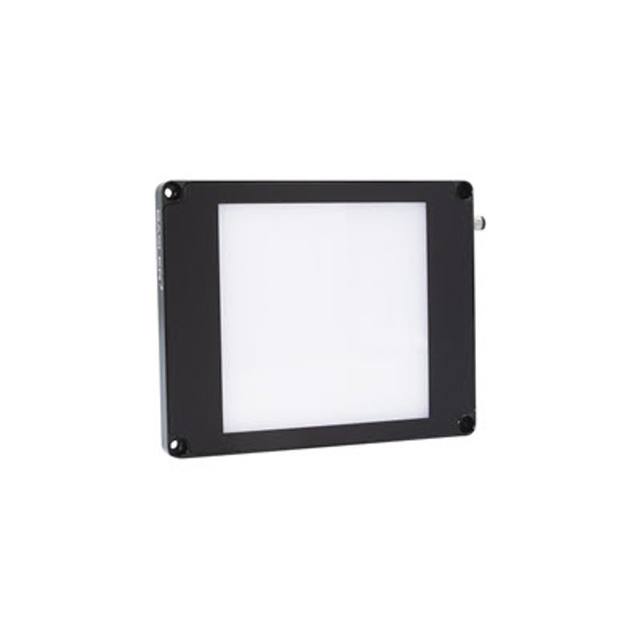
The FLV-DB130130 series provides highly uniform backlighting through a high-density LED array over a 120mm x 114mm emitting surface, housed in an aluminum and PMMA enclosure measuring 144mm x 126mm x 17mm overall. Power consumption is 13.0W for white and blue variants and 11.5W for the red variant, and the unit requires a dedicated Omron FLV-TCC or FLV-ATC series lighting controller. Protection is IP20 and the unit is rated for operating temperatures from 0 to +50°C. The cable is 0.8m long with a 3.5mm diameter connector, and the unit weighs approximately 270g.
The FLV-DB130130 is a direct LED backlight — meaning LEDs are arranged in a high-density planar array immediately behind a PMMA diffuser rather than edge-lit through a light guide — which produces a large, highly uniform emitting surface of 120 mm x 114 mm. That 120 x 114 mm active area, housed in a compact 144 x 126 x 17 mm aluminum case with PMMA diffuser front face, is sized to fill the field of view of cameras shooting mid-format parts without the shadowed edges and hot-spots that plague edge-lit panels. The PMMA diffuser scatters the direct LED output so the camera sees a smooth, consistent luminance field across the full emitting rectangle. For silhouette and outline inspection the uniformity figure is critical: any brightness falloff toward the edges would be read as a partial occlusion or edge anomaly, so the direct-array geometry is the correct choice for dimensional gauging or presence/absence work on this scale.
Three wavelength variants are offered — white, red (typ. 625 nm), and blue (typ. 460 nm) — and the choice has meaningful impact on image contrast beyond simple brightness. The blue 460 nm variant maximises contrast against warm-coloured or amber substrates and enhances silhouette sharpness on transparent or translucent objects by exploiting the lower transmission of many plastics and adhesives in the blue band. The red 625 nm variant draws slightly less power (11.5 W versus 13.0 W for white and blue) and suits applications where the camera is fitted with a matching narrowband filter to reject ambient illumination, or where the part colour creates better separation at red wavelengths. White light is the broadest-purpose option when the downstream algorithm operates on greyscale luminance and no spectral bias is required. All three run as continuous-output sources driven by a dedicated Omron FLV-TCC or FLV-ATC series controller; strobe operation is handled entirely by the controller, not the light unit itself.
From an installation standpoint the 17 mm body depth keeps the unit close to the conveyor plane and minimises the working-distance penalty inherent in backlight geometry: ideally the part under inspection sits directly on or just above the emitting surface, and the thin profile accommodates tight vertical clearances on existing lines. The 0.8 m cable, 3.5 mm in diameter, routes cleanly in panel cutouts, and the approximately 270 g aluminum and PMMA housing can be bracket-mounted without vibration concerns. IP20 protection is appropriate for controlled indoor environments — clean-room, electronics assembly, or enclosed conveyor lines — and the 0 to +50 °C operating range covers standard factory conditions. Thermal management is passive, relying on the aluminium body, which is adequate at 13 W continuous; installers should confirm enclosure ventilation if the unit is mounted inside a sealed camera housing where heat accumulation could push ambient above 50 °C.
Best for
Silhouette and outline dimensional gauging of mechanical parts, connectors, or moulded components where the 120 x 114 mm emitting area covers the full part footprint and uniform backlighting produces a clean, high-contrast edge for sub-pixel edge detection algorithms.
Presence and completeness inspection of transparent or translucent packaging, blister packs, and pharmaceutical blisters — the blue 460 nm variant increases differential absorption across the part, making voids, missing tablets, or mis-seated components visible as luminance variations against the bright background.
Burr, flash, and geometry inspection on stamped or injection-moulded parts where the silhouette reveals profile deviations; the large uniform field avoids the need to stitch multiple images when the part nearly fills the 120 x 114 mm window.
Lead-frame, PCB substrate, and semiconductor wafer outline verification in electronics manufacturing, where the controlled indoor environment aligns with the IP20 rating and the wavelength options allow pairing with monochrome cameras and narrowband optical filters to suppress overhead fluorescent ambient light.
Label and packaging cut-line verification on flat cartons or pouches, where the backlight reveals die-cut geometry and the continuous controller-driven mode allows integration-time synchronisation without requiring the camera trigger to also strobe the light.
Selection notes
Controller dependency is non-optional: the FLV-DB130130 requires an Omron FLV-TCC4, FLV-TCC1, FLV-TCC3HB, or FLV-ATC series controller and cannot be driven from a generic constant-current supply or directly from a vision system's I/O. Budget and cabinet space for the matching controller, and confirm firmware compatibility between controller and camera trigger timing before ordering.
The 120 x 114 mm emitting area is the usable inspection window — the overall housing is 144 x 126 mm, so mounting slots and mechanical fixturing must accommodate the larger outer dimension while the optics are calibrated to the inner active area. Parts larger than approximately 110 x 100 mm (allowing a small margin for edge uniformity) will require multiple lights or a larger model.
Wavelength selection should be made with the camera sensor's spectral response and any intended optical filter in mind. A monochrome camera with a 625 nm bandpass filter pairs with the red variant to reject most fluorescent and LED ambient light; a camera without a filter works with white for maximum brightness. The blue 460 nm variant is most effective with monochrome sensors whose QE peaks in the blue-green range — colour sensors may show chromatic fringing at the silhouette edge.
IP20 means the unit is not splash-proof or dust-tight. Applications in wash-down areas, metal-cutting coolant environments, or dusty grinding lines require an enclosure or a different product with a higher IP rating. The operating temperature ceiling of +50 °C should be verified against enclosure thermal modelling, particularly when housed with multiple heat-generating components.
The 0.8 m cable length is fixed; plan cable management and controller placement within approximately 0.5–0.6 m of the light mount (accounting for routing bends) and observe the 20 mm minimum bend radius to avoid connector fatigue. Extension cabling, if used, must maintain signal integrity for the controller's drive protocol and is subject to Omron's application guidance.
Specifications: General
Brand
Omron / Sentech
Lighting type
Direct Backlight
Specifications: Interface
Connection
3.5mm dia. cable, 0.8m length, min. bend radius 20mm
Specifications: Optical
Color / wavelength
White / Red (typ. 625nm) / Blue (typ. 460nm)
Diffuser
Yes (PMMA diffuser)
Available wavelengths
White (W), Red typ. 625nm (R), Blue typ. 460nm (B)
Specifications: Electrical
Power consumption
13.0 W (W/B); 11.5 W (R)
Controller required
Yes — FLV-TCC4/TCC1/TCC3HB or FLV-ATC□1024 series
Mode
Continuous (controller-driven)
Specifications: Environment
IP rating
IP20 (IEC60529)
Operating temperature
0 to +50°C (storage: −15 to +60°C)
Specifications: Geometry
Illuminated area
120 x 114 mm
Specifications: Mechanical
Dimensions
144 x 126 x 17 mm (H x W x D overall)
Weight
Approx. 270 g
Housing material
Aluminum case, PMMA diffuser
Applications this camera is commonly selected for. Open one to see the full recommended hardware and approach.
These steps take an Omron Sentech (STC) camera from the box to a stable first image and on to your own application. They apply across the GigE Vision, USB3 Vision and CoaXPress STC families; the interface only changes how you cable and power the camera.
Download and install the Sentech SDK on the host PC. The package provides StViewer, the viewing and configuration software you use to bring the camera up, and StApi, the programming SDK you integrate later. Because the cameras are GenICam/GenTL-compliant, StApi also registers a GenTL producer, so any GenICam-compliant third-party vision software can discover and drive the camera as an alternative front end.
2. Cable, power and connect the camera
Connect according to the interface. GigE Vision: link to a Gigabit NIC (use PoE or the separate power input) and put the camera and host on the same subnet; for USB3 Vision use a USB 3.x port and a certified cable; for CoaXPress (STC) connect to a CoaXPress frame grabber, which also supplies Power-over-Coax. Then open StViewer and let it enumerate the camera. If a GigE camera does not appear, check the IP configuration and firewall, and on USB3 confirm the host bandwidth and driver.
3. Configure exposure, gain and white balance
Open the device in StViewer and start a live stream. Set exposure and gain for a well-exposed, low-noise image: raise exposure first and only add gain when more light or a faster shutter is not an option, keeping exposure short enough to freeze motion on global-shutter models. On colour cameras, run white balance under your actual production lighting. Adjust the lens aperture and focus on a representative target before tuning anything else.
4. Set the trigger and grab a first image
Start in free-run (continuous) acquisition to confirm a clean, stable image. For inline inspection switch to hardware or software triggering: select the trigger source, set the active edge and any delay, and wire the strobe or illumination to the camera's I/O so lighting fires with each exposure. Acquire and save a frame in StViewer; this saved image is your reference for the SDK stage and for downstream inspection.
5. Move to the StApi SDK (or any GenICam software)
Once the image is stable, reproduce the same settings in code. Use StApi to open the device, apply the GenICam features you validated in StViewer (exposure, gain, trigger, pixel format) and grab frames into your application via the bundled C++, C, C#/.NET or Python interfaces; the included samples are the fastest starting point. Prefer a different stack? The same GenICam/GenTL camera works with third-party vision libraries. With a reliable feed, you can route it into a deep-learning inspection such as Rosepetal for AI-based defect detection.
Frequently asked questions
No. The specs explicitly require a dedicated Omron FLV-TCC or FLV-ATC series lighting controller. The controller manages current regulation, strobe timing, and brightness levels. Connecting the unit directly to a 24 V rail without the controller is outside the rated configuration and could damage the LED array.
The emitting (active) area is 120 mm x 114 mm. The overall housing dimensions are 144 mm x 126 mm x 17 mm. The difference — approximately 12 mm on the long sides and 6 mm on the short sides — is the aluminium frame. Your optical field of view and part size must fit within the 120 x 114 mm active area, not the housing footprint.
The blue (typ. 460 nm) variant is generally preferred for transparent or translucent plastics because many polymers absorb or scatter blue light more than red, increasing the contrast between the part boundary and the open backlight field. If the parts are tinted amber or yellow, the blue variant also provides stronger spectral separation. The red (625 nm) variant suits darker or opaque substrates where ambient rejection via a matching filter is the primary concern.
Strobe capability is determined by the connected controller, not by the light unit itself. The FLV-DB130130 spec lists light mode as continuous (controller-driven). Whether pulsed/strobe operation is available depends on the specific FLV-TCC or FLV-ATC controller model selected; consult the controller datasheet for strobe frequency and duty-cycle limits.
The unit carries an IP20 rating per IEC 60529, which protects against solid objects larger than 12.5 mm but provides no ingress protection against liquids. It is not rated for wash-down, high-humidity, or coolant-splash environments. For those conditions a sealed enclosure rated to the required IP level would be needed, or an alternative lighting product with a higher intrinsic IP rating should be selected.