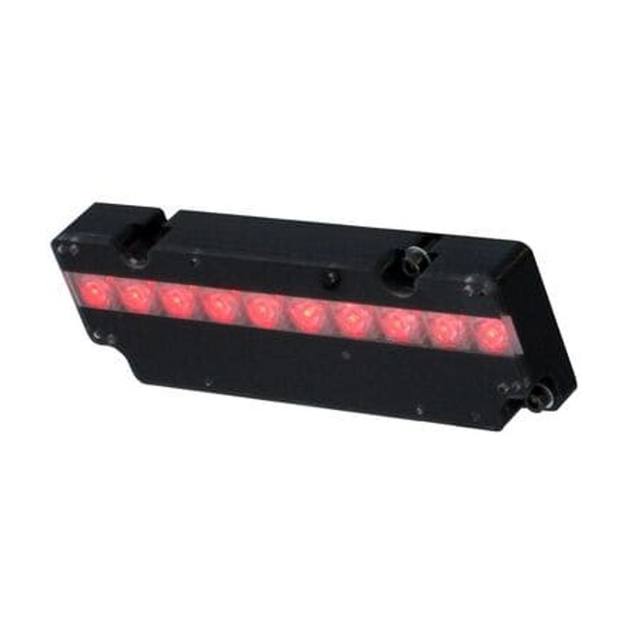
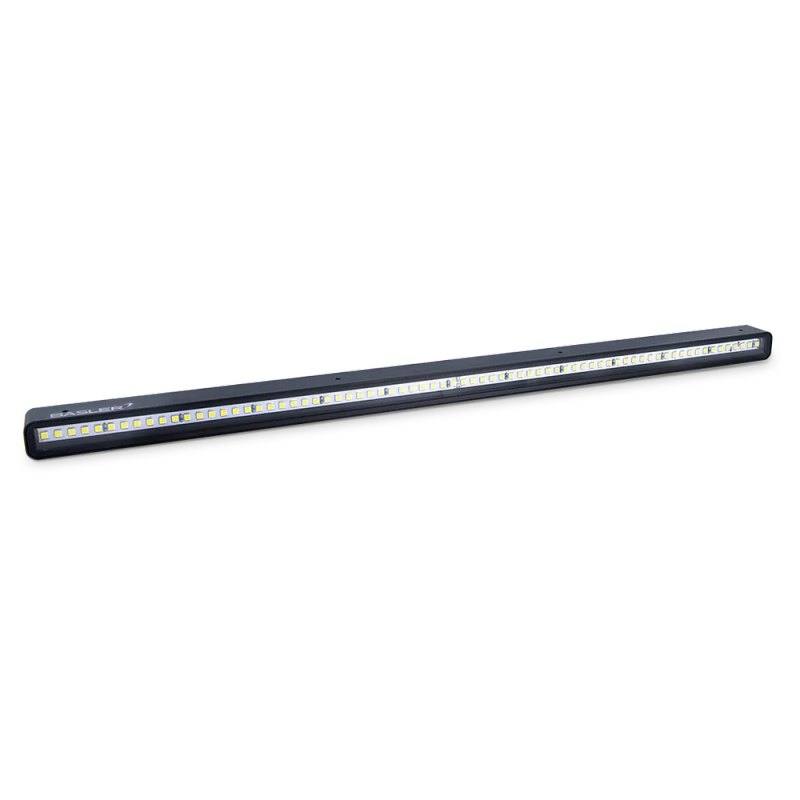
The Basler Standard Light Bar-10x300-x is a versatile narrow bar light with a 10 mm x 300 mm illuminated surface housed in a black anodized aluminum enclosure with PMMA light cover. It operates at 24 VDC and consumes 8 W in continuous mode, with strobe capability at up to 1800 mA peak current (10% duty cycle, 5 ms pulses). The light works standalone in voltage-controlled mode or with a Basler SLP controller in current-controlled mode, supporting both continuous and triggered operation. Four color variants cover the visible and near-infrared spectrum: White (5000 K), Red (625 nm), Blue (465 nm), and IR (850 nm), with a working distance range of 10 to 250 mm and IP54 protection as standard.
Brand
Basler
Lighting type
Bar
Color / wavelength
White (5000 K) / Red (625 nm) / Blue (465 nm) / IR (850 nm)
Available wavelengths
White (5000 K), Red (625 nm), Blue (465 nm), IR (850 nm)
Mode
Continuous and strobe/triggered
Working distance
10–250 mm
Controller required
No (standalone 24 VDC voltage-controlled; optional Basler SLP controller for current-controlled mode)
IP rating
IP54 (IP67 available)
Illuminated area
10 mm × 300 mm
Emission angle
Narrow / direct
Color temperature
5000 K (White variant)
Power consumption
8 W (continuous); Red/White/Blue 450 mA, IR 600 mA
The Basler Standard Light Bar-10x300-x is a narrow-format direct-emission bar light measuring 10 mm × 300 mm across its illuminated surface, housed in a compact 18 mm × 310 mm × 20 mm black anodized aluminum body with a PMMA diffuser cover. Four wavelength variants address the full range of machine vision contrast requirements: White at 5000 K for general-purpose broadband illumination, Red at 625 nm for suppressing background color noise and enhancing red-channel contrast, Blue at 465 nm for revealing surface texture and increasing sensitivity on blue-absorbing materials, and IR at 850 nm for seeing through packaging films, ambient-light rejection, and invisible-light triggering. The narrow 10 mm illuminated width and direct/narrow emission angle make this light well suited to brightfield line-scan setups, tight-clearance conveyor gaps, and dark-field grazing arrangements where a wide-area flood would introduce unwanted scatter. Working distance range is specified at 10 to 250 mm, covering both close-proximity label and surface inspection and moderate stand-off distances for packaging or web inspection.
Power delivery is straightforward: the light runs standalone on any stable 24 VDC ±5% supply at 8 W continuous — 450 mA for White, Red, and Blue variants; 600 mA for IR — requiring nothing beyond a 4-pin M8 connector. For applications demanding strobe mode — typically line-scan cameras with external trigger, high-speed area-scan cameras, or any setup where continuous-on heat accumulation is a concern — the light accepts up to 1800 mA peak at a 10% duty cycle with 5 ms maximum pulse width, delivering substantially higher instantaneous luminance than the continuous-mode rating for the same average power dissipation. The Basler SLP controller unlocks current-controlled operation, which removes the dependency on supply-voltage regulation accuracy and makes light output repeatable across fixtures and over time as LEDs age. At 230 g and with an M8 industrial connector as the sole external interface, mechanical integration is minimal: the aluminum housing provides a straightforward mounting surface and a standard cable is sufficient to commission the unit.
IP54 protection (splash and dust resistant) is the default rating, suitable for most clean-room and light industrial environments; an IP67 variant is available for wash-down or high-humidity installations such as food and beverage lines. The operating temperature range of 10–30 °C (extendable to 45 °C with adequate heat dissipation) means thermal management is a design consideration in enclosed enclosures or during extended continuous operation. Installers pairing this bar with area-scan cameras should orient the long axis of the light parallel to the conveyor travel direction for even illumination across the full width of the field of view, or perpendicular for directional dark-field that enhances edges and raised features. For line-scan camera integrations, the 300 mm length often covers the full sensor footprint at moderate working distances, while strobe synchronization to an encoder pulse keeps motion blur within acceptable limits at high line rates.
Best for
Line-scan camera web or conveyor inspection where the 300 mm bar length matches the sensor's illuminated swath and strobe sync to encoder pulses controls motion blur at high line rates.
Directional dark-field surface inspection of metals, printed labels, or molded parts where the narrow 10 mm width and direct emission angle produce high-contrast shadowing of scratches, embossing, and micro-texture at 10–250 mm working distance.
Packaging and label printing inspection using the White (5000 K) or Red (625 nm) variant for OCR/OCV and code reading tasks where broad spectral output or color-selective contrast is needed on a compact illuminated footprint.
Near-infrared imaging through translucent packaging films or for ambient-light-immune triggering using the IR 850 nm variant, taking advantage of the camera sensor's high IR sensitivity relative to the human eye.
Electronics and PCB traceability tasks — reading 2D DataMatrix or QR codes on dark substrates — where the Blue 465 nm variant improves contrast by absorbing energy in ink and solder mask, increasing symbol edge definition.
Selection notes
Wavelength selection drives contrast: choose Blue (465 nm) for dark ink or solder-mask-on-PCB applications where absorption is high; Red (625 nm) for red-channel separation on multicolor labels or suppressing green ambient; IR (850 nm) for film-penetration or ambient rejection; White (5000 K) when a single light must serve multiple product colors or when downstream image processing requires broadband information.
Strobe mode (up to 1800 mA peak, 10% duty cycle, 5 ms max pulse) delivers substantially higher instantaneous luminance than the continuous-mode rating of 450 mA (White/Red/Blue) or 600 mA (IR) — use it with triggered line-scan or high-speed area-scan cameras to freeze motion and raise signal-to-noise without increasing average thermal load. Verify that your trigger controller or Basler SLP can source the peak current at the required line rate.
Standalone 24 VDC voltage-controlled operation is sufficient for most fixed-scene applications, but add the Basler SLP controller when output repeatability across multiple fixtures or long production runs matters — current-controlled mode eliminates supply-voltage ripple and LED Vf drift as error sources.
IP54 is adequate for clean or mildly contaminated environments; if coolant mist, wash-down cycles, or submersion risk exists, specify the IP67 variant explicitly — the two configurations share the same housing design so the switch does not require a mechanical redesign.
The 10–30 °C ambient operating range (45 °C with adequate heat dissipation) is narrower than some industrial environments. In enclosed enclosures or when running continuous-on at 8 W, verify that the aluminum housing can conduct heat to a sufficiently large mounting surface or add forced-air cooling; switching to strobe mode also substantially reduces average power dissipation.
Specifications: General
Brand
Basler
Lighting type
Bar
Specifications: Interface
Connection
M8 socket, male, 4-pin
Specifications: Optical
Color / wavelength
White (5000 K) / Red (625 nm) / Blue (465 nm) / IR (850 nm)
Available wavelengths
White (5000 K), Red (625 nm), Blue (465 nm), IR (850 nm)
Working distance
10–250 mm
Emission angle
Narrow / direct
Color temperature
5000 K (White variant)
Diffuser
PMMA light cover (diffuser)
Specifications: Electrical
Mode
Continuous and strobe/triggered
Controller required
No (standalone 24 VDC voltage-controlled; optional Basler SLP controller for current-controlled mode)
Power consumption
8 W (continuous); Red/White/Blue 450 mA, IR 600 mA
Supply voltage
24 VDC ±5%
Specifications: Environment
IP rating
IP54 (IP67 available)
Operating temperature
10–30 °C (up to 45 °C with adequate heat dissipation)
Specifications: Geometry
Illuminated area
10 mm × 300 mm
Specifications: Mechanical
Housing material
Black anodized aluminum housing with PMMA light cover
Dimensions
18 mm × 310 mm × 20 mm (H × W × D)
Weight
230 g
Applications this camera is commonly selected for. Open one to see the full recommended hardware and approach.
Get a first image quickly with the pylon Viewer, then move into the pylon SDK for your application. These cameras are GenICam/GenTL-compliant, so any compliant vision software can drive them as well.
Download and install the pylon Camera Software Suite for your OS from Basler. This provides the pylon Viewer, the GenTL transport-layer producers and the pylon SDK (C/C++/.NET/Python). On Windows the installer adds the needed drivers; on Linux follow the included setup notes for USB and network permissions.
2. Connect the camera and check the link
Cable the camera to its matching interface: GigE Vision to a GigE port (use a quality cable and, ideally, a dedicated NIC with jumbo frames enabled), USB3 Vision to a USB 3.x port with the supplied cable, or CoaXPress to the frame grabber. Provide power where required (PoE, USB bus power, or PoCXP). Open the pylon Viewer and confirm the camera appears in the device list; for GigE, make sure the camera and NIC are on the same subnet.
3. Grab a first image and set exposure, gain and pixel format
Select the camera in the pylon Viewer and start a continuous grab. Adjust exposure time and gain until the image is well exposed (avoid clipped highlights), set the pixel format (e.g. Mono8 or a Bayer/RGB format), and focus the lens. Use a test pattern if the lens or scene is not ready yet.
4. Configure triggering and acquisition
Decide between free-run and triggered acquisition. For synchronized capture, set the trigger source (software or a hardware line on the I/O connector), trigger mode and any debounce or exposure mode, then verify timing. Note the parameter names you change in the Viewer feature tree, as you will reuse them in code.
5. Move to the SDK or a GenICam-compliant library
Recreate your settings in code with the pylon SDK (C, C++, .NET or Python) to open the device, apply the same features and pull frames into your pipeline; pylon vTools and pylon AI can add processing blocks. Because the cameras are GenICam/GenTL standard, third-party vision libraries work too. Once the image stream is stable, you can route frames to a deep-learning inspection such as Rosepetal for automated defect detection.
Frequently asked questions
Yes. The light runs standalone in voltage-controlled mode from any 24 VDC ±5% supply via the M8 4-pin connector, drawing 450 mA (White/Red/Blue) or 600 mA (IR) at 8 W continuous. The Basler SLP controller is optional and adds current-controlled mode for improved output repeatability; it is not required for basic continuous or externally triggered operation.
The light accepts up to 1800 mA peak in strobe mode at a maximum 10% duty cycle with individual pulses no longer than 5 ms. At this peak current the light delivers substantially higher instantaneous luminance than its continuous-mode rating, which is useful for freezing motion on high-speed lines or increasing signal-to-noise on dark targets.
The Blue variant at 465 nm is typically the best choice for PCB traceability. Solder mask and many inks have high absorption in the blue band, increasing contrast between the code symbol and substrate. Red (625 nm) or IR (850 nm) may be preferable on specific substrates — always test with a sample board before committing to a wavelength.
The specified working distance range is 10 to 250 mm from the light cover surface. The 10 mm × 300 mm illuminated area refers to the light emitter geometry; actual spot size on the target expands with distance due to the direct/narrow emission angle. At very short distances the illumination footprint closely follows the 10 mm narrow dimension, producing high-intensity directional illumination suitable for dark-field setups.
IP54 provides splash and dust resistance adequate for many dry food and packaging environments. For lines with regular wet wash-down, condensation, or coolant exposure the IP67 variant is the appropriate choice. Both share the same housing design, so the upgrade is a drop-in mechanical substitution.