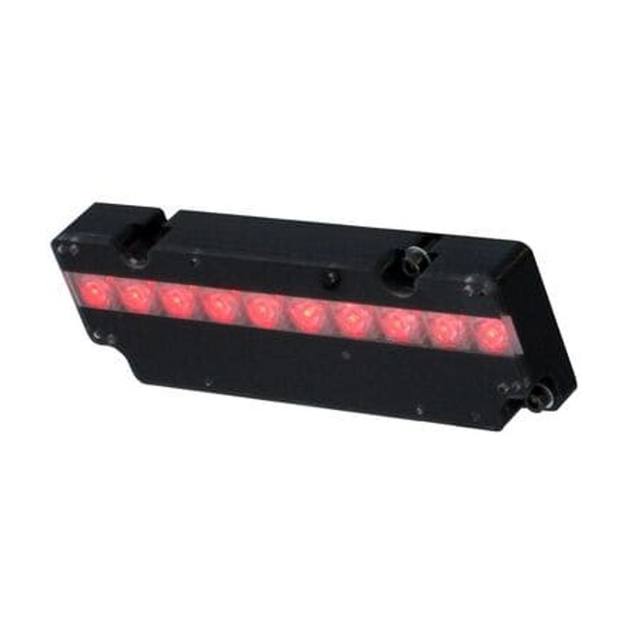
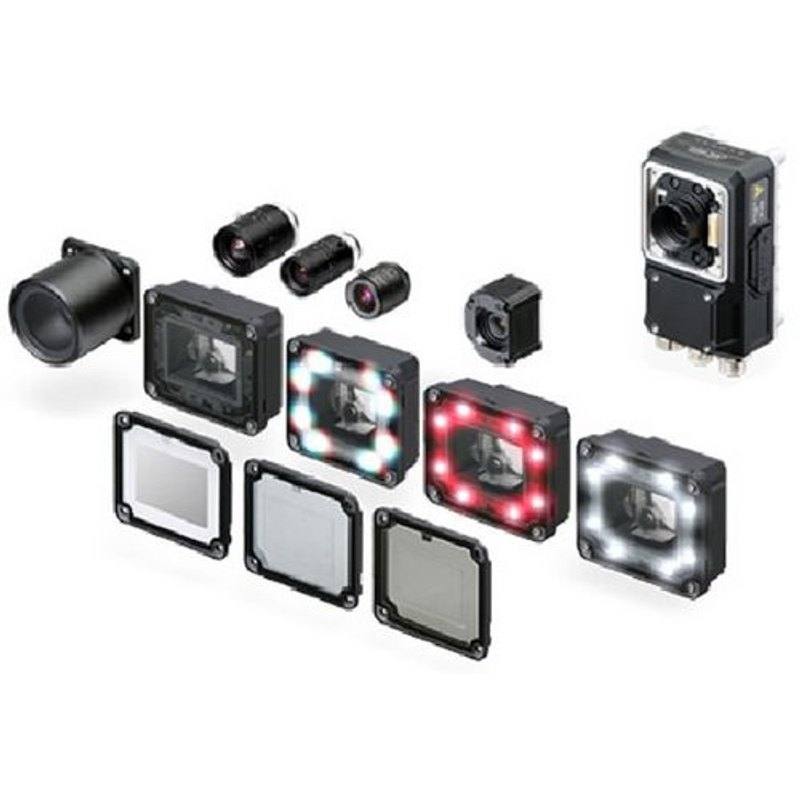
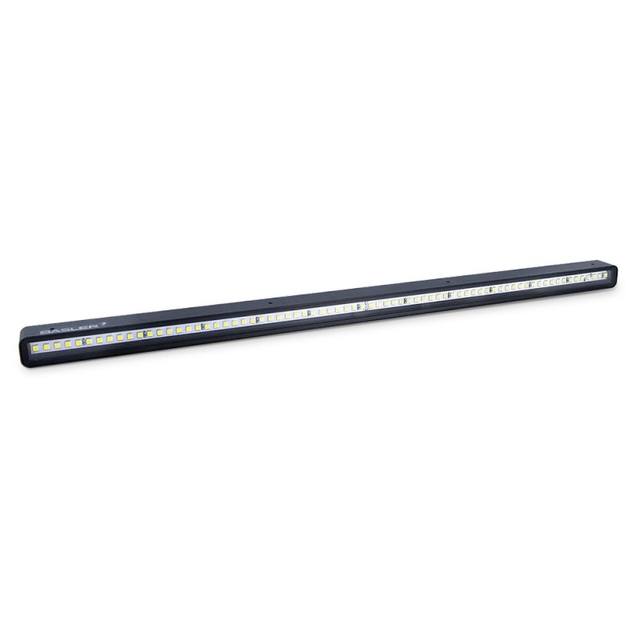
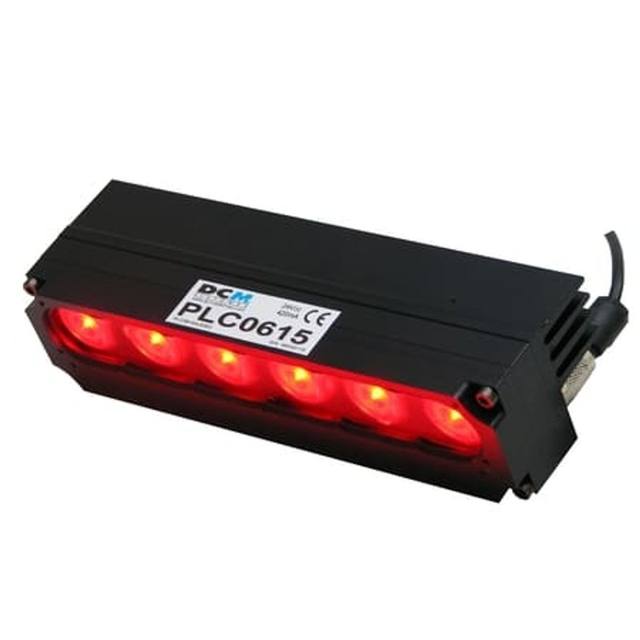
The FLV-BR14030 is a constant-current LED bar light in Omron's FLV Series, sized 140×30×19 mm with a 126×25 mm active emitting area. It is available in three wavelengths — white (broadband), red (typ. 635 nm), and blue (typ. 460 nm) — with power consumption of 6.1 W (W/B) or 4.8 W (R). The light must be driven by a dedicated Omron FLV lighting controller (FLV-TCC or FLV-ATC series), which supplies 24 VDC and provides trigger-pulse or continuous drive. An aluminum housing provides structural rigidity; an optional diffuser plate (FLV-BR14030DF) or polarizing plate (FLV-BR14030PL) can be mounted for application-specific illumination control.
Brand
Omron / Sentech
Lighting type
Bar light
Color / wavelength
White / Red (typ. 635 nm) / Blue (typ. 460 nm)
Available wavelengths
White; Red (typ. 635 nm); Blue (typ. 460 nm)
Mode
Continuous and trigger (strobe) via controller
Controller required
Yes — FLV-TCC4/TCC1/TCC3HB or FLV-ATC□1024
Supply voltage
24 VDC ±10 % (supplied via FLV-TCC or FLV-ATC controller)
The FLV-BR14030 is a compact constant-current LED bar light with a 140 × 30 × 19 mm aluminum-alloy body and a 126 × 25 mm active emitting surface. The elongated bar geometry makes it purpose-built for imaging narrow rectangular targets — label panels, connector rows, PCB edges, or film webs — where a square or ring light would either fall short of coverage or introduce unwanted oblique shadows at the extremities. The aluminum-alloy housing acts as a passive heat sink to stabilize LED output over time, and the 140 g mass makes it easy to position on most vision system mounting arms without vibration concerns. The 0.8 m integrated cable (3.5 mm diameter, 20 mm minimum bend radius) is terminated for the dedicated FLV controller, removing the need for a separate connector assembly step on the line.
Three wavelength variants are offered from a single physical form factor: white (broadband), red (typ. 635 nm), and blue (typ. 460 nm). White is the all-purpose choice when color discrimination or maximum raw contrast is the goal. Red at 635 nm is the practical workhorse for monochrome cameras: it sits at or near the peak quantum-efficiency window of silicon sensors, cuts through ambient yellow-white factory lighting, and suppresses green and blue surface noise — making it ideal for reading printed barcodes or DataMatrix codes, inspecting black-on-white labels, and detecting metallic surface scratches. Blue at 460 nm provides the shortest wavelength in this lineup and is best leveraged to accentuate fine topography on highly reflective or light-colored surfaces; it can also be combined with an optical bandpass filter on the camera to reject orange-red process light in foundry or soldering environments. Power draw is 6.1 W for white and blue variants, dropping to 4.8 W for red — modest figures that allow multiple bar lights to be powered from a single multi-channel FLV controller.
Drive and timing are entirely controller-managed: the light accepts 24 VDC supplied by a compatible FLV-TCC (TCC4, TCC1, TCC3HB) or FLV-ATC series controller, and operates in either continuous or trigger-pulse (strobe) mode depending on the controller configuration. Strobe mode is the preferred setup in high-speed line applications because the controller's pulse logic synchronizes the flash precisely with the camera's exposure window, enabling significantly higher peak brightness than the steady-state continuous-mode power ratings would imply — which in turn supports shorter exposure times and freeze-motion sharpness. The IP20 rating makes the FLV-BR14030 appropriate for clean-room electronics or pharmaceutical environments but unsuitable for direct washdown or heavy particulate exposure. Two clip-on accessories address special surface conditions: the FLV-BR14030DF diffuser plate homogenizes the output for even illumination across matte or low-contrast surfaces, while the FLV-BR14030PL polarizing plate, used together with a cross-polarizing filter on the lens, suppresses specular hotspots on glossy packaging film, lacquered components, or curved glass.
Best for
Reading 1D barcodes and 2D DataMatrix codes on label stock or directly marked parts using the red (635 nm) variant with a monochrome area-scan camera, where the wavelength contrast between the code and substrate boosts decode confidence.
Surface-defect inspection on PCBs, connector housings, or pressed-metal panels where the bar geometry provides directional, grazing-angle-style illumination along one axis to reveal scratches, dents, or missing features.
OCR and OCV on pharmaceutical blister packs, food packaging labels, or electronic component markings, combining the white or blue variant with a diffuser plate for shadow-free, even illumination across the entire print field.
Dimensional gauging of elongated parts — flat cable assemblies, SMD component strips, or stamped brackets — where the 126 × 25 mm emitting area uniformly back-lights or side-lights the part width without gradient falloff at the ends.
Packaging integrity checks (seal presence, cap orientation, label registration) on linear conveyor segments, using strobe mode via the FLV controller to freeze fast-moving targets and eliminate motion blur at production-line speeds.
Selection notes
Controller dependency is non-negotiable: the FLV-BR14030 has no standalone driver and cannot be powered directly from a 24 VDC rail. Verify that a compatible FLV-TCC4, FLV-TCC1, FLV-TCC3HB, or FLV-ATC 1024 controller is included in the bill of materials before ordering; channel count on the controller limits how many bar lights can run in a synchronized multi-light setup.
Wavelength selection should be driven by the sensor type and target contrast: red (635 nm) pairs best with monochrome cameras for code reading and surface inspection; blue (460 nm) offers finer topographic contrast on pale or reflective surfaces and enables bandpass-filter rejection of process light; white is the correct choice when a color camera is used or when hue-based defect discrimination is required.
The IP20 enclosure rating means the light is protected only against solid objects larger than 12.5 mm — it is not sealed against dust ingress or any moisture. In environments with coolant mist, cutting fluid aerosol, or regular cleaning spray, a protective enclosure or IP67-rated alternative should be considered instead.
The 126 × 25 mm emitting surface covers a fixed lateral span. If the field of view of the inspection area exceeds approximately 130 mm in the long axis, consider tiling two FLV-BR14030 units end-to-end or selecting a longer bar variant; the slight gap between emitting surfaces may produce a brightness valley at the join that disrupts uniformity-critical measurements.
When specular suppression on glossy targets is required, budget for both the FLV-BR14030PL polarizing plate (accessory, separate order) and a matched cross-polarizing filter on the lens — neither piece alone achieves the effect. The diffuser plate (FLV-BR14030DF) is a lower-cost option when the goal is simply to soften harsh LED point-source artifacts on matte surfaces, not to eliminate reflections.
Specifications: General
Brand
Omron / Sentech
Lighting type
Bar light
Specifications: Interface
Connection
Dedicated cable, 3.5 mm dia., 0.8 m length, min. bend radius 20 mm
Specifications: Optical
Color / wavelength
White / Red (typ. 635 nm) / Blue (typ. 460 nm)
Available wavelengths
White; Red (typ. 635 nm); Blue (typ. 460 nm)
Diffuser
No (optional diffuser plate FLV-BR14030DF available)
Specifications: Electrical
Mode
Continuous and trigger (strobe) via controller
Controller required
Yes — FLV-TCC4/TCC1/TCC3HB or FLV-ATC□1024
Supply voltage
24 VDC ±10 % (supplied via FLV-TCC or FLV-ATC controller)
Power consumption
6.1 W (White/Blue); 4.8 W (Red)
Specifications: Environment
IP rating
IP20 (IEC 60529)
Operating temperature
Operating: 0 to +50 °C; Storage: −15 to +60 °C
Specifications: Geometry
Illuminated area
126×25 mm (emitting surface)
Specifications: Mechanical
Dimensions
140 mm (L) × 30 mm (W) × 19 mm (H)
Weight
approx. 140 g
Housing material
Aluminum alloy
Applications this camera is commonly selected for. Open one to see the full recommended hardware and approach.
These steps take an Omron Sentech (STC) camera from the box to a stable first image and on to your own application. They apply across the GigE Vision, USB3 Vision and CoaXPress STC families; the interface only changes how you cable and power the camera.
Download and install the Sentech SDK on the host PC. The package provides StViewer, the viewing and configuration software you use to bring the camera up, and StApi, the programming SDK you integrate later. Because the cameras are GenICam/GenTL-compliant, StApi also registers a GenTL producer, so any GenICam-compliant third-party vision software can discover and drive the camera as an alternative front end.
2. Cable, power and connect the camera
Connect according to the interface. GigE Vision: link to a Gigabit NIC (use PoE or the separate power input) and put the camera and host on the same subnet; for USB3 Vision use a USB 3.x port and a certified cable; for CoaXPress (STC) connect to a CoaXPress frame grabber, which also supplies Power-over-Coax. Then open StViewer and let it enumerate the camera. If a GigE camera does not appear, check the IP configuration and firewall, and on USB3 confirm the host bandwidth and driver.
3. Configure exposure, gain and white balance
Open the device in StViewer and start a live stream. Set exposure and gain for a well-exposed, low-noise image: raise exposure first and only add gain when more light or a faster shutter is not an option, keeping exposure short enough to freeze motion on global-shutter models. On colour cameras, run white balance under your actual production lighting. Adjust the lens aperture and focus on a representative target before tuning anything else.
4. Set the trigger and grab a first image
Start in free-run (continuous) acquisition to confirm a clean, stable image. For inline inspection switch to hardware or software triggering: select the trigger source, set the active edge and any delay, and wire the strobe or illumination to the camera's I/O so lighting fires with each exposure. Acquire and save a frame in StViewer; this saved image is your reference for the SDK stage and for downstream inspection.
5. Move to the StApi SDK (or any GenICam software)
Once the image is stable, reproduce the same settings in code. Use StApi to open the device, apply the GenICam features you validated in StViewer (exposure, gain, trigger, pixel format) and grab frames into your application via the bundled C++, C, C#/.NET or Python interfaces; the included samples are the fastest starting point. Prefer a different stack? The same GenICam/GenTL camera works with third-party vision libraries. With a reliable feed, you can route it into a deep-learning inspection such as Rosepetal for AI-based defect detection.
Frequently asked questions
No. The light is designed exclusively for use with Omron FLV-series controllers (FLV-TCC4, FLV-TCC1, FLV-TCC3HB, or FLV-ATC 1024). The controller supplies the regulated 24 VDC, manages constant-current drive, and provides the trigger-pulse or continuous mode switching. Connecting the light directly to an unregulated 24 V rail bypasses the current regulation and would likely damage the LEDs.
The red variant (typ. 635 nm) is the strongest choice here. The 635 nm wavelength maximizes contrast between the etched or printed code marks and the surrounding metal surface under a monochrome camera, and it is near the peak sensitivity of most silicon CMOS and CCD sensors. Blue (460 nm) is a secondary option if the anodized finish has a residual orange or red tint that would reduce red-light contrast.
Neither accessory is included; both are ordered separately. The diffuser plate (FLV-BR14030DF) clips onto the emitting surface to spread and homogenize the LED output, reducing bright-spot artifacts on matte or textured targets. The polarizing plate (FLV-BR14030PL) is used together with a cross-polarizing filter fitted to the camera lens to cancel specular reflections on glossy, lacquered, or curved surfaces — a technique commonly used in packaging film and glass inspection.
The light is rated IP20, which provides no protection against dust ingress or moisture. It can be used in clean, dry pharmaceutical or electronics environments where there is no risk of splashing, condensation, or cleaning-spray contact. For food-and-beverage lines where washdown or high humidity is present, a higher-ingress-protection alternative or a sealed protective housing around the light would be required.
Strobe mode, triggered via the FLV controller, allows the controller to drive the LEDs at a higher peak current for the duration of each short pulse than is permitted under continuous steady-state operation (6.1 W for white/blue, 4.8 W for red). This means effective scene illuminance during the exposure window can substantially exceed continuous-mode levels, supporting shorter camera exposure times — which reduces motion blur on fast-moving parts — without thermally stressing the LEDs over time.