
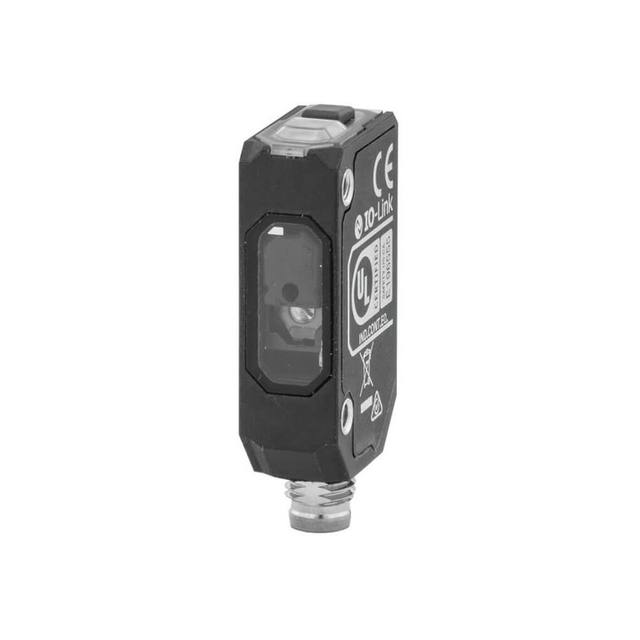
Omron / SentechOmron / Sentech E3AS-F1000I TOF Laser Distance-Settable Photoelectric SensorE3AS-F1000I
- Recommended by AIS Vision
On request
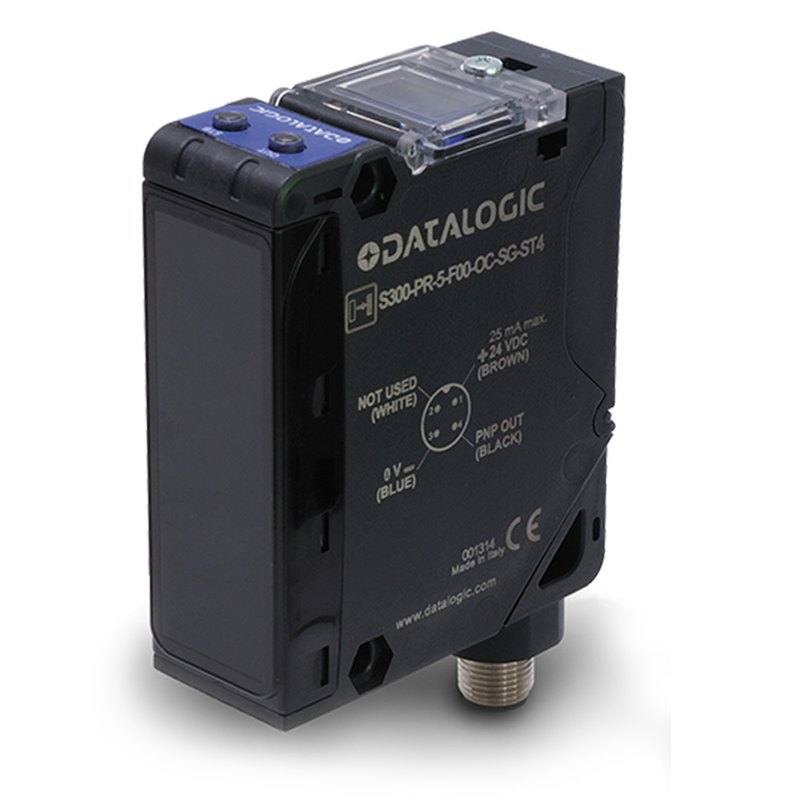
S300 series
The S300 is a cubic "maxi" photoelectric sensor family from Datalogic offered as the standard S300-PA and heavy-duty S300-PR ranges, both housed in IP67 PBT fiberglass-reinforced plastic with a PMMA optical head and a defogging function for outdoor and harsh environments. Optical functions cover through-beam up to 60 m, polarized retroreflective up to about 22 m, diffuse proximity up to 5 m and background suppression, using red-LED or infrared-LED emission. DC models (code "2") provide selectable NPN/PNP dark/light open-collector output at 12-30 Vdc with 1 ms response and 500 Hz switching; multivoltage models (code "1") provide a relay SPDT output at 24-240 Vac / 24-60 Vdc with ~20-25 ms response. All models include dual independent timing functions (ON-delay, OFF-delay, ONE-SHOT) and operate from -40 to +55 C.
The S300 is a "maxi" cubic photoelectric sensor from Datalogic, supplied in two ranges that share the same 25 x 100 x 70 mm body: the standard S300-PA and the heavy-duty S300-PR. As a photoelectric device its job is to detect the presence, absence or position of an object by interrupting or reflecting a light beam, then drive a downstream signal. The family covers the four classic optical functions, so the version you order defines the geometry: through-beam (separate emitter and receiver) reaches up to 60 m, polarized retroreflective (sensor plus a reflector) reaches about 22 m, diffuse proximity (target acts as the reflector) works up to 5 m, and a background-suppression version detects within a fixed window while ignoring whatever sits behind it. Emission is red LED on the retroreflective version and 940 nm infrared LED on the through-beam and diffuse versions. For an installer this means range and the surface/finish of the target drive the choice: long conveyor gaps and dirty environments favor through-beam at distance; a clean fixed reflector position favors polarized retroreflective; and where you can only mount on one side and the target is close, diffuse or background-suppression is the route.
| Brand | Datalogic / Datasensing |
|---|---|
| Sensor type | Photoelectric (maxi cubic) |
| Range / distance | Up to 60 m through-beam (≈22 m polarized retro, up to 5 m diffuse proximity) |
|---|---|
| Response time | 1 ms (DC NPN/PNP models); ~20-25 ms (AC/DC relay models) |
| Switching frequency | 500 Hz (DC models); 25 Hz (AC/DC relay models) |
| Connection | Terminal block or M12 connector (version-dependent) |
|---|
| Supply voltage | 12-30 Vdc (code 2) or 24-240 Vac / 24-60 Vdc multivoltage (code 1) |
|---|
| Operating temperature | S300-PR: -40...+55 C (storage -40...+70 C); S300-PA: -25...+55 C (storage -25...+70 C) |
|---|---|
| IP rating | IP67 |
| Sensing method | Through-beam, polarized retroreflective, diffuse, background suppression (version-dependent) |
|---|---|
| Light source | Red LED (retroreflective) / Infrared LED 940 nm (through-beam & diffuse) |
| Output type | Selectable NPN/PNP open collector, dark/light (code 2) or relay SPDT (code 1) |
|---|
| Housing material | PBT 30% glass-fiber-reinforced housing; frontal window and lens in PC (polycarbonate) |
|---|---|
| Dimensions | 25 x 100 x 70 mm (same for both S300-PA and S300-PR per catalogue) |
A practical guide to selecting discrete sensors that trigger cameras, index parts and gate inspection on a vision station. Covers sensing principle, range, target, PNP/NPN/IO-Link outputs, response time and IP rating, plus wiring the trigger to the camera.
A practical guide to the core photoelectric sensing principles, through-beam, retroreflective, diffuse and background suppression, covering range, reliability, target and surface dependence, light source choice, output options and how to pick the right one for your application.
A practical guide to laser displacement and distance sensors: how triangulation, confocal and time-of-flight measure distance, height and profile, how resolution trades against range and target reflectivity, and when a dedicated measurement sensor beats a vision system.
AIS Vision · Integration
AIS Vision defines and tests the optimal combination of camera, optics and lighting for your application before you buy.