
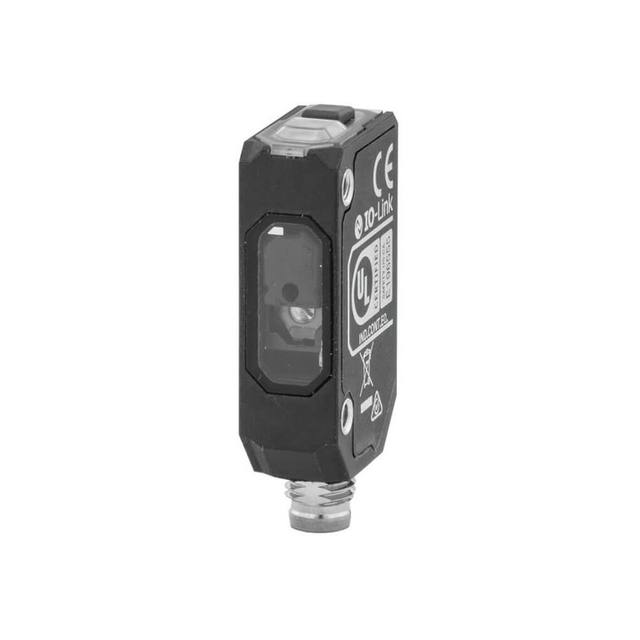
Omron / SentechOmron / Sentech E3AS-F1000I TOF Laser Distance-Settable Photoelectric SensorE3AS-F1000I
- Recommended by AIS Vision
On request
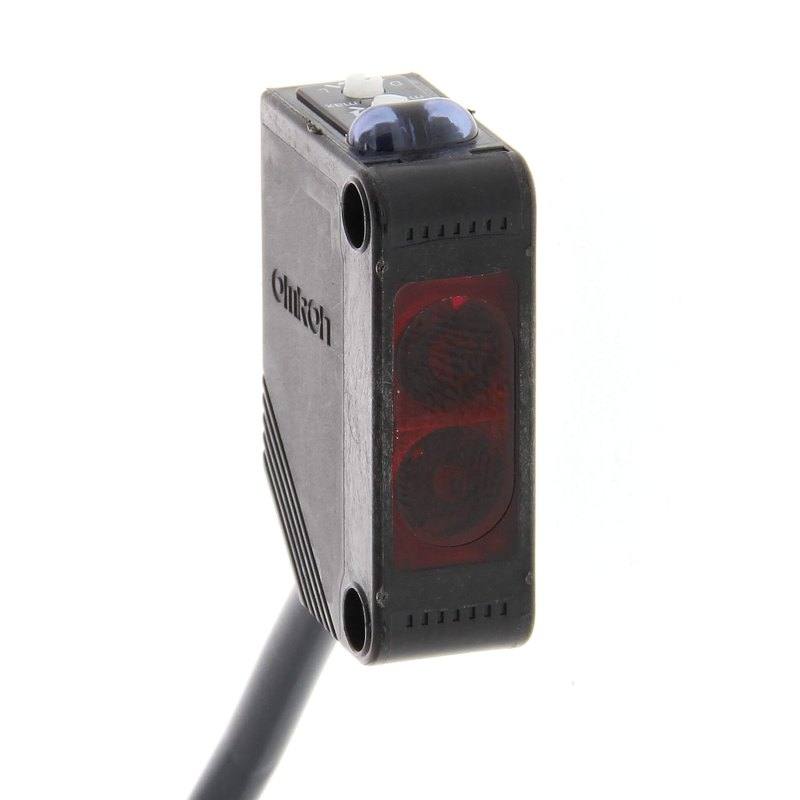
E3Z-B
The Omron E3Z-B is a compact retroreflective photoelectric sensor (without MSR function, using an E39-R1S reflector) that employs Omron's "Inner View" optical system with a 680 nm red LED to detect a wide range of transparent round PET bottles (from 500 ml to 2 l). It is offered in 500 mm and 2 m sensing-distance variants with selectable NPN or PNP open-collector output (100 mA max., L-ON/D-ON selectable) and a 1 ms max. response time. The sensor runs on 12-24 VDC with 30 mA max. consumption, is housed in a PBT case with a methacrylate-resin lens rated IP67, and ships in pre-wired (2 m / 0.5 m cable) or M8 connector versions. It includes reverse-polarity, output short-circuit and mutual-interference protection as standard.
The Omron E3Z-B is a retroreflective photoelectric sensor built around a specific, hard problem: catching clear and PET bottles that conventional through-beam or diffuse sensors tend to see straight through. Its 680 nm red LED works in concert with Omron's "Inner View" optical system and an E39-R1S reflector mounted opposite the sensor head, so the emitter and receiver share one side of the line. In practice that means light leaves the sensor, bounces off the reflector, and returns; a transparent bottle entering the gap perturbs that return enough to trip the output even though the container is largely translucent. The unit ships in 500 mm and 2 m sensing-distance variants (80 mm and 100 mm minimums respectively), which sets the practical width of the detection window across a conveyor or filler infeed.
| Brand | Omron / Sentech |
|---|---|
| Sensor type | Photoelectric (with built-in amplifier) |
| Range / distance | 500 mm (80 mm min.) or 2 m (100 mm min.) depending on model, with E39-R1S reflector |
|---|---|
| Response time | 1 ms max. (operate or reset) |
| Communication | Discrete switching output (open-collector NPN/PNP) |
|---|---|
| Connection | Pre-wired cable (2 m or 0.5 m) or M8 connector, depending on model |
| Supply voltage | 12 to 24 VDC ±10% including 10% (p-p) max. ripple |
|---|
| Operating temperature | Operating: -25 to 55 °C; Storage: -40 to 70 °C (no icing or condensation) |
|---|---|
| IP rating | IP67 (IEC 60529) |
| Sensing method | Retroreflective (without MSR function, uses E39-R1S reflector) |
|---|---|
| Light source | Red LED (680 nm) |
| Output type | npn_or_pnp (model-dependent: NPN = E3Z-B6x, PNP = E3Z-B8x) |
|---|
| Housing material | Case: PBT (polybutylene terephthalate); Lens: methacrylate resin |
|---|---|
| Dimensions | Compact rectangular housing (approx. 10.8 W x 31 H x 20 D mm body) |
| Weight | Approx. 65 g (pre-wired models) / approx. 20 g (connector models), packed state |
A practical guide to selecting discrete sensors that trigger cameras, index parts and gate inspection on a vision station. Covers sensing principle, range, target, PNP/NPN/IO-Link outputs, response time and IP rating, plus wiring the trigger to the camera.
A practical guide to the core photoelectric sensing principles, through-beam, retroreflective, diffuse and background suppression, covering range, reliability, target and surface dependence, light source choice, output options and how to pick the right one for your application.
A field checklist to de-risk a machine vision project before you buy hardware: define defects and tolerances, collect representative samples, prove the imaging, budget resolution and field of view, lock motion and triggers, then run a structured proof of concept against measurable acceptance criteria.
AIS Vision · Integration
AIS Vision defines and tests the optimal combination of camera, optics and lighting for your application before you buy.