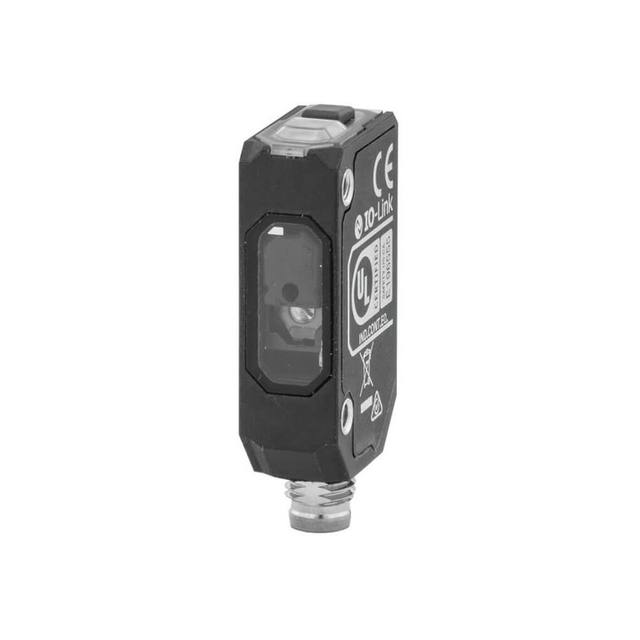
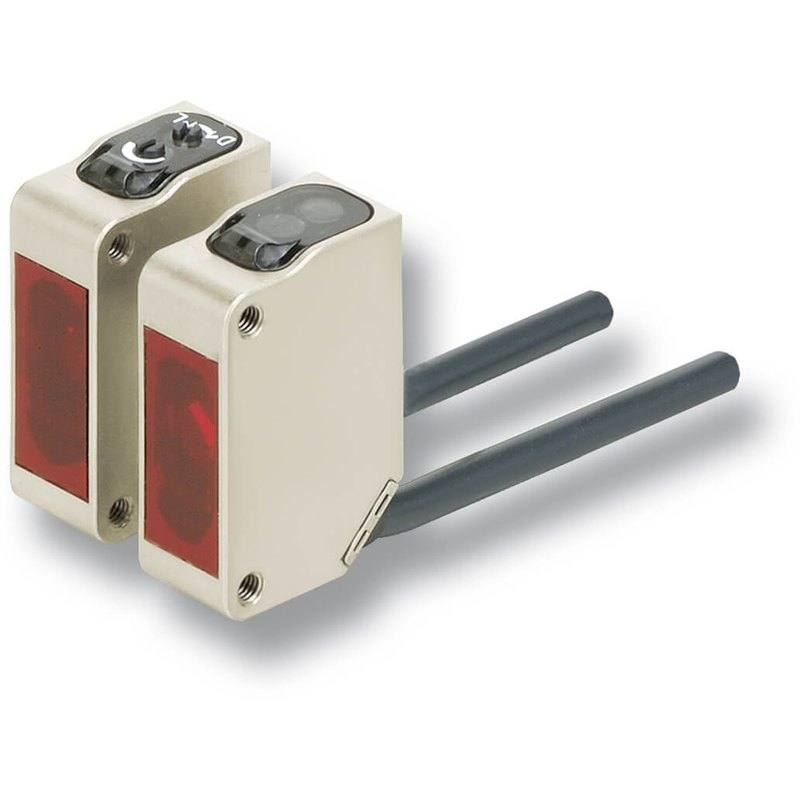
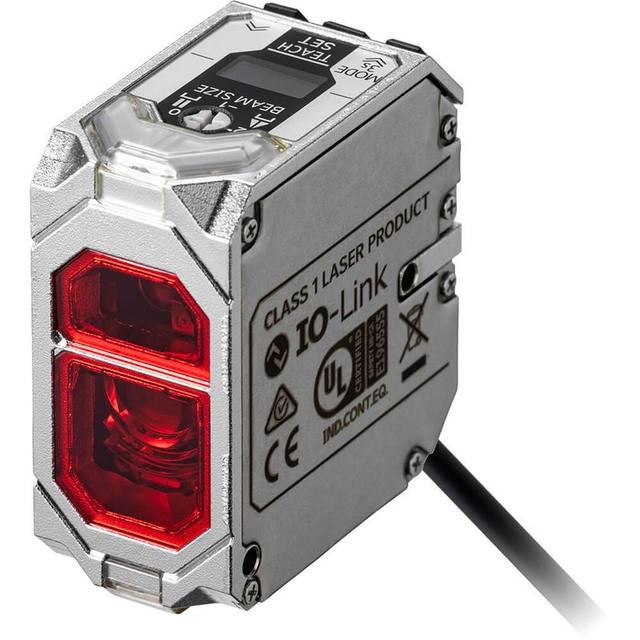
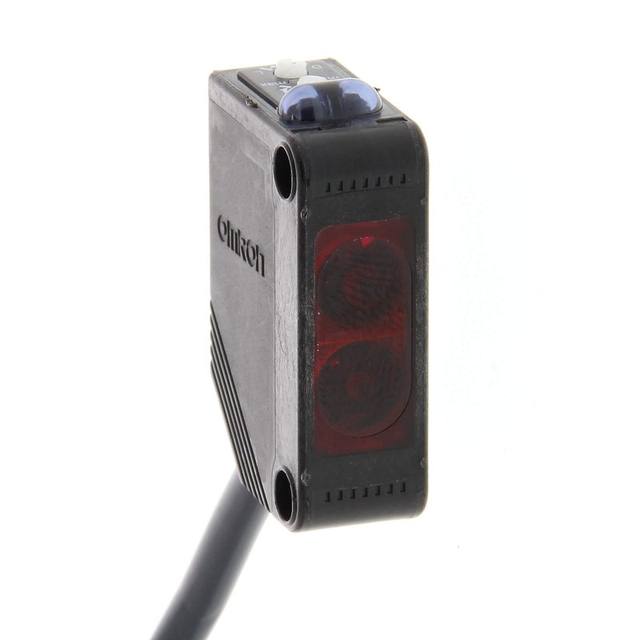
The Omron E3ZM-T is a through-beam photoelectric sensor consisting of a separate emitter and receiver in a rugged SUS316L stainless-steel cuboid housing rated IP67 and IP69K (DIN 40050-9) for high-temperature, high-pressure washdown. It uses an 870 nm infrared LED light source, offering a 15 m sensing range on the standard models (E3ZM-T61/T81 pre-wired, E3ZM-T66/T86 M8 connector) or 0.8 m on the slit models (E3ZM-T63/T83, E3ZM-T68/T88) that detect opaque objects down to 2 mm diameter. Output is an open-collector NPN (T6x) or PNP (T8x) transistor switch rated 30 VDC / 100 mA with selectable Light-ON/Dark-ON, a response time of 1 ms max and 10-30 VDC supply. The sensor is Ecolab-tested for detergent resistance and operates from -25 to 55 degC.
Brand
Omron / Sentech
Sensor type
Photoelectric sensor
Sensing method
Through-beam
Light source
Infrared LED (870 nm)
Range / distance
15 m (standard models); 0.8 m on slit models
Response time
1 ms max. (operate or reset)
Output type
Open-collector PNP (T8x) or NPN (T6x), 30 VDC / 100 mA max
Supply voltage
10 to 30 VDC (incl. 10% ripple p-p)
Connection
Pre-wired 2 m cable or standard M8 4-pin connector
The Omron E3ZM-T is a through-beam photoelectric sensor, which means it ships as a separate emitter and receiver pair that you mount facing each other across the path you want to monitor. The emitter projects an 870 nm infrared LED beam straight to the receiver, and the sensor switches whenever an object breaks that beam. Because detection depends on the target interrupting the beam rather than reflecting it, this is the most reliable and longest-range of the photoelectric principles: the standard models (E3ZM-T61/T81 pre-wired, E3ZM-T66/T86 with M8 connector) cover up to 15 m, and surface color, gloss, or finish of the target are largely irrelevant. There is no retroreflector to keep clean and no dependence on the target's reflectivity, so as a beam-break trigger it is about as deterministic as a photoelectric sensor gets.
Electrically it behaves as a simple open-collector switch sized for direct PLC interfacing. The T8x part numbers give a PNP output and the T6x part numbers give NPN, both rated 30 VDC / 100 mA max, with selectable Light-ON / Dark-ON so you choose whether the output asserts on clear beam or on blocked beam. Supply is 10 to 30 VDC, and the 1 ms max response time (operate or reset) sets the practical edge timing: at line speed a 1 ms response means the trigger position drifts by roughly one millisecond of conveyor travel, which is the number to plug into your camera trigger or reject-actuator delay budget. Wiring is either a 2 m pre-wired pigtail (approx. 150 g) or a standard M8 4-pin connector (approx. 60 g), so it drops onto the same M8 cordsets and quick-disconnects already common on a food line.
The defining feature is the housing. The case is SUS316L stainless steel with a methacrylic resin lens, rated IEC IP67 and DIN 40050-9 IP69K, Ecolab-tested for detergent resistance, and rated for -25 to 55 degC operation (-40 to 70 degC storage). That combination is specified for high-pressure, high-temperature washdown lines in food, beverage and pharmaceutical plants, where the sensor sees caustic CIP/sanitation chemistry and steam directly. The compact 10.8 x 32.2 x 21 mm body fits tight guarding and framing. The slit variants (E3ZM-T63/T83, E3ZM-T68/T88) trade range for precision, covering 0.8 m but resolving opaque objects down to 2 mm in diameter, which is what you want for small-part presence, edge or gap detection rather than long-gap zone monitoring.
Best for
Beam-break presence detection and product counting on washdown food, beverage and pharmaceutical conveyors where the sensor is sprayed with high-pressure, high-temperature CIP chemistry (IP69K, SUS316L, Ecolab-tested)
Generating a hardware trigger for a vision camera or strobe as products pass a fixed point, using the 1 ms response and selectable Light-ON/Dark-ON output
Long-gap zone monitoring up to 15 m with the standard models, e.g. detecting any object crossing a wide conveyor or access opening regardless of target color or finish
Small-part and edge detection down to 2 mm diameter using the slit models (0.8 m range) for caps, tablets, or thin-part presence
Reject confirmation and jam/blockage detection in packaging and logistics sortation where a clean opaque break of the beam is the desired signal
Selection notes
Through-beam requires two mounting points and two cable runs (emitter and receiver) aligned across the gap; budget for both fixtures and for maintaining optical alignment over the full 15 m, where small angular drift matters most.
Pick output polarity by part number before ordering: T8x is PNP and T6x is NPN, both open-collector at 30 VDC / 100 mA max. Confirm it matches your PLC input card, and set Light-ON vs Dark-ON for the logic you need.
Choose range vs resolution at the model level: standard models give 15 m but the slit models cap at 0.8 m in exchange for resolving 2 mm opaque objects. You cannot have both long range and small-object resolution in one part.
Decide connection style up front: the pre-wired version is a fixed 2 m cable (approx. 150 g), while the M8 4-pin connector version (approx. 60 g) lets you use standard cordsets and swap the head without rewiring, which suits frequent washdown maintenance.
Verify the thermal envelope against your process: operating range is -25 to 55 degC. Direct steam or hot-surface proximity above 55 degC on the sensor body exceeds spec even though the IP69K rating covers the washdown pressure and temperature of the spray itself.
Specifications: General
Brand
Omron / Sentech
Sensor type
Photoelectric sensor
Specifications: Performance
Range / distance
15 m (standard models); 0.8 m on slit models
Response time
1 ms max. (operate or reset)
Specifications: Interface
Connection
Pre-wired 2 m cable or standard M8 4-pin connector
Specifications: Electrical
Supply voltage
10 to 30 VDC (incl. 10% ripple p-p)
Specifications: Environment
Operating temperature
Operating -25 to 55 degC; storage -40 to 70 degC
IP rating
IEC IP67, DIN 40050-9 IP69K
Specifications: Sensing
Sensing method
Through-beam
Light source
Infrared LED (870 nm)
Specifications: Output
Output type
Open-collector PNP (T8x) or NPN (T6x), 30 VDC / 100 mA max
These steps take an Omron Sentech (STC) camera from the box to a stable first image and on to your own application. They apply across the GigE Vision, USB3 Vision and CoaXPress STC families; the interface only changes how you cable and power the camera.
Download and install the Sentech SDK on the host PC. The package provides StViewer, the viewing and configuration software you use to bring the camera up, and StApi, the programming SDK you integrate later. Because the cameras are GenICam/GenTL-compliant, StApi also registers a GenTL producer, so any GenICam-compliant third-party vision software can discover and drive the camera as an alternative front end.
2. Cable, power and connect the camera
Connect according to the interface. GigE Vision: link to a Gigabit NIC (use PoE or the separate power input) and put the camera and host on the same subnet; for USB3 Vision use a USB 3.x port and a certified cable; for CoaXPress (STC) connect to a CoaXPress frame grabber, which also supplies Power-over-Coax. Then open StViewer and let it enumerate the camera. If a GigE camera does not appear, check the IP configuration and firewall, and on USB3 confirm the host bandwidth and driver.
3. Configure exposure, gain and white balance
Open the device in StViewer and start a live stream. Set exposure and gain for a well-exposed, low-noise image: raise exposure first and only add gain when more light or a faster shutter is not an option, keeping exposure short enough to freeze motion on global-shutter models. On colour cameras, run white balance under your actual production lighting. Adjust the lens aperture and focus on a representative target before tuning anything else.
4. Set the trigger and grab a first image
Start in free-run (continuous) acquisition to confirm a clean, stable image. For inline inspection switch to hardware or software triggering: select the trigger source, set the active edge and any delay, and wire the strobe or illumination to the camera's I/O so lighting fires with each exposure. Acquire and save a frame in StViewer; this saved image is your reference for the SDK stage and for downstream inspection.
5. Move to the StApi SDK (or any GenICam software)
Once the image is stable, reproduce the same settings in code. Use StApi to open the device, apply the GenICam features you validated in StViewer (exposure, gain, trigger, pixel format) and grab frames into your application via the bundled C++, C, C#/.NET or Python interfaces; the included samples are the fastest starting point. Prefer a different stack? The same GenICam/GenTL camera works with third-party vision libraries. With a reliable feed, you can route it into a deep-learning inspection such as Rosepetal for AI-based defect detection.
Frequently asked questions
The standard models (E3ZM-T61/T81 pre-wired and E3ZM-T66/T86 M8 connector) sense up to 15 m. The slit models (E3ZM-T63/T83, E3ZM-T68/T88) are limited to 0.8 m but resolve opaque objects down to 2 mm in diameter.
Yes. The housing is SUS316L stainless steel with a methacrylic resin lens, rated IEC IP67 and DIN 40050-9 IP69K for high-pressure, high-temperature washdown, and it is Ecolab-tested for detergent resistance. It operates from -25 to 55 degC.
Both are available by part number: T8x models provide an open-collector PNP output and T6x models provide NPN, each rated 30 VDC / 100 mA max with selectable Light-ON / Dark-ON operation.
Response time is 1 ms max for both operate and reset, fast enough to act as a beam-break trigger for a vision camera or strobe. Account for that 1 ms in your trigger-position and reject-delay timing at line speed.
Supply is 10 to 30 VDC (including 10% ripple p-p). Connection is either a 2 m pre-wired cable (approx. 150 g) or a standard M8 4-pin connector (approx. 60 g) that accepts common M8 cordsets.