Skip to content
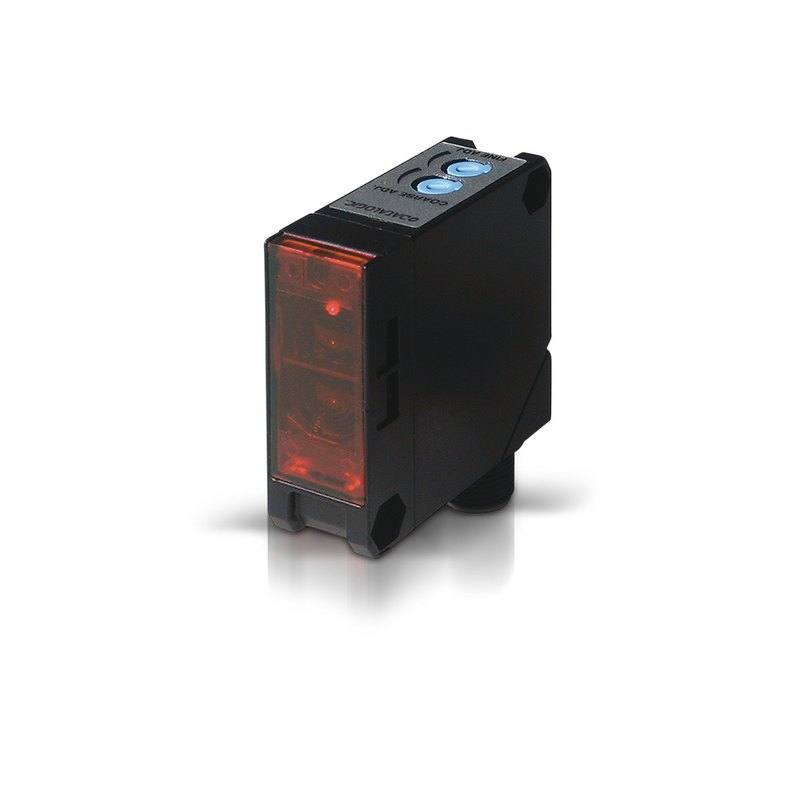
Datalogic / Datasensing S6 series machine vision sensor
  • Recommended by AIS Vision

Datasensing S6 Series Compact Photoelectric Sensor

S6 series

The S6 is a universal compact 50x50 mm (18x50x50) cubic photoelectric sensor family using an infrared LED source with trimmer adjustment. Operating distance depends on the model: 2 m diffuse proximity, 25/50 cm background suppression, 5 m polarized retroreflex, 1 m retroreflex for transparent objects, and 20 m through-beam. Multivoltage (24-240 VAC) versions provide a relay SPDT output with cable connection (e.g. S6-1-C200: 30 ms response, 16 Hz), while 10-30 Vdc versions provide selectable NPN/PNP transistor output with cable or M12 4-pole connection (e.g. S6-5-C200: 1 ms response, 500 Hz). The housing is ABS with PMMA optics, rated IP65 and -25 to +55 C; the series is listed by datasensing.com as legacy/phase-out.

Brand
Datalogic / Datasensing
Sensor type
Photoelectric sensor
Sensing method
Diffuse (series also offers retroreflective, polarized retroreflective, background suppression and through-beam variants)
Light source
Infrared LED with trimmer adjustment
Range / distance
2 m nominal (diffuse C200); series range up to 20 m through-beam
Response time
1 ms (10-30 Vdc transistor versions); 30 ms (multivoltage relay versions)
Switching frequency
500 Hz (transistor versions); 16 Hz (relay versions)
Output type
NPN/PNP transistor, L/D selectable (10-30 Vdc versions); relay SPDT 3 A (24-240 VAC versions)
Supply voltage
10-30 Vdc (transistor versions) or 24-240 VAC (multivoltage relay versions)
Connection
M12 4-pole connector or 2 m cable
Housing material
ABS housing, PMMA optical front
Dimensions
18 x 50 x 50 mm (compact cubic)

Technical overview

The S6 is a compact 50x50 mm cubic photoelectric sensor family (18 x 50 x 50 mm body) built around an infrared LED source with a trimmer for sensitivity adjustment. In a machine-vision cell it is not an imager but a detection element: it tells the rest of the system when an object is present. The sensing principle and reach depend on the variant you order. The diffuse C200 model used as the reference here detects an object directly off its own returned light at up to 2 m, while the wider family spans 25/50 cm background-suppression, 5 m polarized retroreflex, 1 m retroreflex tuned for transparent objects, and 20 m through-beam. That spread means one mechanical footprint and mounting pattern can cover everything from short-range part presence to long through-beam gating across a conveyor.

Output and speed split cleanly into two electrical worlds, and choosing the right one is the main design decision. The 10-30 Vdc transistor versions give a selectable NPN/PNP output with light/dark switching, a 1 ms response time and 500 Hz switching frequency, available on a 2 m cable or an M12 4-pole connector. That speed is what makes this part usable as a real production trigger: at 1 ms it can flag a package edge or a part entering the field of view fast enough to fire a camera strobe or start an inspection cycle on a moving line. The multivoltage 24-240 VAC versions instead provide a relay SPDT output (cable connection, around 30 ms response and 16 Hz), which suits direct switching of contactors, valves or legacy AC control logic where raw speed is not the concern.

Mechanically and environmentally the S6 is a general-purpose plant-floor sensor rather than a washdown or hot-zone device. The housing is ABS with a PMMA optical front, rated IP65 and specified for -25 C to +55 C without freezing. IP65 covers dust and low-pressure water jets, which is appropriate for packaging and dry logistics areas but stops short of the IP67/IP69K sealing you would want for high-pressure food washdown. For a vision installer, the practical role is clear: wire a transistor S6 as the trigger source feeding the camera's external trigger input (or a controller PLC input), set the trimmer so the part reliably switches without false triggers from background, and let the camera handle the imaging while the S6 handles presence and timing. Note the series is listed by datasensing.com as legacy/phase-out, so it belongs on existing or short-horizon designs rather than new long-lifecycle platforms.

Best for

  • Hardware trigger for a machine-vision camera on a moving conveyor: the 10-30 Vdc transistor version's 1 ms response and 500 Hz switching fire image capture as each part or package enters the field of view
  • Package and product presence detection in packaging lines, using the 2 m diffuse variant to confirm an item is in position before an inspection or fill step
  • Logistics and parcel sortation gating, where the 20 m through-beam variant of the family spans a wide conveyor to detect packages crossing a divert point
  • Transparent-object detection (clear film, PET bottles, glass) using the 1 m retroreflex variant tuned for transparent targets
  • Direct switching of AC loads such as valves, contactors or stack lights via the 24-240 VAC multivoltage relay SPDT version where high speed is not required

Selection notes

  • Pick the electrical family first: the 10-30 Vdc transistor version (1 ms, 500 Hz, NPN/PNP selectable) is the one to use as a camera trigger or fast PLC input; the 24-240 VAC relay version (30 ms, 16 Hz, SPDT) is for direct AC load switching and is too slow for line-rate triggering
  • Match the sensing variant to the target rather than assuming diffuse: diffuse C200 reaches 2 m off the object itself, but background suppression (25/50 cm), polarized retroreflex (5 m), transparent-object retroreflex (1 m) and through-beam (20 m) each solve a different geometry and reflectivity problem within the same housing
  • Confirm IP65 is sufficient for the environment: the ABS body with PMMA optics handles dust and water jets for packaging and dry logistics, but it is not rated for high-pressure or submersion washdown, and the -25 to +55 C (no freezing) window rules out hot ovens or deep-freeze zones
  • Plan wiring around the available connection options: choose the M12 4-pole connector for serviceable, quick-disconnect installs or the fixed 2 m cable for cost-sensitive permanent mounts, and use the L/D selection plus the IR-LED trimmer to set reliable switching without false triggers
  • Treat lifecycle as a constraint: datasensing.com lists the S6 as legacy/phase-out, so design it into existing platforms and spares rather than new long-life machines where a current-generation sensor would be the safer specification

Specifications: General
BrandDatalogic / Datasensing
Sensor typePhotoelectric sensor

Specifications: Performance
Range / distance2 m nominal (diffuse C200); series range up to 20 m through-beam
Response time1 ms (10-30 Vdc transistor versions); 30 ms (multivoltage relay versions)
Switching frequency500 Hz (transistor versions); 16 Hz (relay versions)

Specifications: Interface
ConnectionM12 4-pole connector or 2 m cable

Specifications: Electrical
Supply voltage10-30 Vdc (transistor versions) or 24-240 VAC (multivoltage relay versions)

Specifications: Environment
Operating temperature-25 C to +55 C (without freezing)
IP ratingIP65

Specifications: Sensing
Sensing methodDiffuse (series also offers retroreflective, polarized retroreflective, background suppression and through-beam variants)
Light sourceInfrared LED with trimmer adjustment

Specifications: Output
Output typeNPN/PNP transistor, L/D selectable (10-30 Vdc versions); relay SPDT 3 A (24-240 VAC versions)

Specifications: Mechanical
Housing materialABS housing, PMMA optical front
Dimensions18 x 50 x 50 mm (compact cubic)

Frequently asked questions

Related technical guides

AIS Vision · Integration

We validate camera + lens + lighting

AIS Vision defines and tests the optimal combination of camera, optics and lighting for your application before you buy.