Skip to content
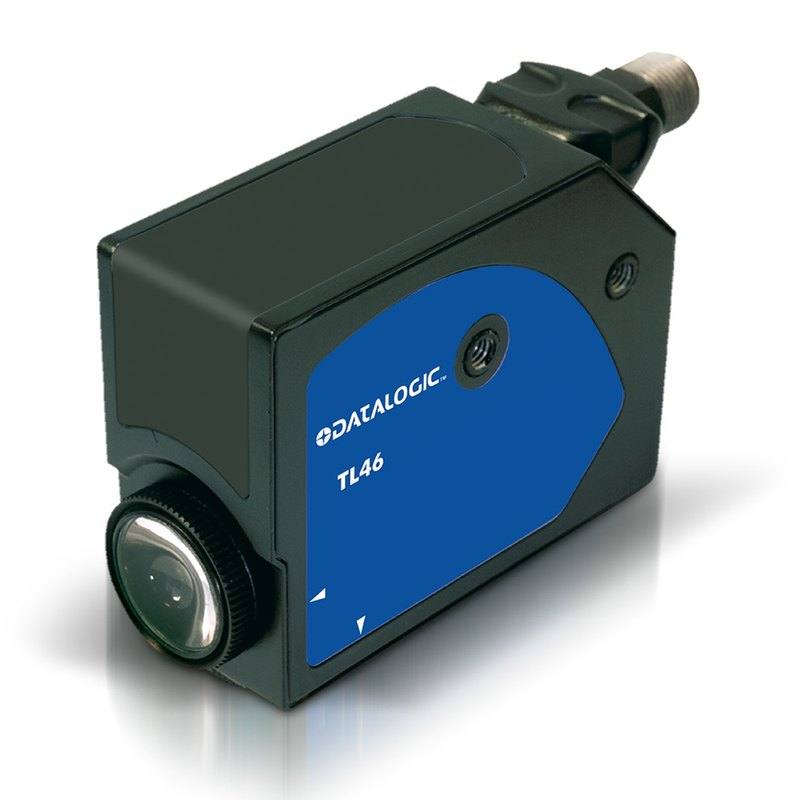
Datalogic / Datasensing TL46 contrast sensor family machine vision sensor
  • Recommended by AIS Vision

TL46 Contrast Sensor Family

TL46 contrast sensor family

The TL46 family comprises seven model tiers — basic (TL46-W), standard with bargraph (TL46-WL), enhanced with 4-digit display (TL46-WLF), color-contrast mode (TL46-WE), low-jitter (TL46-WJ), IO-Link base (TL46-W…PZ), ultra-fast IO-Link (TL46-WH…PZ), and trimmer-adjusted axial-optic (TL46-A) — all sharing a 32 × 60 × 82 mm aluminium/glass housing with M12 five-position rotatable connector, 10–30 VDC supply, and IP67 protection. Optical emission uses wide-spectrum RGB LEDs (blue 465 nm / green 520 nm / red 630 nm) for W-series models, and white or red LEDs for A-series; the standard 9 mm lens produces a 1.5 × 5 mm spot at a 9 ± 3 mm nominal sensing distance. Outputs span PNP, NPN, push-pull, 0–5 V analog (A/W/WL), and IO-Link V1.1.2 (WH…PZ, W…PZ variants), with switching frequencies of 10–70 kHz and jitter ranging from 50 µs (color mode) down to 3 µs (TL46-WH…PZ). Approved to CE and cULus; rated for −10 °C to +55 °C operation.

Brand
Datalogic / Datasensing
Sensor type
Contrast / color registration-mark sensor
Sensing method
Diffuse (registration mark detection)
Light source
RGB LED (blue 465 nm / green 520 nm / red 630 nm) for W-series; white LED 400–700 nm or red LED 630 nm for A-series
Range / distance
9 ± 3 mm nominal sensing distance (standard 9 mm lens)
Response time
6 µs – 100 µs depending on model (TL46-WH…PZ: 6 µs; TL46-W: 33 µs; TL46-A/WL: 25 µs; TL46-WLF/WE contrast: 16 µs; TL46-WE color: 100 µs)
Switching frequency
10 kHz (TL46-WE color) / 15 kHz (TL46-W) / 20 kHz (TL46-A/WL) / 25 kHz (TL46-W…PZ) / 30 kHz (TL46-WLF/WE contrast) / 50 kHz (TL46-WJ) / 70 kHz (TL46-WH…PZ)
Output type
PNP, NPN, or push-pull (PP); 0–5 V analog output on A/W/WL models; IO-Link V1.1.2 on WH…PZ and W…PZ
Communication
IO-Link V1.1.2 Smart sensor profile double-channel I/O (TL46-WH…PZ, TL46-W…PZ)
Supply voltage
10–30 VDC (ripple ≤ 2 Vpp)
Connection
M12 5-pole connector, rotatable to 5 positions
Housing material
Aluminium body; PMMA lens (TL46-A, TL46-W basic) or glass lens (TL46-W-815G, WL, WLF, WJ, WE)

Technical overview

The TL46 family operates on a diffuse reflection principle using wide-spectrum RGB LEDs — blue at 465 nm, green at 520 nm, and red at 630 nm — to differentiate printed registration marks from substrate backgrounds. That three-channel illumination is the core of the sensor's versatility: by independently evaluating reflected intensity across the visible spectrum, the W-series models can resolve colour contrast between marks and backgrounds that would be indistinguishable to a monochrome sensor. The A-series uses white LED (400–700 nm) or red LED (630 nm) illumination instead. The standard 9 mm lens delivers a 1.5 × 5 mm elongated spot at a 9 ± 3 mm nominal sensing distance, which is intentionally small and well-defined so the spot stays within the bounds of a typical registration mark even at high web speeds. The aluminium body carries a PMMA lens on the basic TL46-W and TL46-A variants, and a glass lens on the TL46-W-815G, WL, WLF, WJ, and WE variants. The W/WL/WLF/WE/WJ/WH series measures 32 × 60 × 82 mm; the axial-optic TL46-A measures 31 × 81 × 58 mm. All variants weigh no more than 170 g and carry an IP67 rating, making them straightforward to mount close to the web without concern for ink mist, wash-down splashes, or ambient contamination.

Switching frequency is the headline differentiator across the seven model tiers. The entry TL46-W tops out at 15 kHz (33 µs response), the bargraph TL46-WL and axial TL46-A at 20 kHz (25 µs), the enhanced display TL46-WLF and the contrast mode of the TL46-WE at 30 kHz (16 µs response), while the IO-Link base TL46-W…PZ reaches 25 kHz. The dedicated low-jitter TL46-WJ pushes to 50 kHz, and the ultra-fast IO-Link TL46-WH…PZ reaches 70 kHz with a 6 µs response time and jitter as low as 3 µs. To translate those numbers for a press or packaging line installer: at 70 kHz the sensor can fire, settle, and deliver a valid output edge roughly 70,000 times per second — sufficient to gate a servo or cutter at web speeds well above several hundred metres per minute without missing a mark. Jitter of 3 µs bounds the positional uncertainty of that trigger edge to sub-millimetre values even at high belt velocities, which matters when downstream cutting, printing, or labelling must register precisely to a prior impression.

Output wiring spans PNP, NPN, and push-pull discrete signals plus a 0–5 V analog output on A, W, and WL variants for applications that want a proportional contrast signal rather than a switched edge. The IO-Link V1.1.2 interface on the WH…PZ and W…PZ variants allows the host PLC or IO-Link master to read process values, adjust thresholds, and capture diagnostic data over the same M12 five-pole cable used for power and switching — eliminating a separate teach-pendant visit when a job change requires a new threshold. The M12 connector rotates to five positions, a practical detail that reduces cable-bend stress when the sensor is mounted at an awkward angle in a compact machine frame. Supply voltage accepts 10–30 VDC with ripple up to 2 Vpp, covering both 12 V and 24 V panel architectures without a separate regulator. The operating range of −10 °C to +55 °C and CE plus cULus approvals cover the vast majority of production and cold-room packaging environments.

Best for

  • High-speed printing and press registration: detecting printed colour or contrast marks on flexible packaging, labels, cartons, or paper webs where switching frequencies of 30–70 kHz are needed to keep pace with high web speeds.
  • Pharmaceutical blister and label positioning: triggering blister-sealing, foil cutting, or label applicator heads in registration with pre-printed artwork on film or lidding material, where jitter as low as 3 µs (TL46-WH…PZ) supports cut-position repeatability.
  • Food and beverage flexible packaging: mark detection on PE, PP, or aluminium foil substrates in environments subject to washdown, where IP67 protection and colour-contrast discrimination prevent false triggers from film print noise or moisture.
  • Label and ticket converting: register control on die-cutters, slitters, and rewinders processing multi-colour labels, where the RGB LED illumination separates a registration mark colour from an adjacent background colour that would fool a single-wavelength sensor.
  • Automotive trim and tape dispensing: detecting orientation marks or colour-coded features on rolled material entering an assembly station, using the 0–5 V analog output (available on A, W, and WL variants) for proportional position correction rather than a simple switched edge.

Selection notes

  • Choose the model tier by required switching frequency: if the application runs above 30 kHz, only the TL46-WJ (50 kHz) or TL46-WH…PZ (70 kHz) qualify; the display-equipped TL46-WLF caps at 30 kHz and the basic TL46-W at 15 kHz, so fitting a lower-tier model to a fast press to save cost will produce missed marks.
  • Specify glass-lens variants (TL46-W-815G, WL, WLF, WJ, WE) for applications involving solvents, ink mist, or regular cleaning agents — the PMMA lens on the basic TL46-W and TL46-A is less chemically resistant and will haze over time in those environments.
  • Use the IO-Link variants (W…PZ for 25 kHz, WH…PZ for 70 kHz) whenever the machine requires remote threshold adjustment during job changes without sending a technician to the sensor; IO-Link V1.1.2 also exposes process data and diagnostics to the PLC, which is valuable in OEE monitoring setups.
  • The 9 ± 3 mm nominal sensing distance is fixed by the standard 9 mm lens — confirm the mechanical design positions the sensor face at 6–12 mm from the web surface before committing to a mounting bracket design.
  • For colour-contrast applications (mark colour differs from background colour rather than just being darker or lighter), select the TL46-WE model in colour mode — but note that colour mode operates at 10 kHz with a 100 µs response time, substantially slower than the monochrome contrast mode at 30 kHz; verify the slower speed is acceptable for the web speed before specifying it.

Specifications: General
BrandDatalogic / Datasensing
Sensor typeContrast / color registration-mark sensor

Specifications: Performance
Range / distance9 ± 3 mm nominal sensing distance (standard 9 mm lens)
Response time6 µs – 100 µs depending on model (TL46-WH…PZ: 6 µs; TL46-W: 33 µs; TL46-A/WL: 25 µs; TL46-WLF/WE contrast: 16 µs; TL46-WE color: 100 µs)
Switching frequency10 kHz (TL46-WE color) / 15 kHz (TL46-W) / 20 kHz (TL46-A/WL) / 25 kHz (TL46-W…PZ) / 30 kHz (TL46-WLF/WE contrast) / 50 kHz (TL46-WJ) / 70 kHz (TL46-WH…PZ)

Specifications: Interface
CommunicationIO-Link V1.1.2 Smart sensor profile double-channel I/O (TL46-WH…PZ, TL46-W…PZ)
ConnectionM12 5-pole connector, rotatable to 5 positions

Specifications: Electrical
Supply voltage10–30 VDC (ripple ≤ 2 Vpp)

Specifications: Environment
Operating temperature−10 °C to +55 °C
IP ratingIP67

Specifications: Sensing
Sensing methodDiffuse (registration mark detection)
Light sourceRGB LED (blue 465 nm / green 520 nm / red 630 nm) for W-series; white LED 400–700 nm or red LED 630 nm for A-series

Specifications: Output
Output typePNP, NPN, or push-pull (PP); 0–5 V analog output on A/W/WL models; IO-Link V1.1.2 on WH…PZ and W…PZ

Specifications: Mechanical
Housing materialAluminium body; PMMA lens (TL46-A, TL46-W basic) or glass lens (TL46-W-815G, WL, WLF, WJ, WE)
Dimensions32 × 60 × 82 mm (W/WL/WLF/WE/WJ/WH…PZ); 31 × 81 × 58 mm (TL46-A)
Weight170 g max.

Frequently asked questions

Related technical guides

AIS Vision · Integration

We validate camera + lens + lighting

AIS Vision defines and tests the optimal combination of camera, optics and lighting for your application before you buy.