Omron / Sentech E3S-DC Color Mark Photoelectric Sensor (IO-Link COM2)
E3S-DCP21-IL2
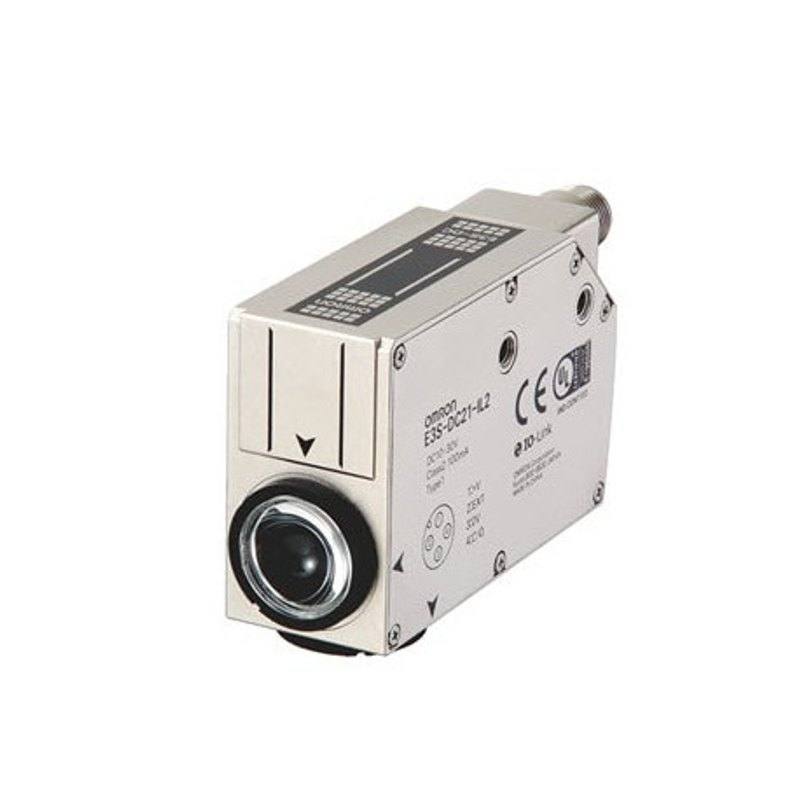
The E3S-DCP21-IL2 is a high-performance color mark detection sensor using a three-element RGB LED (635 nm red, 525 nm green, 465 nm blue) to detect subtle color differences on packaging and registration marks. It delivers a 50 µs response time in 2-point teaching mode with a 1×4 mm spot size at a 10±3 mm sensing distance. The sensor supports IO-Link V1.1 at COM2 (38.4 kbps) for RGB data transmission to the host and provides bank switching across up to 9 stored threshold memories. The housing is diecast zinc (nickel-plated brass), rated IP67, and connects via an M12 4-pin connector.
Brand
Omron / Sentech
Sensor type
Contrast/Color Mark Sensor
Sensing method
Diffuse-reflective (mark detection)
Light source
Red LED (635 nm), Green LED (525 nm), Blue LED (465 nm) — RGB triple
Range / distance
10 ±3 mm (white paper 10×10 mm)
Response time
50 µs max (2-point teaching mode); 150 µs max (1-point teaching mode)
The E3S-DCP21-IL2 is a diffuse-reflective color mark sensor built around a three-channel RGB LED emitter — 635 nm red, 525 nm green, and 465 nm blue — that illuminates a 1x4 mm spot at a tightly controlled 10 ±3 mm sensing distance. By sampling all three wavelength channels simultaneously, the sensor resolves color differences that would be invisible to a single-wavelength photoelectric sensor, making it capable of reliably distinguishing registration marks, colored labels, or ink-printed patterns that differ only in hue or saturation rather than reflectivity. The 50 µs maximum response time in 2-point teaching mode means a target moving at high conveyor speed crosses the spot and triggers an output well within the timing budget of most PLC-controlled reject or registration systems.
Two teaching modes trade response time against tolerance: the faster 2-point mode (50 µs) stores the color at two reference positions and interpolates a threshold, while 1-point mode (150 µs) teaches from a single sample — useful when only one color variant is available during setup. Up to nine threshold memories can be stored and switched via bank switching inputs, which allows a single installed sensor to handle multiple product SKUs or label colorways on the same line without re-teaching. The push-pull output is electrically NPN/PNP selectable, so the sensor wires directly into either sink-input or source-input PLC modules without external conversion. The M12 4-pin connector conforms to the IO-Link V1.1 COM2 standard at 38.4 kbps, enabling the host IO-Link master to read live RGB intensity data from all three channels — not just the switched binary output — which is invaluable for remote threshold diagnostics and predictive maintenance before a color shift causes false rejects.
The housing is diecast zinc (nickel-plated brass) and carries an IP67 rating per IEC 60529, making it suitable for washdown-adjacent environments in food-beverage and pharmaceutical packaging where water jets or humidity are routine. Operating temperature is -10 to 55°C, covering most indoor factory environments. At 320 g and 80.4 × 53.7 × 56 mm, the sensor is a fixed-mount, mid-body form factor rather than a miniature slot sensor, so mounting bracket selection and beam clearance on narrow web or small product pitches should be factored into mechanical design. The 10–30 VDC supply range accommodates both 12 V and 24 V DC panel designs without special regulators.
Best for
Printed packaging registration: detecting color-printed registration marks on flexible packaging film or folded cartons where the mark color differs subtly from the substrate, using the RGB triple-LED spot at 10 mm standoff.
Label presence and color verification on bottling or filling lines where multiple SKUs share the same line and bank switching across up to 9 stored memories allows rapid changeover without re-teaching.
Printing and converting web control where the 50 µs response time at 2-point teaching is fast enough for high-speed web registration triggers at web speeds common in label printing and converting.
Logistics sortation gates where IO-Link live RGB data is fed to a SCADA or line controller to monitor color-channel signal margins and flag gradual sensor contamination before misreads occur.
Automotive or electronics sub-assembly marking verification where colored adhesive, sealant bead, or component color must be confirmed present and correct in a compact inspection cell with a 24 V PLC architecture.
Selection notes
Sensing distance is fixed at 10 ±3 mm — this is not an adjustable background-suppression sensor, so the mounting bracket must place the sensing face within 7–13 mm of the target surface. Designing for the nominal 10 mm with mechanical adjustment range to cover the ±3 mm tolerance is strongly recommended.
The 1×4 mm spot size governs the minimum detectable mark width; marks smaller than roughly 1 mm in the short axis may produce ambiguous readings, and the mark must be fully within the spot during the response window, which constrains maximum target speed for a given mark size.
IO-Link COM2 at 38.4 kbps requires a compatible IO-Link V1.1 master port; standard digital input modules will only see the binary switched output. To exploit live RGB data for threshold monitoring or remote parameter setting, the master must be specified at the panel design stage.
Bank switching (up to 9 stored memories) is accessed via the sensor's input wiring — confirm the number of available PLC output channels and the switching logic before relying on more than two or three banks, as each active bank requires a dedicated control signal.
The diecast zinc body and IP67 rating make the sensor suitable for damp or lightly washdown environments, but the PMMA lens should be protected from abrasive cleaning agents or high-pressure steam that can cloud the lens surface over time and shift the effective sensing distance.
Specifications: General
Brand
Omron / Sentech
Sensor type
Contrast/Color Mark Sensor
Specifications: Performance
Range / distance
10 ±3 mm (white paper 10×10 mm)
Response time
50 µs max (2-point teaching mode); 150 µs max (1-point teaching mode)
Specifications: Interface
Communication
IO-Link V1.1, COM2 (38.4 kbps)
Connection
M12, 4-pin connector
Specifications: Electrical
Supply voltage
10 to 30 VDC ±10% (ripple p-p 10% max.)
Power consumption
960 W
Specifications: Environment
Operating temperature
Operating: -10 to 55°C; Storage: -25 to 70°C
IP rating
IEC 60529 IP67
Specifications: Sensing
Sensing method
Diffuse-reflective (mark detection)
Light source
Red LED (635 nm), Green LED (525 nm), Blue LED (465 nm) — RGB triple
These steps take an Omron Sentech (STC) camera from the box to a stable first image and on to your own application. They apply across the GigE Vision, USB3 Vision and CoaXPress STC families; the interface only changes how you cable and power the camera.
Download and install the Sentech SDK on the host PC. The package provides StViewer, the viewing and configuration software you use to bring the camera up, and StApi, the programming SDK you integrate later. Because the cameras are GenICam/GenTL-compliant, StApi also registers a GenTL producer, so any GenICam-compliant third-party vision software can discover and drive the camera as an alternative front end.
2. Cable, power and connect the camera
Connect according to the interface. GigE Vision: link to a Gigabit NIC (use PoE or the separate power input) and put the camera and host on the same subnet; for USB3 Vision use a USB 3.x port and a certified cable; for CoaXPress (STC) connect to a CoaXPress frame grabber, which also supplies Power-over-Coax. Then open StViewer and let it enumerate the camera. If a GigE camera does not appear, check the IP configuration and firewall, and on USB3 confirm the host bandwidth and driver.
3. Configure exposure, gain and white balance
Open the device in StViewer and start a live stream. Set exposure and gain for a well-exposed, low-noise image: raise exposure first and only add gain when more light or a faster shutter is not an option, keeping exposure short enough to freeze motion on global-shutter models. On colour cameras, run white balance under your actual production lighting. Adjust the lens aperture and focus on a representative target before tuning anything else.
4. Set the trigger and grab a first image
Start in free-run (continuous) acquisition to confirm a clean, stable image. For inline inspection switch to hardware or software triggering: select the trigger source, set the active edge and any delay, and wire the strobe or illumination to the camera's I/O so lighting fires with each exposure. Acquire and save a frame in StViewer; this saved image is your reference for the SDK stage and for downstream inspection.
5. Move to the StApi SDK (or any GenICam software)
Once the image is stable, reproduce the same settings in code. Use StApi to open the device, apply the GenICam features you validated in StViewer (exposure, gain, trigger, pixel format) and grab frames into your application via the bundled C++, C, C#/.NET or Python interfaces; the included samples are the fastest starting point. Prefer a different stack? The same GenICam/GenTL camera works with third-party vision libraries. With a reliable feed, you can route it into a deep-learning inspection such as Rosepetal for AI-based defect detection.
Frequently asked questions
Yes — the RGB triple LED (635 nm red, 525 nm green, 465 nm blue) measures reflectance in three spectral bands simultaneously. Marks that appear similar to a human observer but have a measurable difference in any one color channel can be differentiated, provided the color difference produces enough signal margin between the two taught threshold points in 2-point teaching mode.
The sensor's response time is 50 µs in 2-point teaching mode. The maximum detectable speed depends on the mark length in the direction of travel: a 4 mm mark (matching the long axis of the 1×4 mm spot) would need to remain over the spot for at least 50 µs, which corresponds to a maximum speed of roughly 80 m/s — far above typical conveyor speeds. In practice the limiting factor is usually the mark size relative to the spot, not the response time.
Yes — the output is push-pull with NPN/PNP selectability, meaning the same sensor can sink current (NPN mode) or source current (PNP mode) depending on wiring configuration, without hardware substitution.
Over IO-Link V1.1 COM2 (38.4 kbps), the host master can read the live RGB intensity values from all three color channels, not just the binary switched output. This enables remote threshold diagnostics, parameter backup and restore, and condition monitoring — for example, detecting a gradual drop in signal margin due to lens contamination before the sensor begins producing false outputs.
The housing is diecast zinc (nickel-plated brass) rated IP67 per IEC 60529, which means it withstands temporary immersion up to 1 m for 30 minutes and is protected against water jets from any direction. It is not rated IP69K, so it is not certified for high-pressure hot washdown. The PMMA lens should also be protected from aggressive cleaning chemicals that can cause hazing.