DCM Sistemes ALB0804A Direct Ringlight (Red 630nm, iBlueDrive, Medium angle)
ALB0804A-630i/AM
The ALB0804A is a direct high-powered ringlight measuring 94.5x77x16.5 mm with a 40 mm inner diameter and a recommended working distance >50 mm; it weighs 120 g and is rated IP40. It is powered at 24VDC +/-8% through a 3-pole aerial connector (150 mm) and houses iBlueDrive technology, enabling continuous, strobe and overdrive operation. In the 630nm (red) iBlueDrive version the maximum instantaneous consumption is 720 mA, with a powered rating of 12W (17W strobe / 7.7W continuous). The housing is anodized aluminium; the device is offered in 365/400/470/525/630/850 nm and white, with narrow (/AN), medium (/AM), wide (/AW) and diffuse (/AD) emission angles.
Brand
DCM Sistemes
Lighting type
Ring light (direct high-powered ringlight)
Color / wavelength
Red, 630 nm (also available 365/400/470/525/850 nm and white)
Mode
iBlueDrive: continuous, strobe and overdrive modes
Working distance
Recommended working distance >50 mm
Controller required
Built-in iBlueDrive driver; controlled via 3-pin connector (no external controller required)
Diffuser
Diffuse emission (/AD) and diffuser filter (/FDR) available as options
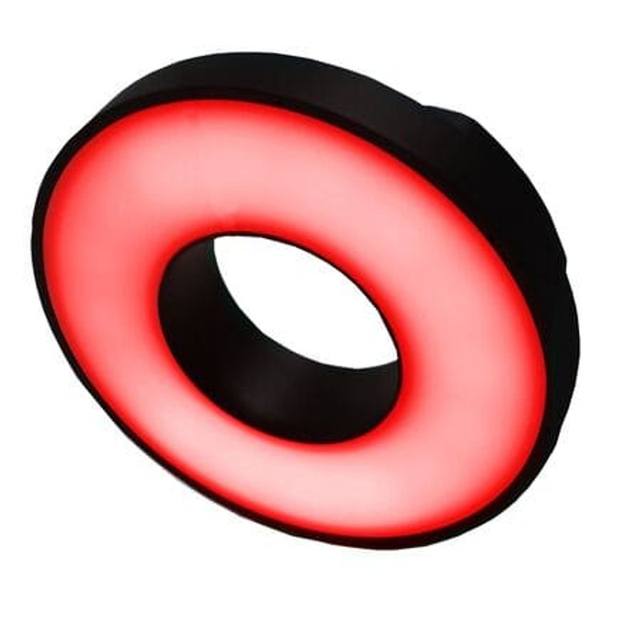
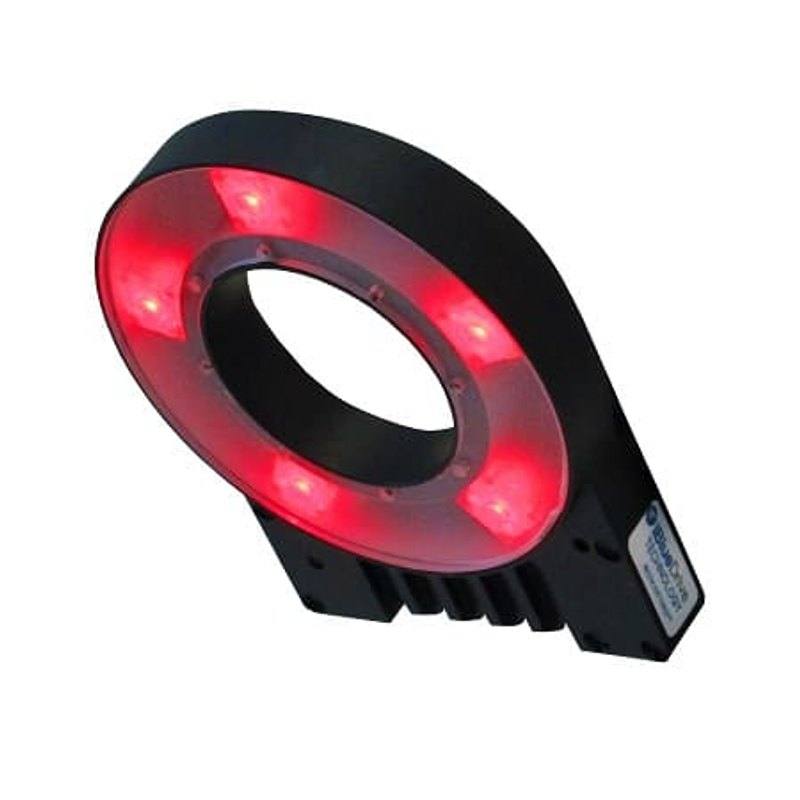
The ALB0804A is a direct high-powered LED ringlight: its emitters sit in a ring around a 40 mm inner diameter so the camera looks straight through the centre while light is projected forward onto the part. This /AM (medium-angle) version directs the beam at a moderate spread, the general-purpose choice between the narrow (/AN) build and the wide (/AW) build offered in this family. Because the illumination arrives largely on-axis and front-lit, this geometry brightens flat, matte and topographic surfaces evenly and brings out printed marks, engraved or embossed text and surface texture; it is less suited to producing the grazing shadows that low-angle lighting uses to exaggerate scratches and dents, so for pure defect-relief work the narrow build or a dedicated low-angle option is worth comparing. The red 630 nm emission is a deliberate choice rather than white: a single narrow wavelength gives high contrast on many materials and, paired with a matching bandpass filter on the lens, lets the camera reject ambient light and stray colour. The unit is offered in 365/400/470/525/630/850 nm and white variants, so the wavelength can be tuned to the target material and the camera's spectral response, but this specific part is the 630 nm red build.
Positioning is governed by the recommended working distance of greater than 50 mm and the 40 mm inner diameter: the ring is mounted coaxially in front of the lens so the optical axis passes through the central opening, and the part is placed at least 50 mm from the emitters where the medium-angle cones overlap into an even field. The compact 94.5 x 77 x 16.5 mm footprint and 120 g mass make it easy to bracket close to the camera in tight cells. A standout feature is the integrated iBlueDrive driver: the light houses its own electronics and is run directly through a 3-pole aerial connector (150 mm lead) on 24 VDC (+/-8%), so no separate strobe controller is required to access continuous, strobe and overdrive operation. Continuous mode suits steady inspection; strobe synchronises a short, bright pulse to the camera exposure to freeze moving parts; and overdrive pushes the LEDs above their continuous rating for brief pulses to gain extra light when the application is light-starved. The electrical envelope reflects this: 720 mA maximum instantaneous current and a 12 W powered rating that resolves to 17 W in strobe versus 7.7 W continuous in this 630 nm version.
Mechanically and environmentally the housing is anodized aluminium for rigidity and heat dissipation, with an IP40 rating and a 0-40 degC operating range, which places it in clean, dry, indoor inspection cells rather than washdown or heavily contaminated stations. To pair it with a camera, the lens is sized so its entrance fits through or just behind the 40 mm inner diameter, the part is set at or beyond the >50 mm working distance, and the 3-pin connection is wired to a 24 VDC supply with the strobe line driven from the camera or PLC trigger when pulsed operation is used. Adding a bandpass filter matched to the red illumination on the lens completes the monochromatic imaging chain, maximising contrast while suppressing ambient and other-colour light.
Best for
Reading and verifying printed or marked text on electronic assemblies and components, where the on-axis red ring evenly front-lights flat boards for OCR/OCV character inspection.
Traceability tasks such as decoding 1D/2D codes and date or lot marks on packaging and automotive parts, with strobe mode freezing the code as it passes under the camera on a moving line.
AI-based defect inspection of matte or coated surfaces in automotive and metal production, using the medium-angle even field as a consistent baseline illumination for the vision model.
General surface inspection of stamped, machined or molded metal parts, where the anodized-aluminium ring brackets close to the camera in a compact indoor cell.
High-speed in-line inspection of packaging and electronics where overdrive pulses provide the extra brightness needed for short exposures without an external controller.
Selection notes
Confirm the lens and its mount fit the 40 mm inner diameter and that the part can be placed at or beyond the recommended >50 mm working distance, since the medium-angle cones need that gap to overlap into an even field.
If the goal is to exaggerate fine scratches, dents or embossing rather than to evenly illuminate, consider the narrow (/AN) angle or a low-angle/darkfield approach, as this front-lit medium-angle ring favours uniform brightening over shadow relief.
Pair the 630 nm red output with a matching bandpass filter on the lens and a monochrome (or red-responsive) camera to gain ambient-light rejection and maximum contrast; choose a different wavelength variant (365/400/470/525/850 nm or white) if the target material responds better to another colour.
Plan the 3-pin aerial connection to a 24 VDC (+/-8%) supply and route the strobe trigger from the camera or PLC, since the built-in iBlueDrive driver means no separate controller is needed but the pulse timing must still be wired in for strobe and overdrive use.
Verify the IP40 rating and 0-40 degC range suit the installation: this is an indoor, clean, dry-cell light, so a higher-sealed alternative is needed for washdown, dusty or wet environments.
Specifications: General
Brand
DCM Sistemes
Lighting type
Ring light (direct high-powered ringlight)
Specifications: Interface
Connection
3-pin aerial connector
Specifications: Optical
Color / wavelength
Red, 630 nm (also available 365/400/470/525/850 nm and white)
Working distance
Recommended working distance >50 mm
Diffuser
Diffuse emission (/AD) and diffuser filter (/FDR) available as options
Emission angle
Medium
Specifications: Electrical
Mode
iBlueDrive: continuous, strobe and overdrive modes
Controller required
Built-in iBlueDrive driver; controlled via 3-pin connector (no external controller required)
Supply voltage
24 (+/-8%) VDC
Power consumption
12 W
Driver technology
iBlueDrive (built-in)
Specifications: Environment
IP rating
IP40
Operating temperature
0 - 40 degC
Specifications: Mechanical
Dimensions
94.5 x 77 x 16.5 mm
Weight
120 g
Housing material
Anodized aluminium
Specifications: Geometry
Inner diameter
40 mm
Applications this camera is commonly selected for. Open one to see the full recommended hardware and approach.
No. It houses a built-in iBlueDrive driver and is controlled directly through its 3-pin aerial connector, giving continuous, strobe and overdrive operation without a separate controller. It runs on 24 VDC (+/-8%).
The recommended working distance is greater than 50 mm, and the ring has a 40 mm inner diameter through which the camera images. Mount the light coaxially in front of the lens and place the part at or beyond 50 mm so the medium-angle illumination evens out.
This part is the 630 nm red, medium-angle (/AM) build, which gives high monochromatic contrast and pairs well with a matching bandpass filter for ambient rejection. The same ringlight is offered in 365/400/470/525/630/850 nm and white, with narrow (/AN), medium (/AM), wide (/AW) and diffuse (/AD) emission options.
Continuous runs the LEDs steadily at the lower 7.7 W rating; strobe pulses the light in sync with the camera exposure to freeze motion; overdrive drives the LEDs harder for brief pulses to gain extra brightness, reflected in the 17 W strobe figure and 720 mA peak instantaneous current. All three are available through the built-in iBlueDrive driver.
It is rated IP40 with a 0-40 degC operating range and an anodized-aluminium housing, so it is intended for clean, dry indoor inspection cells. For wet, dusty or washdown stations a more highly sealed light should be selected.