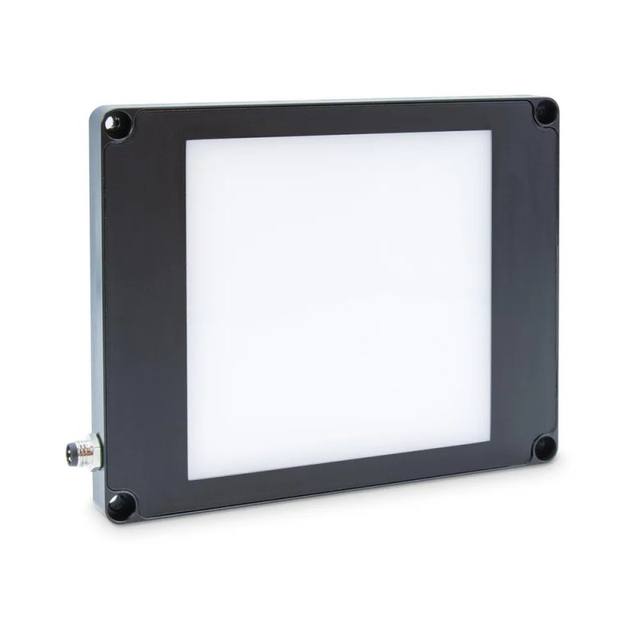
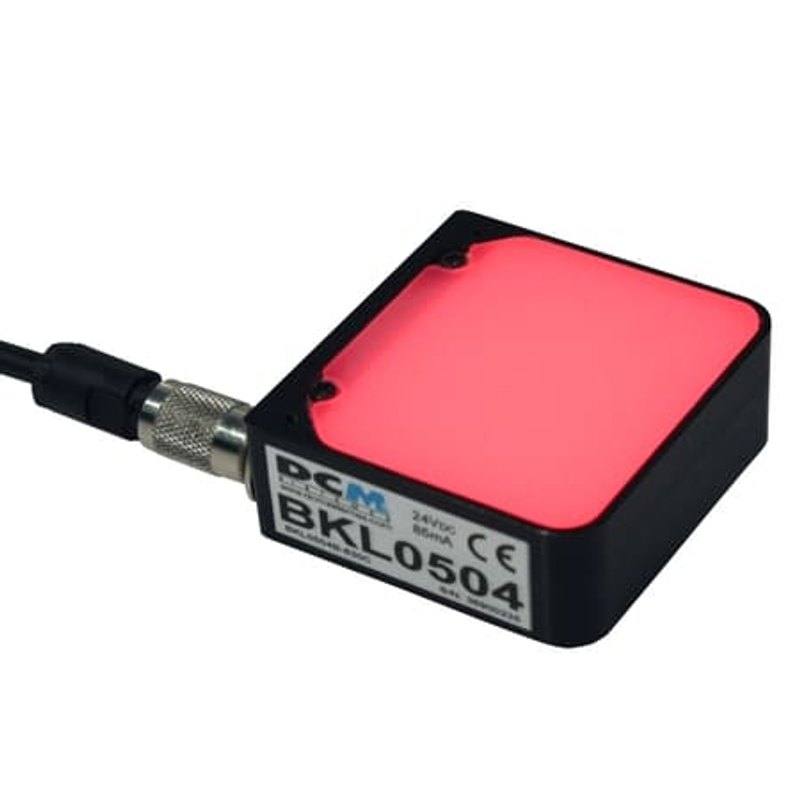
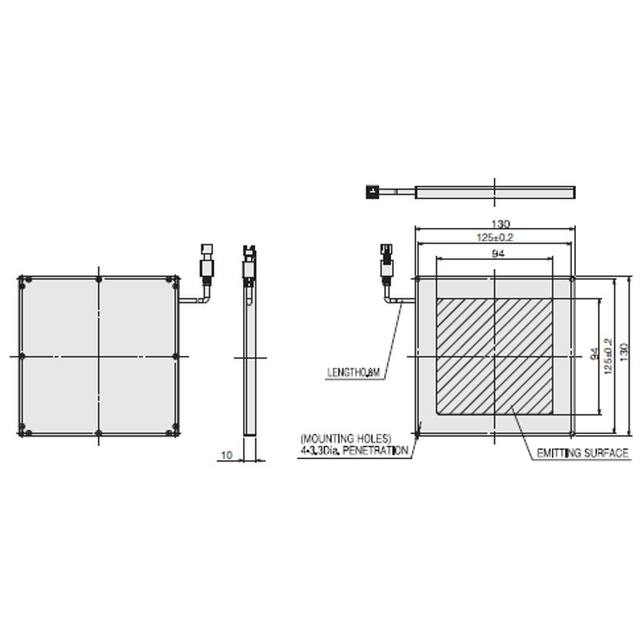
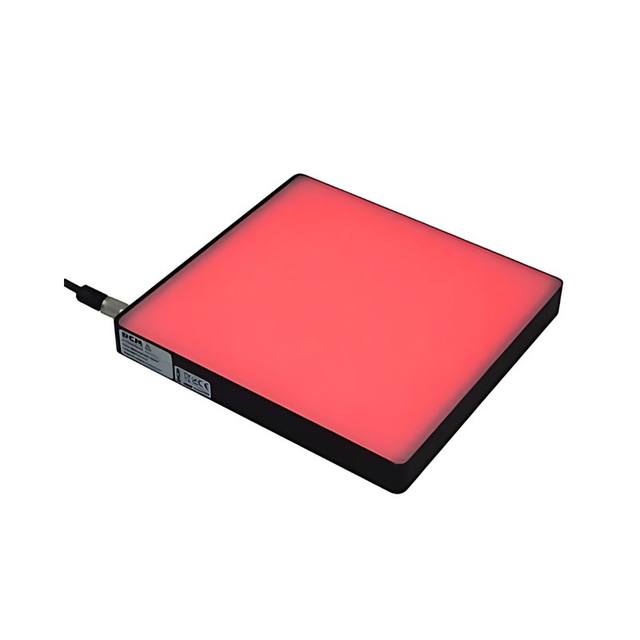
The BKL0504B is a posterior diffuse LED backlight (52 x 55 x 22 mm, 40 x 50 mm active surface, 85 g, IP40) used for profile/edge inspection, dimensional measurement and bright-field creation by emphasizing light-dark contrast. It runs on 24 VDC and is available in multiple wavelengths (470 nm blue, 525 nm green, 630 nm red, 850 nm IR, white and RGB); the white continuous variant draws about 0.7 W. Standard versions use a 2P male chassis connector (Type C continuous / Type S strobe, VCB power cable), while iBlueDrive intelligent versions such as the BKL0504B-W00i integrate the strobe controller and use a 3P aerial inline connector (VCC cable), supporting continuous, powered and strobe/overdrive modes up to 600 percent. The anodized aluminium housing operates from 0 to 40 C.
Brand
DCM Sistemes
Lighting type
Backlight (area, posterior diffuse)
Color / wavelength
White (also 470 blue / 525 green / 630 red / 850 IR / RGB available)
Mode
Continuous (Type C); Strobe (Type S) and iBlueDrive overdrive variants available
Controller required
No external controller required (Type C continuous; iBlueDrive 'i' integrates the controller)
Diffuser
Diffuse emission (posterior diffuse backlight)
IP rating
IP40 (IP65 modifier available)
Illuminated area
Active surface 40 x 50 mm
Emission angle
Diffuse
Available wavelengths
470 nm blue, 525 nm green, 630 nm red, 850 nm IR, white (W00), RGB
Driver technology
iBlueDrive integrated controller (intelligent 'i' versions); continuous/strobe standard versions
Power consumption
0.7 W (white continuous -W00C); e.g. 1.4 W at 470 nm; iBlueDrive -W00i 3.8 W [17 W overdrive / 3 W continuous]
The BKL0504B is a posterior diffuse LED backlight, not a front light: its job is to sit behind the part so the camera sees a dark silhouette against a bright, evenly-lit field. The active emitting surface measures 40 x 50 mm, which sets a hard ceiling on usable part size - the feature you want to silhouette (an edge, a hole, a thread, a pin pitch) must fall comfortably inside that 40 x 50 mm window with margin for placement tolerance. Because emission is diffuse rather than directional, the panel washes the back of the part with light from a wide range of angles, which is exactly what you want for clean edge transitions: diffuse backlighting suppresses the bright fringing and refraction halos you get from a collimated source, giving you the crisp light-dark boundary that subpixel edge and dimensional algorithms rely on.
Wavelength is selectable, and the choice is the main image-quality lever on this fixture. The default white (W00) variant is the general-purpose option and draws only about 0.7 W in continuous mode, so it runs cool and can be left on indefinitely. For demanding metrology, monochromatic options exist - 470 nm blue, 525 nm green and 630 nm red - and on a monochrome camera a shorter wavelength such as blue generally yields sharper, less diffraction-limited edges; 850 nm IR is available where you need to see through certain materials or ignore visible-spectrum surface markings. The 470 nm variant draws more power (about 1.4 W), a normal trade-off for the higher-energy LEDs. An RGB variant is also offered if you need to switch effective wavelength in software. Pair any monochromatic version with a matching bandpass filter on the lens and a monochrome camera to reject ambient light and maximize silhouette contrast.
Driving and integration come in two flavors. Standard Type C is continuous and needs no external controller - feed it 24 VDC (+/-3%) through the 2P male chassis connector and VCB cable and it simply stays on, the simplest possible install. Type S is the strobe version for synchronized flash, and the iBlueDrive intelligent variant (e.g. BKL0504B-W00i) builds the strobe controller into the fixture itself, accepts a wider 24 VDC +/-8% supply over a 3P aerial inline connector (VCC cable), and supports continuous, powered and strobe/overdrive modes up to 600 percent for brief high-intensity pulses on fast lines. The housing is anodized aluminium for heat dissipation, weighs 85 g, fits a 52 x 55 x 22 mm envelope, and is rated IP40 - adequate for clean, dry enclosed cells but not for washdown or dusty environments unless you order the IP65 modifier. Operating range is 0 to 40 C (storage 0 to 60 C), so keep it out of hot ovens and direct process heat.
Best for
Silhouette-based dimensional measurement of small parts (gauging diameters, gaps, hole positions, thread pitch) where the feature fits inside the 40 x 50 mm emitting window
Edge and profile inspection - presence/absence, completeness and outline checks where a clean light-dark boundary drives subpixel edge detection
Backlit inspection of pins, connectors and small electronic components on the back side, using blue (470 nm) with a mono camera for the sharpest edges
Transparent or translucent packaging checks (fill level, seal outline, blister contour) where diffuse transmitted light reveals contours visible-light front lighting would miss
High-speed line inspection using the Type S strobe or iBlueDrive overdrive (up to 600%) variant to freeze motion with a short, bright flash synchronized to the camera trigger
Selection notes
Size your part to the light, not the reverse: the 40 x 50 mm active surface is the usable silhouette area, so leave placement-tolerance margin - features near the panel edge lose even illumination. For larger parts you need a bigger backlight or a tiled array.
Decide continuous vs strobe up front because it changes the part number, connector and wiring. Type C continuous (2P chassis, VCB cable, no controller) is simplest; Type S or the iBlueDrive 'i' version (3P aerial connector, VCC cable, integrated controller) is required for synchronized strobe/overdrive on moving product.
Match wavelength to the task and the camera: monochromatic blue (470 nm) sharpens edges for metrology on a mono camera; white (W00) is the low-power (~0.7 W) general default; 850 nm IR is for materials that need near-infrared transmission. Add a matching lens filter to lock out ambient light.
Confirm the supply tolerance for your driver: Type C/S expect 24 VDC at +/-3%, while iBlueDrive tolerates +/-8%. Budget the higher current and power of the overdrive variant (iBlueDrive -W00i ~3.8 W nominal, up to 17 W in overdrive) versus 0.7 W for white continuous.
Check the environment against IP40 and 0-40 C: this rating suits clean, dry, enclosed vision cells. For washdown, dust or splash exposure specify the IP65 modifier, and keep the fixture away from process heat sources.
Specifications: General
Brand
DCM Sistemes
Lighting type
Backlight (area, posterior diffuse)
Specifications: Interface
Connection
2P male chassis connector (Type C/S, VCB cable); iBlueDrive: 3P aerial male inline connector (VCC cable)
Specifications: Optical
Color / wavelength
White (also 470 blue / 525 green / 630 red / 850 IR / RGB available)
Diffuser
Diffuse emission (posterior diffuse backlight)
Emission angle
Diffuse
Available wavelengths
470 nm blue, 525 nm green, 630 nm red, 850 nm IR, white (W00), RGB
Specifications: Electrical
Mode
Continuous (Type C); Strobe (Type S) and iBlueDrive overdrive variants available
Controller required
No external controller required (Type C continuous; iBlueDrive 'i' integrates the controller)
Driver technology
iBlueDrive integrated controller (intelligent 'i' versions); continuous/strobe standard versions
Power consumption
0.7 W (white continuous -W00C); e.g. 1.4 W at 470 nm; iBlueDrive -W00i 3.8 W [17 W overdrive / 3 W continuous]
The active emitting surface is 40 x 50 mm, so the feature you want to silhouette must fall within that window with margin for placement tolerance. Larger parts require a bigger backlight or a tiled array.
Not for the standard continuous (Type C) version - it runs directly from 24 VDC with no external controller, using a 2P male chassis connector and VCB cable. The iBlueDrive intelligent 'i' versions integrate the strobe controller in the fixture; the separate Type S is the strobe variant.
White (W00) is the general-purpose default and draws about 0.7 W. For sharper edges in dimensional metrology on a monochrome camera, choose a monochromatic option: 470 nm blue, 525 nm green or 630 nm red. 850 nm IR is offered for near-infrared transmission, and an RGB variant allows software wavelength selection.
Yes. The Type S version provides strobe operation, and the iBlueDrive variant supports continuous, powered and strobe/overdrive modes up to 600 percent, letting you fire a short bright pulse synchronized to the camera trigger to freeze motion.
The standard rating is IP40, which suits clean, dry, enclosed vision cells but not washdown, splash or heavy dust. An IP65 modifier is available for harsher conditions. Operating temperature is 0 to 40 C.
It runs on 24 VDC. Type C/S versions expect +24 V at +/-3%; iBlueDrive tolerates +/-8%. The white continuous variant (-W00C) draws about 0.7 W, the 470 nm version about 1.4 W, and the iBlueDrive -W00i about 3.8 W nominal (up to 17 W in overdrive, 3 W continuous).