
- Rosepetal compatible
- Recommended by AIS Vision
On request
BKL1818A
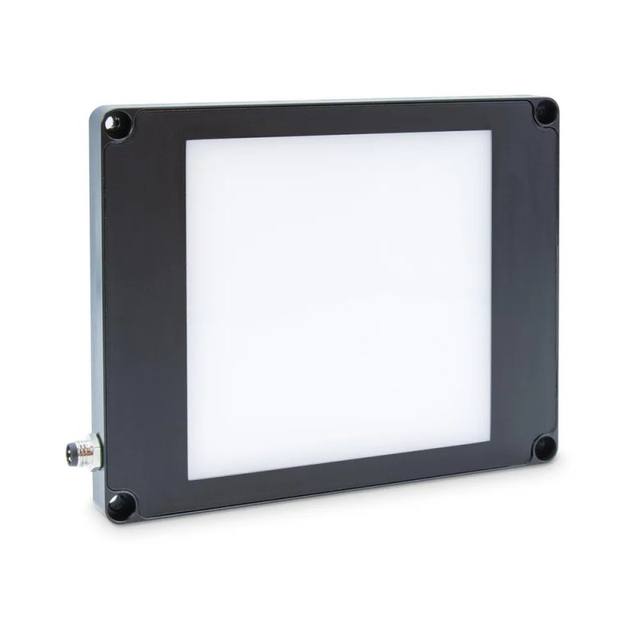
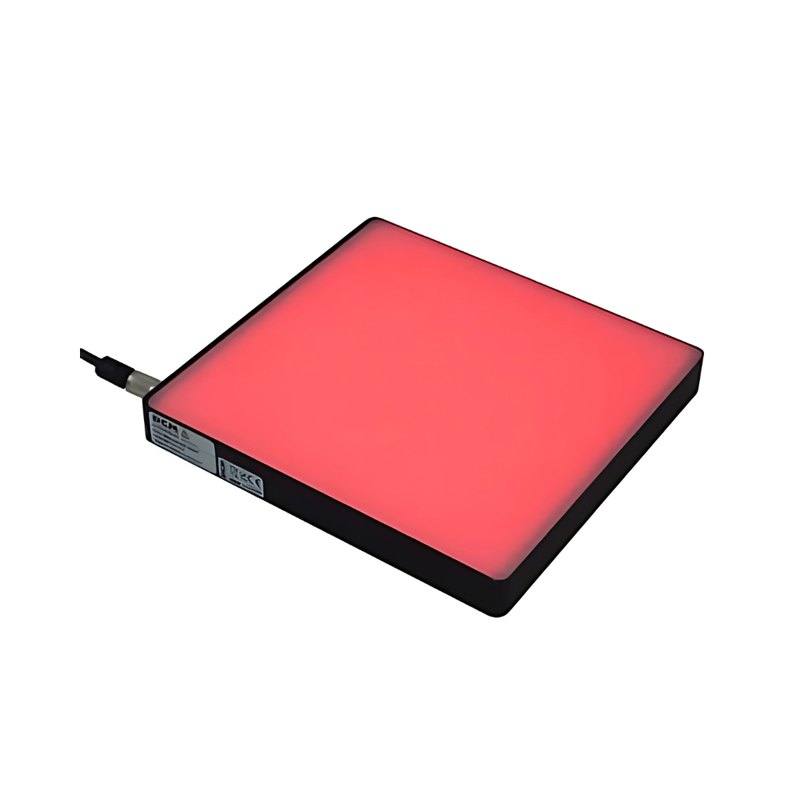
The BKL1818A is a posterior diffuse area backlight with a 180x180 mm uniform illuminated surface in a 194x184x22 mm anodized aluminium housing weighing 770 g, rated IP40 (IP65/IP67 modifiers available). It runs on 24 VDC through a 2-pin male chassis connector and is offered in multiple monochromatic wavelengths (470 nm blue, 525 nm green, 630 nm red, 850 nm IR), white (W00) and RGB, with a typical continuous Type-C consumption of about 16 W in white and up to 27 W in IR. It supports continuous, strobe and powered operating modes, and an intelligent iBlueDrive variant adds a 3-pin aerial inline connector with integrated control. It is designed to emphasize light-dark contrast for measuring object shape, inspecting profiles and edges, and creating bright fields, with selectable medium/narrow/wide/diffuse emission via modifiers.
The BKL1818A is a posterior diffuse area backlight, not a front light, and that single fact governs how it is used: the part under inspection sits between the camera and this 180x180 mm uniform emitting surface, so the sensor sees the object as a dark silhouette against a bright, evenly lit field. The diffuser and the medium default emission angle (narrow, wide and diffuse are available as modifiers) spread the LED output across the active area so edges resolve crisply without hotspots or directional shadows. That makes it a contrast-generating tool rather than a feature-revealing one: it is built to nail down outlines, gaps, presence/absence and dimensional extent, and the technical summary itself frames it around measuring object shape, inspecting profiles and edges, and creating bright fields.
| Brand | DCM Sistemes |
|---|---|
| Lighting type | Backlight (area / posterior diffuse) |
| Connection | 2P male chassis connector (24 VDC); iBlueDrive variant: 3P aerial male inline |
|---|
| Color / wavelength | White (W00); also available 470 blue, 525 green, 630 red, 850 IR, RGB |
|---|---|
| Available wavelengths | 470 nm blue, 525 nm green, 630 nm red, 850 nm IR, white (W00), RGB |
| Diffuser | Yes (diffuse area backlight; diffuse emission modifier available) |
| Emission angle | Medium (default); narrow/wide/diffuse available as modifiers |
| Mode | Continuous (Type C); also strobe (Type S), powered, intelligent iBlueDrive (Type i) |
|---|---|
| Controller required | No (driven directly at 24 VDC; iBlueDrive integrated control on Type i variant) |
| Power consumption | ~16 W continuous (Type C, white W00); up to 27 W (850 nm IR) |
| Supply voltage | 24 VDC (PIN1 +24V +/-3%, PIN2 0V) |
| Driver technology | iBlueDrive intelligent inline technology (Type i variant) |
| IP rating | IP40 (IP65/IP67 via modifier) |
|---|---|
| Operating temperature | 0 - 40 C operating (storage 0 - 60 C) |
| Illuminated area | 180 x 180 mm active surface |
|---|
| Housing material | Anodized aluminium |
|---|---|
| Dimensions | 194 x 184 x 22 mm |
| Weight | 770 g |
A practical guide to choosing machine vision lighting: geometry, wavelength, strobe vs continuous, ambient control and how to maximise feature contrast for reliable inspection.
A practical guide to machine vision lighting geometries — ring, bar, backlight, coaxial, dome and dark field — explaining what each reveals, the surfaces it suits, and how to choose the right one directly from your inspection problem.
A practical guide to continuous, strobed, and overdrive LED lighting in machine vision: why a short pulse freezes motion, why overdrive (not strobing alone) adds brightness, how to synchronize the pulse to camera exposure, the duty-cycle limits that protect LED life, and how to size and select a lighting controller.
Rosepetal · AI
Validate your visual inspection with AI: send us sample images and we evaluate the case on your hardware.
AIS Vision · Integration
AIS Vision defines and tests the optimal combination of camera, optics and lighting for your application before you buy.