Skip to content
DCM Sistemes DKL5650B machine vision lighting
  • Rosepetal compatible
  • Recommended by AIS Vision

DCM Sistemes DKL5650B Darkfield Ring Light

DKL5650B

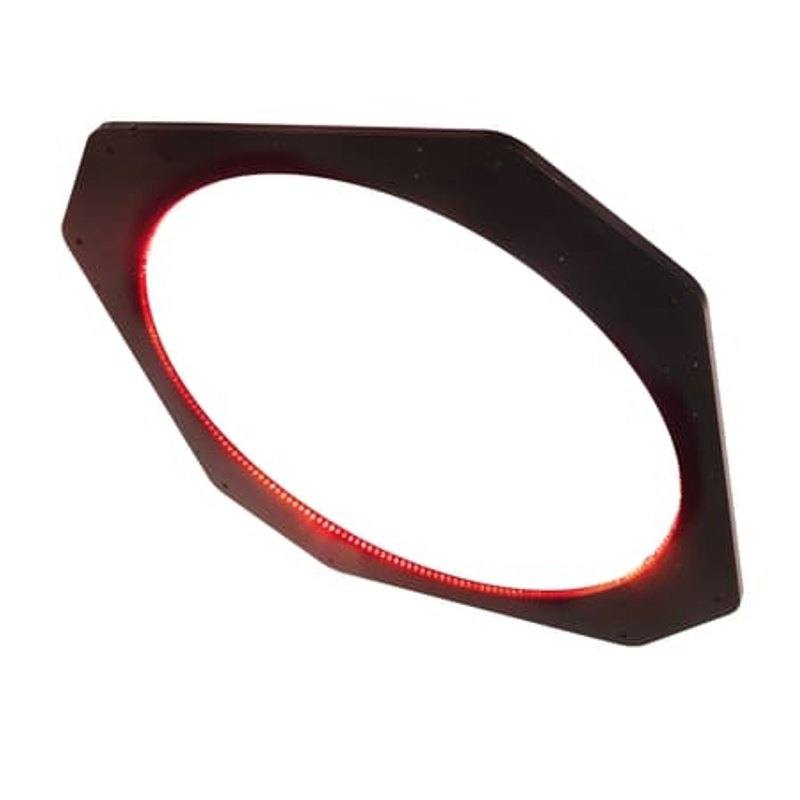
The DCM Sistemes DKL5650B is a darkfield (low-angle) ring light from the DKL family with external dimensions of 570 x 570 x 10 mm and a 500 mm inner diameter, leaving a large central aperture for the camera optical path. It is offered in multiple wavelengths including 470 nm blue, 525 nm green, 630 nm red, 850 nm IR, 400 nm UV and W00 white, and supports Continuous (C), Powered (P), Strobe (S) and iBlueDrive (i) operating modes. The unit runs on 24 VDC (+/-3% in C/P/S modes, +/-8% in iBlueDrive mode) with maximum instantaneous consumption up to about 4390 mA in strobe mode, and connects via 2-pole flying-lead cables (1800 mm) or a 3-pole aerial connector (150 mm) for iBlueDrive; external strobe operation uses a VST-series controller.

Brand
DCM Sistemes
Lighting type
Darkfield / low-angle ring light
Color / wavelength
Available in white (W00), blue 470nm, green 525nm, red 630nm, IR 850nm and UV 400nm
Mode
Continuous (C), Powered (P), Strobe (S) and iBlueDrive (i) modes available
Controller required
Continuous mode needs no controller; external strobe mode uses a VST-series strobe controller (not included)
Dimensions
570 x 570 x 10 mm
Inner diameter
500 mm
Supply voltage
24 (+/-3% in C/P/S; +/-8% in iBlueDrive) VDC
Available wavelengths
470nm blue, 525nm green, 630nm red, 850nm IR, 400nm UV, W00 white
Connection
Flying leads

Technical overview

The DCM Sistemes DKL5650B is a darkfield, low-angle ring light: rather than illuminating a part head-on, its emitters sit in a 570 x 570 mm frame and skim light across the surface from a shallow grazing angle. Light striking a smooth, flat region reflects away from the camera and reads as dark, while any feature that disturbs the surface - a scratch, an engraved or embossed character, a raised edge, a particle, a crack or a printing defect - catches that grazing light and scatters it back into the lens, appearing bright against a dark background. This is the inverse of brightfield lighting and is what makes the DKL5650B suited to revealing texture, edges and surface relief that would otherwise wash out. The very large 500 mm inner diameter is the defining geometric fact here: it leaves an open central aperture for the camera's optical path and is intended to surround large parts, so the whole field of view sits inside the ring rather than the light being a small accessory beside the camera.

Wavelength is selectable, and the choice changes what the light brings out. The unit is offered as W00 white plus monochromatic 470 nm blue, 525 nm green, 630 nm red, 850 nm IR and 400 nm UV. A monochromatic option paired with a matching bandpass filter on the camera lets you suppress ambient light and lift contrast on a specific defect type, while white is the general-purpose, colour-faithful choice. As a general rule in machine-vision lighting, shorter wavelengths tend to emphasise fine surface texture and longer wavelengths interact differently with certain surface colours, so the available band can be matched to the target defect. Because the frame geometry is fixed, the practical positioning variable an installer controls is standoff: the working distance and the height of the ring above the part set the effective grazing angle, so the light is dialled in by moving it up or down until the defect of interest pops and the good surface stays dark.

Electrically the DKL5650B runs on 24 VDC and supports four operating modes: Continuous (C), Powered (P), Strobe (S) and DCM's iBlueDrive (i). In continuous mode it needs no external controller and can be driven directly from a 24 VDC supply (regulated to +/-3%), which is the simplest way to deploy it for steady-state inspection. For external strobing - pulsing the light in sync with the camera to freeze fast-moving parts - a VST-series strobe controller is required, and peak instantaneous consumption can reach about 4390 mA in strobe mode, so the supply and wiring must be sized for that draw. iBlueDrive mode relaxes the supply tolerance to +/-8% and uses a 3-pole aerial connector (150 mm); in the standard C/P/S modes the unit terminates in 2-pole flying leads (1800 mm), which an installer wires straight into the power source or controller. The thin 10 mm profile and ring form factor make it straightforward to mount over a conveyor or fixture, with the camera looking down through the open centre.

Best for

  • Surface defect inspection on large flat or near-flat metal parts, where grazing darkfield light makes scratches, dents, dings and tooling marks scatter bright against a dark background across a wide field of view.
  • Reading embossed, engraved or laser-etched marks and date/lot codes that have surface relief but little colour contrast, in automotive and metal-component lines, by lighting the relief from a low angle.
  • AI-based defect inspection of large electronic assemblies or panels, where the 500 mm aperture lets the camera image the whole part inside the ring while the low angle exposes solder, coating or print anomalies.
  • Dimensional and edge measurement of sizeable parts, using the darkfield edge-brightening effect to produce a crisp, high-contrast outline of features for reliable edge finding.
  • High-speed surface inspection on moving product, pairing the strobe mode with a VST-series controller and a synchronised camera to freeze motion while still grazing the surface.

Selection notes

  • Size the field of view to the ring, not the other way around: with a 570 x 570 mm frame and 500 mm clear inner diameter, this light is built to surround large parts. Confirm the part and its field of view fit inside the central aperture and that the camera can be mounted to look straight down through that opening.
  • Match the wavelength to the defect and pair it with a filter. Pick a monochromatic option (470/525/630/850/400 nm) plus a matching bandpass filter on the lens to kill ambient light and maximise defect contrast, or choose W00 white when colour fidelity matters more than narrow-band contrast.
  • Tune the working distance to set the grazing angle. Because the frame geometry is fixed, the standoff height above the part is your main adjustment - raise or lower the ring until good surface stays dark and the target defect brightens.
  • Decide continuous versus strobe up front, because it changes your bill of materials. Continuous mode runs directly from regulated 24 VDC with no controller, but if you need to freeze motion via external strobing you must add a VST-series strobe controller and size the 24 VDC supply for peak instantaneous consumption of about 4390 mA.
  • Plan the wiring and connector for your chosen mode: standard C/P/S modes use 2-pole flying leads (1800 mm) into power or controller, while iBlueDrive uses a 3-pole aerial connector (150 mm) and a looser +/-8% supply tolerance. If your part is small or you need shadow-free even illumination instead of edge/relief contrast, a smaller ring or a different lighting geometry would be a better fit.

Specifications: General
BrandDCM Sistemes
Lighting typeDarkfield / low-angle ring light

Specifications: Interface
ConnectionFlying leads

Specifications: Optical
Color / wavelengthAvailable in white (W00), blue 470nm, green 525nm, red 630nm, IR 850nm and UV 400nm
Available wavelengths470nm blue, 525nm green, 630nm red, 850nm IR, 400nm UV, W00 white

Specifications: Electrical
ModeContinuous (C), Powered (P), Strobe (S) and iBlueDrive (i) modes available
Controller requiredContinuous mode needs no controller; external strobe mode uses a VST-series strobe controller (not included)
Supply voltage24 (+/-3% in C/P/S; +/-8% in iBlueDrive) VDC

Specifications: Mechanical
Dimensions570 x 570 x 10 mm

Specifications: Geometry
Inner diameter500 mm

Frequently asked questions

Related technical guides

Rosepetal · AI

Test this camera with Rosepetal

Validate your visual inspection with AI: send us sample images and we evaluate the case on your hardware.

AIS Vision · Integration

We validate camera + lens + lighting

AIS Vision defines and tests the optimal combination of camera, optics and lighting for your application before you buy.