Skip to content
DCM Sistemes DOM1410A-630C machine vision lighting
  • Rosepetal compatible
  • Recommended by AIS Vision

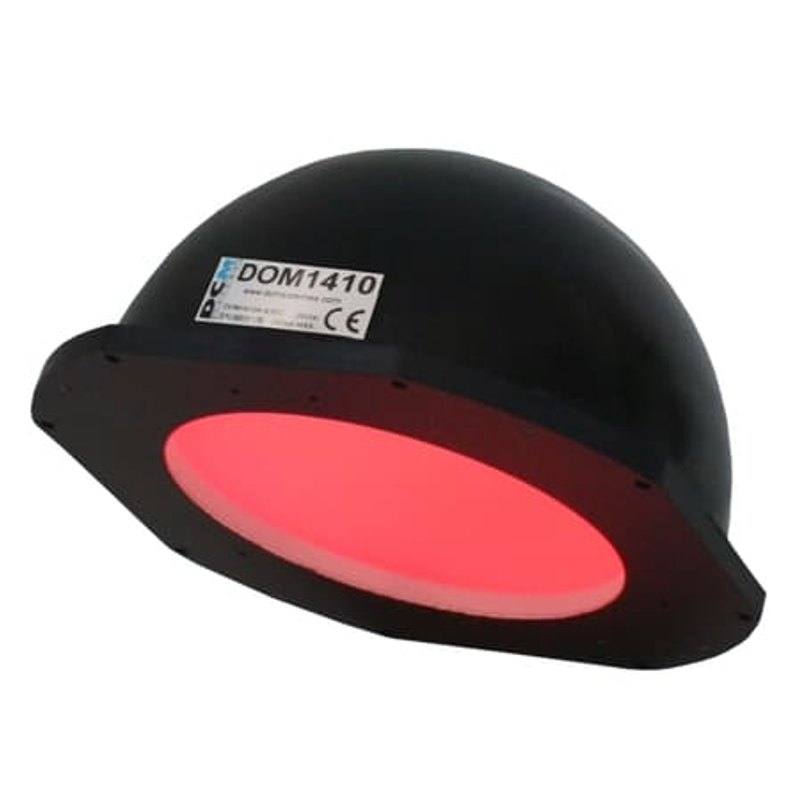
DCM Sistemes DOM1410A-630C Dome Light (Red, 145 mm)

DOM1410A-630C

The DOM1410A-630C is a 145 x 145 x 72 mm diffuse dome light with a 100 mm bottom aperture and a 40 mm camera/dome hole, weighing 274 g. It uses 630 nm red monochromatic LEDs, runs on 24 VDC (+/-3%) via a 2-pole flying-lead cable (L = 180 mm), and consumes 8.5 W in continuous Type C operation. Its standard rating is IP00 (an IP65 modifier is available) and the recommended working distance is under 20 mm. The same DOM1410A geometry is also offered in strobe (Type S, e.g. 630S at 1410 mA / 34 W) and other wavelengths (470/525/850 nm and white).

Brand
DCM Sistemes
Lighting type
Dome (diffuse 'cloudy day') light
Color / wavelength
Red, 630 nm monochromatic
Mode
Continuous (Type C); strobe variant -630S also available
Working distance
Recommended working distance < 20 mm
Controller required
No controller required for Type C continuous (-630C); driven directly from 24 VDC
Diffuser
Yes — diffuse dome ('cloudy day') illumination
IP rating
IP00 standard; IP65 available as a modifier (no IP00 enum value; nearest low-protection rating shown — see extraSpecs for exact IP00/IP65)
Dimensions
145 x 145 x 72 mm
Weight
274 g
Supply voltage
24 VDC (+/-3%)
Power consumption
8.5 W

Technical overview

The DOM1410A-630C is a diffuse dome light, the geometry machine-vision engineers reach for when they need to suppress, rather than create, shadows and specular glare. LEDs fire upward into the inside of a hemispherical white dome, so the object below is bathed in light arriving from nearly every angle at once. The result is the so-called 'cloudy day' effect: a soft, omnidirectional wash with no hard highlights, which is exactly what you want for reading print, codes or surface markings on curved, glossy or uneven parts where a directional light would bounce a bright hot-spot straight back into the lens. The camera looks down through the 40 mm hole at the top of the dome, on-axis with the illumination, so the field of view sits in the most uniform part of the lit zone. With a 100 mm bottom aperture and a 145 x 145 x 72 mm body weighing 274 g, this is a compact unit sized for inspecting small to medium parts that fit within that opening.

The 630 nm red monochromatic emission is a deliberate engineering choice rather than a cosmetic one. A narrow red band gives clean, repeatable contrast on a wide range of materials, lets you pair the light with a matching 630 nm bandpass filter on the lens to reject ambient room light, and is a strong default for general-purpose contrast and code reading. Because the LEDs are monochromatic, the scene is imaged in a single colour band, which plays naturally to monochrome cameras. If red is not the right contrast for your target, the same DOM1410A geometry is catalogued in 470 nm blue, 525 nm green, 850 nm infrared and white, so the dome form factor can be retuned to the surface without changing the mechanical design-in.

Electrically this is a low-friction part. The -630C is the continuous (Type C) variant, drawing 8.5 W from a 24 VDC supply (+/-3%) through a simple two-pole flying-lead cable, and it explicitly needs no controller: you wire it straight to 24 V and it stays on. That makes it the easy path for static or slow-moving inspection stations where you do not need to freeze fast motion. The trade-off is the very short recommended working distance of under 20 mm, meaning the dome must sit close above the part, and the standard IP00 rating, which is open-frame and suited to clean, enclosed cells rather than washdown areas; an IP65 modifier is offered when the environment is wetter or dustier. If the line moves fast enough to need a brief, bright synchronised flash, the catalogue also lists a strobe sibling (the -630S, rated 1410 mA / 34 W) intended for controller-driven strobe operation.

Best for

  • Reading 2D codes, date/lot marks and printed text on glossy or curved packaging where directional light would create glare hotspots that defeat the reader.
  • Surface and cosmetic defect inspection on small reflective parts (stamped metal, electronic components) that need shadowless, even illumination to expose scratches, dents and contamination.
  • AI-based defect-inspection stations imaging shiny or textured surfaces, where uniform diffuse light keeps the appearance consistent for a trained model.
  • Traceability and packaging-line verification of labels and codes on food, beverage and consumer-goods containers in a clean, enclosed inspection cell.
  • Inspection of small parts in electronics and automotive assembly that fit within the 100 mm aperture and can be presented close beneath the dome.

Selection notes

  • Plan for the very short working distance: the recommended distance is under 20 mm, so the dome must sit close above the part and the mechanical fixture has to bring product right up under the 100 mm aperture. Parts taller than that clearance, or fields of view wider than the aperture, point you to a larger dome.
  • Pair the 630 nm red emission with a matching red bandpass filter on the lens to suppress ambient light and lock in contrast; mount a monochrome camera to make full use of the single-band illumination.
  • Confirm your part presents well to diffuse on-axis light. Dome lighting excels on glossy, curved and reflective surfaces but flattens contrast on features that depend on shadow or raking light, where a dark-field or directional light would serve better.
  • Wiring is straightforward: the -630C runs continuous from 24 VDC (+/-3%) on two flying leads and needs no controller, so budget a regulated 24 V rail rather than a lighting controller. Choose the -630S strobe variant (1410 mA / 34 W, controller-driven strobe) only if you must freeze fast motion.
  • Check the environment against the IP00 standard rating. For clean, enclosed cells this is fine; for damp, dusty or washdown lines specify the IP65 modifier. If red contrast is wrong for the target, the same dome is available in 470 nm blue, 525 nm green, 850 nm IR and white.

Specifications: General
BrandDCM Sistemes
Lighting typeDome (diffuse 'cloudy day') light

Specifications: Interface
ConnectionFlying leads

Specifications: Optical
Color / wavelengthRed, 630 nm monochromatic
Working distanceRecommended working distance < 20 mm
DiffuserYes — diffuse dome ('cloudy day') illumination
Available wavelengths470 nm blue, 525 nm green, 630 nm red, 850 nm IR, W00 white

Specifications: Electrical
ModeContinuous (Type C); strobe variant -630S also available
Controller requiredNo controller required for Type C continuous (-630C); driven directly from 24 VDC
Supply voltage24 VDC (+/-3%)
Power consumption8.5 W

Specifications: Environment
IP ratingIP00 standard; IP65 available as a modifier (no IP00 enum value; nearest low-protection rating shown — see extraSpecs for exact IP00/IP65)

Specifications: Mechanical
Dimensions145 x 145 x 72 mm
Weight274 g

Frequently asked questions

Related technical guides

Rosepetal · AI

Test this camera with Rosepetal

Validate your visual inspection with AI: send us sample images and we evaluate the case on your hardware.

AIS Vision · Integration

We validate camera + lens + lighting

AIS Vision defines and tests the optimal combination of camera, optics and lighting for your application before you buy.