Skip to content
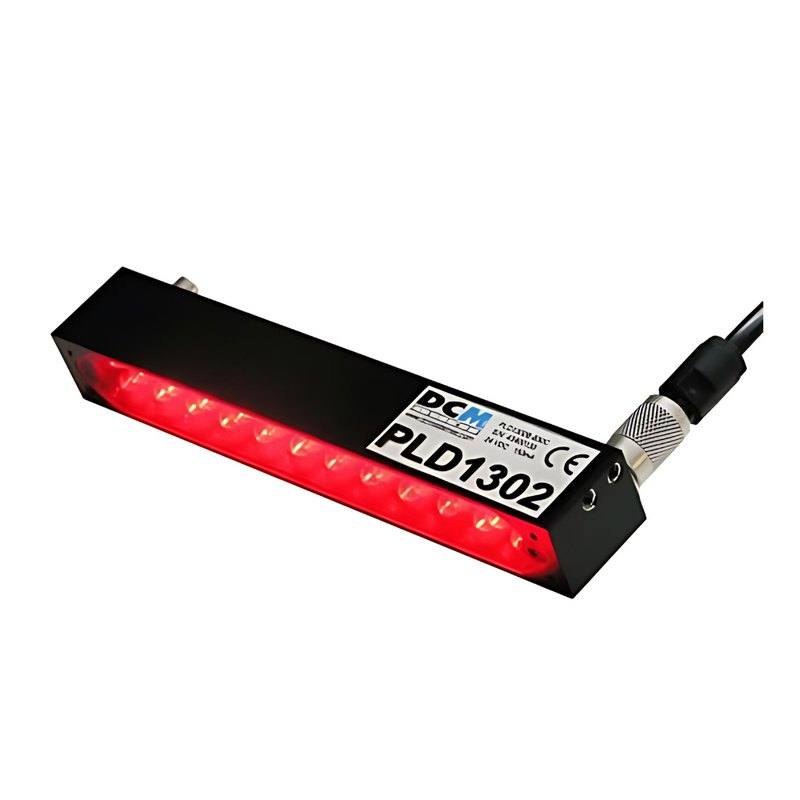
DCM Sistemes PLD1302B machine vision lighting
  • Rosepetal compatible
  • Recommended by AIS Vision

DCM Sistemes PLD1302B Direct Linear Bar Light

PLD1302B

The PLD1302B is a 150 x 20 x 24 mm direct linear LED bar projector from DCM Sistemes' PLD series, offering a 128 x 16 mm illuminated active surface and a recommended working distance greater than 50 mm. It operates at 24 VDC with power consumption varying by wavelength (1.4 W to 3.7 W depending on color), and supports continuous (Type C), powered (Type P), strobe (Type S), and intelligent iBlueDrive (Type i) operating modes. The housing is black anodized aluminum rated IP40, weighing 125 g, and connects via a 2-pin chassis connector for standard versions or a 3-pin aerial inline connector (715 mm cable) when fitted with iBlueDrive technology. Available wavelengths span UV (365 nm, 400 nm), visible (470 nm blue, 525 nm green, 630 nm red), infrared (850 nm), and white; optional angle modifiers allow narrow, medium (default), or wide emission angles.

Brand
DCM Sistemes
Lighting type
Bar (direct linear projector)
Color / wavelength
Red (630 nm); also available in Blue 470 nm, Green 525 nm, IR 850 nm, UV 365 nm, UV 400 nm, White
Available wavelengths
365 nm UV-, 400 nm UV, 470 nm Blue, 525 nm Green, 630 nm Red, 850 nm IR, White
Mode
Continuous (Type C), Powered/Overdrive (Type P), Strobe (Type S), iBlueDrive intelligent (Type i)
Working distance
> 50 mm
Illuminated area
128 x 16 mm active surface
IP rating
IP40
Supply voltage
24 VDC ±3% (standard) / 24 VDC ±8% (iBlueDrive)
Power consumption
2.9 W (Red/630 nm, continuous); 1.4 W (Green); 2.5 W (Blue); 3.6 W (IR); 3.7 W (White powered)
Connection
2P male chassis connector (standard); 3P aerial male inline 715 mm (iBlueDrive)
Housing material
Black anodized aluminum

Technical overview

The PLD1302B is a compact direct-emission LED bar light measuring 150 x 20 x 24 mm with an active illuminated surface of 128 x 16 mm. Its directional, grazing geometry is the defining characteristic: light strikes the inspected surface at a low, near-tangential angle rather than flooding it uniformly, which causes micro-relief features — scratches, burrs, stamping marks, casting seams, embossed characters, and surface cracks — to cast hard shadows detectable even with monochrome cameras. The minimum recommended working distance of 50 mm keeps the light source clear of the part and any tooling. The fixture ships with the medium /AM angle modifier as the catalogue default, which gives a practical mid-range emission profile suited to most dark-field texture inspection setups; the narrow (0°) direct mode is available without a modifier, and an optional wide /AW modifier broadens the beam further. An optional VDF diffuser filter accessory is also available for maximum uniformity.

Seven wavelength variants — 365 nm UV-, 400 nm UV, 470 nm blue, 525 nm green, 630 nm red, 850 nm IR, and white — let integrators tune the spectral response to the camera sensor and the surface's optical properties. Red (630 nm, 2.9 W continuous) is the general-purpose choice for most dark-field texture inspections. IR (850 nm, 3.6 W) couples naturally with standard silicon sensors and passes through some surface coatings that block visible wavelengths. The UV variants (365 nm and 400 nm) excite fluorescent markings or contamination, enabling contrast that is invisible under white light. Power consumption across the range stays low — 1.4 W for green (continuous) up to 3.7 W for white (powered mode) — so the fixture generates minimal heat. The 24 VDC supply (±3% for standard versions, ±8% for iBlueDrive) is compatible with standard industrial switch-mode power supplies and 24 V PLC output rails.

Four operating modes give the integrator precise control over illumination intensity and timing. Continuous mode (Type C) suits slower conveyor lines or static inspection stations and requires no external controller — only the 24 V supply and the 2-pin chassis connector. Powered/overdrive mode (Type P) boosts LED drive current above the continuous-rated level for brief periods to increase brightness when faster acquisition is needed. Strobe mode (Type S) synchronises with the camera's external trigger via a DCM VST strobe controller, delivering short, high-intensity pulses that effectively freeze motion and extend LED service life by reducing thermal duty cycle; this is the recommended mode for high-throughput production lines. The iBlueDrive intelligent variant (Type i) integrates closed-loop intensity regulation directly into the fixture — connected via a 3-pin aerial inline 715 mm cable — so brightness stays constant across temperature drift and LED ageing without an external controller. The anodized aluminum housing (IP40, 125 g) handles standard factory environments; IP40 is adequate for non-wash-down applications where the fixture is protected from direct water spray.

Best for

  • Dark-field surface defect detection on metal parts — stamped, machined, or cast components where scratches, tool marks, porosity, and cracks must be separated from the specular base surface. The narrow grazing angle maximises shadow contrast on low-relief defects invisible under diffuse illumination.
  • Embossed and debossed character or code reading on packaging, metal cans, and moulded plastics, where the OCV or OCR task depends on shadow relief rather than ink contrast. The 128 mm active length covers standard label and closure widths in a single pass.
  • Surface finish and texture classification on printed, lacquered, or anodized panels, where the directional beam reveals orange-peel, waviness, or uneven coating that diffuse lighting would not differentiate.
  • UV fluorescence inspection for adhesive bead verification, seal integrity, or tamper-evident ink detection using the 365 nm or 400 nm variants, where fluorescent compounds must be excited to become visible to a monochrome or colour camera.
  • Presence and alignment checks on fine mechanical assemblies — springs, connectors, PCB components — where the directional shadow of the bar light accentuates height differences and missing-component gaps within the 128 x 16 mm illuminated footprint.

Selection notes

  • Wavelength choice drives contrast: pair 630 nm red with standard CMOS sensors for general dark-field work; choose 850 nm IR when surface coatings or protective films absorb visible light; use 365 nm UV only with UV-pass filters and UV-sensitive sensors, and verify the camera's UV response before ordering.
  • The working distance must exceed 50 mm — measure from the active surface to the part. The medium /AM modifier ships as the catalogue default; the narrow (0°) direct mode is the base without any modifier; and the wide /AW modifier is available for broader coverage. If the working distance grows significantly or a softer beam is needed, switch to the /AW modifier accordingly.
  • For high-throughput production lines or when motion blur is a concern, select the strobe (Type S) variant paired with a DCM VST controller rather than continuous mode. Strobe pulses freeze motion and extend LED lifetime; the VST controller provides the TTL/24 V trigger input that synchronises the flash to the camera's exposure window.
  • IP40 protection is sufficient for clean or semi-clean factory environments. If the fixture is positioned near coolant mist, cutting fluid, or wash-down zones, evaluate whether a secondary protective enclosure or a higher-IP alternative is required, since IP40 does not protect against water ingress.
  • The iBlueDrive (Type i) variant is the right selection wherever LED ageing or ambient temperature variation would otherwise cause brightness drift that shifts detection thresholds over time — for example, in 24/7 automotive lines where recalibration downtime is costly. Note that the Type i variant uses a different connector (3-pin aerial inline, 715 mm cable) from the standard 2-pin chassis connector, so the wiring harness must be specified accordingly at installation.

Specifications: General
BrandDCM Sistemes
Lighting typeBar (direct linear projector)

Specifications: Interface
Connection2P male chassis connector (standard); 3P aerial male inline 715 mm (iBlueDrive)

Specifications: Optical
Color / wavelengthRed (630 nm); also available in Blue 470 nm, Green 525 nm, IR 850 nm, UV 365 nm, UV 400 nm, White
Available wavelengths365 nm UV-, 400 nm UV, 470 nm Blue, 525 nm Green, 630 nm Red, 850 nm IR, White
Working distance> 50 mm
Emission angleNarrow (0°) direct; optional medium /AM (default) or wide /AW via modifiers
DiffuserNo (optional VDF diffuser filter available as accessory)

Specifications: Electrical
ModeContinuous (Type C), Powered/Overdrive (Type P), Strobe (Type S), iBlueDrive intelligent (Type i)
Supply voltage24 VDC ±3% (standard) / 24 VDC ±8% (iBlueDrive)
Power consumption2.9 W (Red/630 nm, continuous); 1.4 W (Green); 2.5 W (Blue); 3.6 W (IR); 3.7 W (White powered)
Controller requiredNot required for continuous mode; strobe controller (VST) recommended for strobe/powered modes

Specifications: Environment
IP ratingIP40
Operating temperature0 – 40 °C

Specifications: Geometry
Illuminated area128 x 16 mm active surface

Specifications: Mechanical
Housing materialBlack anodized aluminum
Dimensions150 x 20 x 24 mm (L x W x H)
Weight125 g

Frequently asked questions

Related technical guides

Rosepetal · AI

Test this camera with Rosepetal

Validate your visual inspection with AI: send us sample images and we evaluate the case on your hardware.

AIS Vision · Integration

We validate camera + lens + lighting

AIS Vision defines and tests the optimal combination of camera, optics and lighting for your application before you buy.