Skip to content
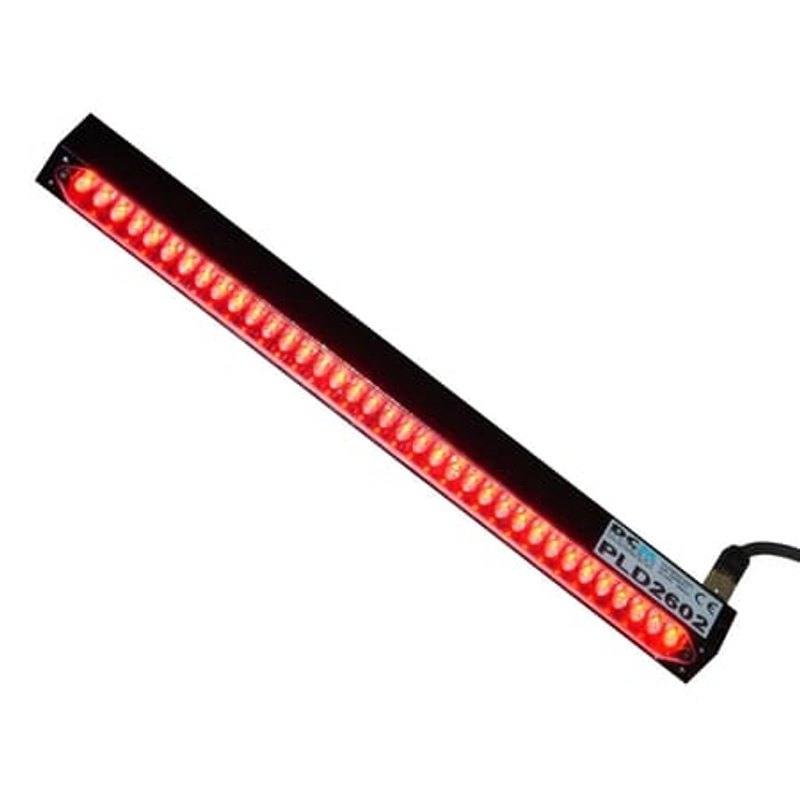
DCM Sistemes PLD2602A-850C machine vision lighting
  • Rosepetal compatible
  • Recommended by AIS Vision

DCM Sistemes PLD2602A-850C Linear Projector (IR 850 nm)

PLD2602A-850C

The PLD2602A-850C is a direct-light linear LED projector with a 259x16 mm illuminated area and external dimensions of 280x20x24 mm, weighing 205 g in a black anodized aluminium housing. It emits infrared light at 850 nm in continuous mode from a 24 VDC ±3% supply, with a powered duty-cycle option (1/2, 60 s Ton max). It is rated IP40, has a recommended working distance greater than 50 mm, two 2P chassis connectors, and complies with RoHS, CE and WEEE.

Brand
DCM Sistemes
Lighting type
Bar / linear projector
Color / wavelength
Infrared 850 nm
Mode
Continuous (powered duty-cycle 1/2, 60 s Ton max available)
Working distance
Recommended working distance > 50 mm
Controller required
No external controller required (driven directly at 24 VDC)
IP rating
IP40
Illuminated area
259 x 16 mm
Dimensions
280 x 20 x 24 mm
Weight
205 g
Housing material
Black anodized aluminium
Supply voltage
24 VDC ±3%

Technical overview

The PLD2602A-850C is a direct-light linear bar projector: a 280 mm long aluminium housing that emits a narrow 259 x 16 mm strip of infrared light at 850 nm. As a bar geometry it is built to throw even, directional illumination across a long, narrow zone, which makes it a natural fit for a moving web or a part passing under a camera on a conveyor. Because it is a direct (rather than diffuse or coaxial) source, it lays light onto the surface at an angle and emphasises texture, edges and topographic features. Mounted low and raking across the surface it acts as a grazing light that throws shadows from scratches, dents, embossing and print, while mounted more frontally it gives flatter, brighter coverage for reading codes and characters. The illuminated strip is the working dimension to plan around: orient the bar so its long axis lines up with the camera's field of view across the part or the travel direction of the line.

The choice of 850 nm infrared is the defining optical property of this model and it changes how you build the rest of the station. Infrared light is invisible to operators, so it does not create a distracting glare on the line, and at 850 nm it tends to suppress the influence of printed colour and many surface dyes, flattening colour contrast so that the camera sees structure and material rather than ink. To capture it you must pair the projector with a camera whose sensor remains sensitive in the near-infrared (most monochrome industrial sensors are) and, for best contrast, fit an 850 nm band-pass filter on the lens so ambient room and daylight are rejected and only the projector's own light reaches the sensor. This is what lets the station hold a stable exposure regardless of changing factory lighting.

Electrically the projector is simple to integrate: it runs directly from a 24 VDC supply held to within 3 percent, connects through two 2-pin aerial chassis connectors, and requires no external lighting controller in its default continuous mode. That keeps the bill of materials and wiring short for a steady-state, always-on inspection. For applications that need brighter pulses or want to limit heating, it also supports a powered duty-cycle mode (1/2 duty, 60 seconds maximum on-time) rather than a free-running, freely strobing overdrive; because there is no separate controller in the default configuration, any pulsing or camera synchronisation would be handled by externally switching the 24 V feed. The housing is black anodised aluminium, weighs only 205 g, and the recommended working distance is greater than 50 mm, so it can sit close to the part. Its IP40 rating and 0 to 40 C operating range mean it is suited to clean, dry, enclosed inspection cells rather than washdown or wet, dusty environments.

Best for

  • Surface and defect inspection on metal or machined automotive parts, where the bar is mounted to rake infrared light across the surface and throw shadows from scratches, dents and tooling marks for an AI defect model.
  • Reading 1D/2D traceability codes and printed lot data on electronics and packaging as parts move under the camera, using 850 nm light to flatten print colour and stabilise contrast.
  • OCR/OCV of stamped, laser-marked or printed characters on metal and electronic components, where infrared raking light emphasises engraved or embossed text.
  • Conveyor-based web or strip inspection in packaging lines, where the long 259 mm illuminated strip matches the travel direction and gives uniform light across the moving material.
  • Continuous, always-on inspection stations inside enclosed cells that need a glare-free, operator-invisible light source without the cost of a separate lighting controller.

Selection notes

  • Pair it with a camera and lens that are near-infrared sensitive (typically a monochrome sensor) and fit an 850 nm band-pass filter on the lens to reject ambient and daylight; without IR sensitivity the projector will look dim or invisible to the camera.
  • Plan the geometry around the 259 x 16 mm illuminated strip and a working distance greater than 50 mm: align the long axis of the bar with the field of view or the conveyor travel, and tilt it for grazing light if you are hunting surface defects or keep it frontal for code and character reading.
  • It runs natively in continuous mode from 24 VDC with no controller, which simplifies wiring; if your application instead needs short, camera-synchronised strobe pulses or true overdrive intensity, you would switch the 24 V feed externally or choose a controller-driven strobe bar.
  • Confirm the environment matches IP40 and 0 to 40 C: this is an enclosed-cell light, not a washdown or heavy-dust unit, so add an external enclosure or pick a higher-IP fixture for harsh or wet lines.
  • If the application requires color discrimination or visible-spectrum imaging, the 850 nm wavelength is the wrong choice because it deliberately suppresses colour; select a white or visible-colour bar instead.

Specifications: General
BrandDCM Sistemes
Lighting typeBar / linear projector

Specifications: Interface
Connection2-pin aerial connector

Specifications: Optical
Color / wavelengthInfrared 850 nm
Working distanceRecommended working distance > 50 mm

Specifications: Electrical
ModeContinuous (powered duty-cycle 1/2, 60 s Ton max available)
Controller requiredNo external controller required (driven directly at 24 VDC)
Supply voltage24 VDC ±3%

Specifications: Environment
IP ratingIP40
Operating temperature0 to 40 °C

Specifications: Geometry
Illuminated area259 x 16 mm

Specifications: Mechanical
Dimensions280 x 20 x 24 mm
Weight205 g
Housing materialBlack anodized aluminium

Frequently asked questions

Related technical guides

Rosepetal · AI

Test this camera with Rosepetal

Validate your visual inspection with AI: send us sample images and we evaluate the case on your hardware.

AIS Vision · Integration

We validate camera + lens + lighting

AIS Vision defines and tests the optimal combination of camera, optics and lighting for your application before you buy.