Skip to content
DCM Sistemes SAC0505A machine vision lighting
  • Rosepetal compatible
  • Recommended by AIS Vision

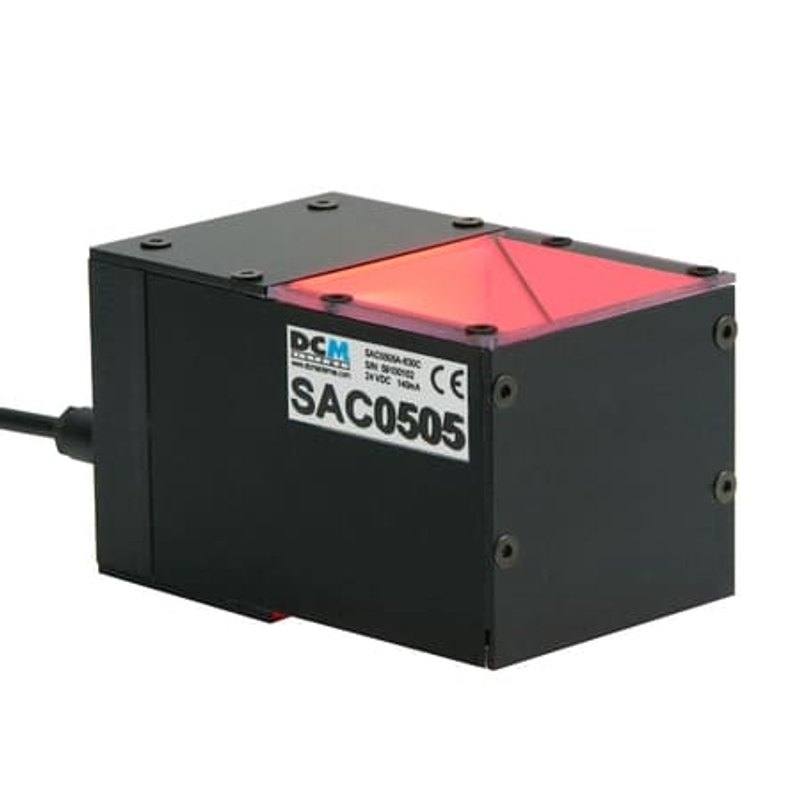
DCM SAC0505A Diffuse Axial Compact Light

SAC0505A

The SAC0505A is the smallest model in DCM Sistemes' SAC series of diffuse axial compact lights, generating diffused illumination coaxial with the camera axis via an integrated beamsplitter. It is available in blue (470nm), green (525nm), red (630nm), infrared (850nm), white (W00), and RGB variants, and supports continuous, strobe, and iBlueDrive integrated-controller operating modes. In continuous mode, power consumption ranges from 3.8W (white) to 4.2W (green/red) at 24VDC; in strobe mode, peak current reaches 615mA (15W) for most wavelengths and 1465mA (35W) for IR. The housing is anodized aluminium rated IP40 with overall dimensions of 100x62x61mm and a recommended working distance under 100mm.

Brand
DCM Sistemes
Lighting type
Diffuse axial (coaxial on-axis)
Color / wavelength
470nm (Blue), 525nm (Green), 630nm (Red), 850nm (IR), RGB, White (W00)
Available wavelengths
470nm (Blue), 525nm (Green), 630nm (Red), 850nm (IR), RGB, White (W00)
Mode
Continuous (C), Strobe (S), iBlueDrive (i)
Working distance
< 100 mm (recommended)
Illuminated area
52 x 50 mm active surface
Dimensions
100 x 62 x 61 mm
Weight
400 g
IP rating
IP40
Supply voltage
24 VDC ±3% (C/S modes); 24 VDC ±8% (iBlueDrive mode)
Power consumption
3.8–4.2 W continuous; up to 15 W strobe (35 W for 850nm strobe)

Technical overview

The DCM SAC0505A is the smallest model in DCM Sistemes' SAC series of diffuse axial compact lights, delivering on-axis illumination across a 52 x 50 mm active surface through an integrated beamsplitter and diffuser assembly housed in an anodized aluminium body measuring 100 x 62 x 61 mm and weighing 400 g. Coaxial geometry means the illumination travels along exactly the same optical axis as the camera, so specular surfaces — polished metal, mirror-finished plastics, glass, bare PCB copper — return light directly back into the lens rather than scattering it to the sides. The integrated diffuser homogenises that return, suppressing hot-spots and producing a flat, evenly lit field across the full active area. At a recommended working distance under 100 mm this geometry is inherently a close-range tool, making it ideal for component-level or label-level inspection where the camera is mounted directly above a part on a conveyor, fixture, or indexing table.

Six wavelength options — 470 nm blue, 525 nm green, 630 nm red, 850 nm near-infrared, broadband white (W00), and RGB — give integrators precise control over contrast. Blue and green wavelengths enhance contrast on yellow or orange substrates and improve character edge sharpness for OCR tasks. Red emphasises surface relief on lighter materials and pairs naturally with red-pass filters to reject ambient light. The 850 nm IR variant is insensitive to visible-spectrum ambient interference, making it reliable on factory floors with variable lighting; its strobe peak current rises to 1465 mA (35 W), roughly double that of the visible wavelengths (615 mA / 15 W), compensating for the lower quantum efficiency of most CMOS and CCD sensors in the near-IR. Continuous mode draws only 3.8–4.2 W at 24 VDC, keeping thermal load minimal in enclosed housings. Strobe mode multiplies effective brightness for short-exposure freeze-motion capture without that sustained heat, though it requires an external VS-series controller. The iBlueDrive mode — activated by the inline ST00 controller connected via the 715 mm aerial 3-pin cable — adds NPN, PNP, TTL, continuous, and dimming control in a single compact inline driver, eliminating the need for a separate DIN-rail controller and simplifying cable routing; in iBlueDrive mode the supply voltage tolerance widens to ±8%, versus ±3% for continuous and strobe modes.

Three operating modes (continuous, strobe, iBlueDrive) give the SAC0505A a broad deployment range. In continuous mode it runs directly from 24 VDC via its 2-pin chassis connector and no external intelligence — the lowest-cost, lowest-complexity integration path, suited to slow-line or triggered-camera setups where the camera's own exposure control is sufficient. Strobe mode demands a VS-series controller but delivers substantially higher peak intensity, enabling very short exposures that freeze motion on high-speed lines while maintaining the low average power and LED lifetime benefits of pulsed drive. iBlueDrive mode sits in between: the ST00 inline controller is compact enough to mount in the cable run rather than in a control cabinet, reducing panel space and wiring, and it supports intensity dimming for fine-tuning uniformity or matching a calibrated reference target. The IP40 housing is suited to clean-room, semiconductor, electronics, and pharmaceutical environments where particulate exclusion matters but liquid wash-down is not required. Operating temperature range of 0–40 °C covers standard factory and laboratory conditions.

Best for

  • Reading printed, laser-marked, or embossed codes and characters on specular label stock, metal nameplates, or glossy packaging — coaxial geometry eliminates the reflective glare that makes character edges disappear under conventional ring or bar lights.
  • Surface-defect inspection of polished or mirror-finished metal parts (turned components, stamped contacts, lead frames) where scratches, pits, and burrs appear as dark interruptions against a bright specular background when lit on-axis.
  • PCB and electronic assembly inspection — bare copper pads, solder paste deposits, and component markings on reflective board surfaces are rendered with high contrast for paste inspection, component presence/polarity checks, and OCR of part date codes.
  • Pharmaceutical and cosmetic primary packaging inspection — foil seals, blister pack windows, vial crimp caps, and embossed lot codes on glossy closures benefit from the flat, shadow-free field the diffuser produces, supporting both dimensional checks and print verification.
  • Compact inline gauging and dimensional measurement of small reflective parts where the 52 x 50 mm active surface and sub-100 mm working distance match directly to short-working-distance macro or telecentric lens setups common in precision metrology cells.

Selection notes

  • Working distance is the most critical mechanical constraint: the recommended envelope is under 100 mm. If the inspection distance imposed by the machine layout exceeds this, consider a larger SAC series model or a different coaxial geometry — brightness falls off rapidly beyond the rated distance for a fixed active area of 52 x 50 mm.
  • Wavelength selection should be made with a sample part in hand before ordering, as the part finish and ink/marking chemistry determine which wavelength maximises contrast. IR (850 nm) is the default choice when ambient light rejection matters most, but note the strobe peak power is 35 W versus 15 W for visible variants — verify the VS-series controller or ST00 iBlueDrive driver is rated for IR strobe at those levels.
  • Mode selection drives cabling and control architecture. Continuous and strobe modes both accept 24 VDC ±3% via the 2-pin chassis connector; continuous requires no external controller while strobe requires a VS-series controller and its associated trigger wiring from the PLC or camera strobe output. iBlueDrive mode requires the ST00 inline driver (24 VDC ±8%); confirm the 715 mm cable length fits the routing between the light and the cabinet before specifying.
  • IP40 protection is adequate for enclosed vision stations and clean-room environments but does not provide liquid or wash-down protection. If the cell uses compressed-air blow-off, coolant mist, or cleaning sprays near the inspection zone, an enclosure or lens-tube baffle should be added to protect the beamsplitter face.
  • The anodised aluminium housing is mechanically compatible with standard dovetail or M-thread bracket systems, but the 100 x 62 x 61 mm footprint and 400 g mass require a rigid, vibration-damped mount. On high-speed indexing lines, verify that the mounting bracket can maintain positional repeatability within the depth of field of the chosen lens, as axial displacement shifts the illuminated field relative to the sensor plane.

Specifications: General
BrandDCM Sistemes
Lighting typeDiffuse axial (coaxial on-axis)

Specifications: Interface
Connection2P male chassis connector (C/S); 3P aerial inline connector L=715mm (iBlueDrive)

Specifications: Optical
Color / wavelength470nm (Blue), 525nm (Green), 630nm (Red), 850nm (IR), RGB, White (W00)
Available wavelengths470nm (Blue), 525nm (Green), 630nm (Red), 850nm (IR), RGB, White (W00)
Working distance< 100 mm (recommended)
DiffuserYes – integrated diffuser for uniform axial output

Specifications: Electrical
ModeContinuous (C), Strobe (S), iBlueDrive (i)
Supply voltage24 VDC ±3% (C/S modes); 24 VDC ±8% (iBlueDrive mode)
Power consumption3.8–4.2 W continuous; up to 15 W strobe (35 W for 850nm strobe)
Controller requiredNo external controller required for continuous mode; strobe controller (VS series) required for strobe mode; iBlueDrive inline ST00 required for iBlueDrive mode
Driver technologyiBlueDrive inline controller (ST00); supports NPN, PNP, TTL, continuous, dim modes

Specifications: Environment
IP ratingIP40
Operating temperature0 – 40 °C

Specifications: Geometry
Illuminated area52 x 50 mm active surface

Specifications: Mechanical
Dimensions100 x 62 x 61 mm
Weight400 g
Housing materialAnodized aluminium

Frequently asked questions

Related technical guides

Rosepetal · AI

Test this camera with Rosepetal

Validate your visual inspection with AI: send us sample images and we evaluate the case on your hardware.

AIS Vision · Integration

We validate camera + lens + lighting

AIS Vision defines and tests the optimal combination of camera, optics and lighting for your application before you buy.