Skip to content
Omron / Sentech FLV-CL40 machine vision lighting
  • Rosepetal compatible
  • Recommended by AIS Vision

Omron / Sentech FLV-CL40 Coaxial Light

FLV-CL40

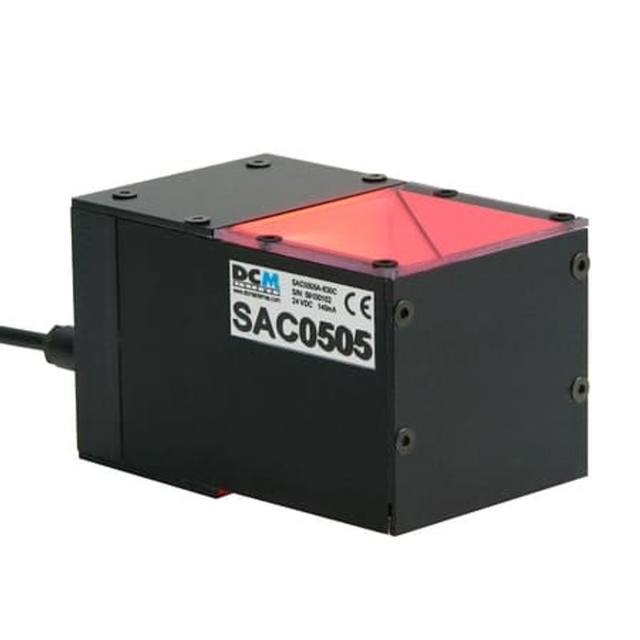
The FLV-CL40 is part of Omron's FLV Series coaxial lighting line, using a half-mirror and diffusion plate to project light coaxially through the optical axis of a vision lens, eliminating shadow artefacts on highly reflective surfaces such as semiconductor chips, silicon wafers, BGA pads, and laser-marked components. The housing is aluminium alloy with an emitting surface of 25 mm and a cable of 0.8 m. Three wavelength variants are available: white (FLV-CL40W, 3.9 W), red at 635 nm (FLV-CL40R, 2.3 W), and blue at 460 nm (FLV-CL40B, 3.9 W). The unit is passively powered through a dedicated Omron lighting controller (FLV-TCC or FLV-ATC series) and weighs approximately 170 g.

Brand
Omron / Sentech
Lighting type
Coaxial
Color / wavelength
White / Red (635 nm) / Blue (460 nm)
Available wavelengths
White, Red (Typ. 635 nm), Blue (Typ. 460 nm)
Mode
Continuous and trigger lighting (via controller)
Controller required
Yes — FLV-TCC4/TCC1/TCC3HB or FLV-ATC□1024
Diffuser
Yes — internal diffusion plate and half-mirror
Illuminated area
34 mm emitting surface (square)
Power consumption
3.9 W (White/Blue); 2.3 W (Red)
Supply voltage
12 VDC (camera) or 24 VDC external via lighting controller
IP rating
IP20 (IEC60529)
Housing material
Aluminium alloy case

Technical overview

The Omron FLV-CL40 is a coaxial LED illuminator built around a half-mirror and internal diffusion plate that redirects light along the exact optical axis of the vision lens. This geometry is what separates coaxial lighting from ring or dome alternatives: by projecting light collinearly with the camera's line of sight, it returns specular reflections only from surfaces that are flat and perpendicular to the axis, while any raised edge, scratch, contamination particle, or height change scatters light away from the sensor and registers as a dark feature against a bright field. The result is high-contrast imaging of surface features on highly reflective targets — semiconductor chips, BGA solder pads, silicon wafers, mirror-polished metal stampings, and laser-marked glossy plastics — without the hot-spot gradients that plague ring lights on these same surfaces.

Three wavelength variants address the spectral sensitivity of the camera and the optical properties of the workpiece. The white variant (FLV-CL40W, 3.9 W) suits broadband monochrome or colour cameras and general-purpose work where spectral tuning is not required. The red variant (FLV-CL40R, 635 nm typical, 2.3 W) pairs well with silicon-based monochrome CMOS and CCD sensors and is the standard choice for reading laser marks, printed codes, and etched part numbers on metal. The blue variant (FLV-CL40B, 460 nm typical, 3.9 W) provides shorter-wavelength illumination suited to fluorescence suppression, detecting fine surface cracks on metals, or imaging through AR coatings. The 40 mm outer diameter and 74 mm height keep the unit compact enough to fit inside tight gantry or pick-and-place envelopes, and the aluminium alloy housing manages heat passively within the 0–50 °C operating range.

The FLV-CL40 is powered and controlled exclusively through a compatible Omron lighting controller — FLV-TCC4, FLV-TCC1, FLV-TCC3HB, or FLV-ATC series — via its 0.8 m proprietary cable. The controller provides both continuous and triggered (strobe) lighting modes; strobe mode allows the illuminator to be driven at higher-than-continuous current for very short exposures, which is the primary technique for freezing motion on moving conveyor targets without motion blur while keeping average LED junction temperature, and therefore lifetime, within specification. The IP20 rating means the unit requires a clean, dry cabinet or fixture enclosure — it is not splash-rated — consistent with the controlled environments typical for semiconductor back-end, PCB assembly, and pharmaceutical blister inspection.

Best for

  • Reading laser marks, dot-peen marks, and direct part marking (DPM) codes on reflective metal components, where the coaxial geometry suppresses background glare and renders the mark as a dark feature on a bright field.
  • BGA and QFP solder joint inspection on PCBs, where the half-mirror delivers even axial illumination across the pad array and avoids the highlight asymmetry caused by angled ring lights.
  • Surface defect detection on mirror-polished or semi-specular parts such as silicon wafers, polished stampings, and thin-film coatings, where scratches and particulates scatter coaxial light and become clearly visible.
  • OCR and OCV of printed, embossed, or laser-engraved text on pharmaceutical blister packs, medical device labels, and electronic component markings, where consistent flat-field illumination is needed for reliable character segmentation.
  • Dimensional gauging on flat, reflective workpieces where a uniform bright field removes illumination-induced edge-location errors that would otherwise inflate measurement uncertainty.

Selection notes

  • Controller compatibility is mandatory: the FLV-CL40 has no standalone power input. Budget for one of the FLV-TCC or FLV-ATC series controllers; confirm the controller channel count against the number of lighting zones in your station before ordering.
  • The 25 mm emitting surface (housed in a 40 mm outer body) defines the effective illuminated field. Match this to your camera's field of view and working distance: if your FOV significantly exceeds the emitting area, illumination uniformity will fall off at the edges and create a non-flat field that complicates thresholding.
  • Wavelength selection should be driven by the camera's QE curve and the workpiece's spectral reflectance. The red (635 nm) variant typically yields the highest signal-to-noise on standard silicon CMOS sensors and also draws less power (2.3 W vs 3.9 W for white and blue). The blue (460 nm) variant demands a camera with adequate blue-range sensitivity and may require longer exposure times to compensate for the lower reflectivity of most metals at shorter wavelengths.
  • IP20 rating limits use to clean, dry environments. Coolant mist, dust ingress, or wash-down cycles in an automotive or food-grade environment will require an enclosure. Do not specify this unit for open-floor installations near cutting or grinding operations without an appropriate housing.
  • Strobe mode (via controller) is the preferred operating mode for moving-line applications: it freezes motion and improves apparent brightness while preserving LED lifetime. Size the strobe pulse width and camera exposure together — confirm the controller's maximum strobe current and duty cycle limits to avoid exceeding the LED's thermal rating.

Specifications: General
BrandOmron / Sentech
Lighting typeCoaxial

Specifications: Interface
Connection0.8 m cable (3.5 mm dia), proprietary lighting controller connector

Specifications: Optical
Color / wavelengthWhite / Red (635 nm) / Blue (460 nm)
Available wavelengthsWhite, Red (Typ. 635 nm), Blue (Typ. 460 nm)
DiffuserYes — internal diffusion plate and half-mirror

Specifications: Electrical
ModeContinuous and trigger lighting (via controller)
Controller requiredYes — FLV-TCC4/TCC1/TCC3HB or FLV-ATC□1024
Power consumption3.9 W (White/Blue); 2.3 W (Red)
Supply voltage12 VDC (camera) or 24 VDC external via lighting controller

Specifications: Environment
IP ratingIP20 (IEC60529)
Operating temperatureOperating: 0 to +50°C; Storage: −15 to +60°C

Specifications: Geometry
Illuminated area34 mm emitting surface (square)

Specifications: Mechanical
Housing materialAluminium alloy case
Dimensions40 mm dia × 74 mm H (outer)
WeightApprox. 170 g

Frequently asked questions

Related technical guides

Rosepetal · AI

Test this camera with Rosepetal

Validate your visual inspection with AI: send us sample images and we evaluate the case on your hardware.

AIS Vision · Integration

We validate camera + lens + lighting

AIS Vision defines and tests the optimal combination of camera, optics and lighting for your application before you buy.