Skip to content
DCM Sistemes SAL0202A machine vision lighting
  • Rosepetal compatible
  • Recommended by AIS Vision

DCM Sistemes SAL0202A 90° Diffuse Axial Light

SAL0202A

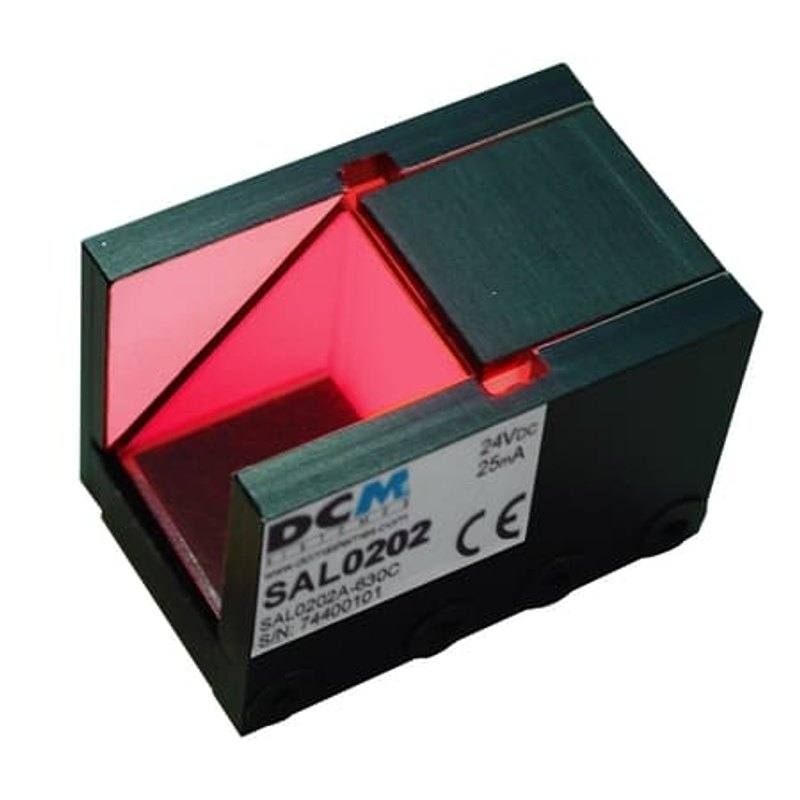
The SAL0202A is the smallest model in DCM Sistemes' SAL series of 90° diffuse axial coaxial lights, projecting light through a beamsplitter so the camera images the part along the same optical axis to eliminate reflections and shadows. It has a 17x17 mm active surface in a 38x25x30 mm housing, weighs 65 g, is rated IP40, and recommends a working distance below 100 mm. Standard Type C (continuous) units draw 0.6 W at 24 VDC and are available in blue (470 nm), green (525 nm), red (630 nm), IR (850 nm) and white; strobe (Type S) and iBlueDrive (Type i) intelligent variants are also offered. The base model connects via a 1.8 m 2-pin flying-lead cable (BN=+24V, BU=0V), while iBlueDrive versions use a 3-pin aerial male inline connector and require an iBlueDrive controller.

Brand
DCM Sistemes
Lighting type
90° diffuse axial / coaxial (on-axis)
Color / wavelength
Available: white, blue (470 nm), green (525 nm), red (630 nm), IR (850 nm)
Available wavelengths
White (W00), Blue 470 nm, Green 525 nm, Red 630 nm, IR 850 nm
Mode
Continuous (Type C); also Strobe (Type S) and iBlueDrive intelligent (Type i)
Diffuser
Yes - diffuse axial illumination via beamsplitter
Emission angle
Diffuse (on-axis)
Working distance
RWD < 100 mm
Illuminated area
Active surface 17 x 17 mm
Controller required
No for Type C/S; iBlueDrive (Type i) variant requires iBlueDrive controller
IP rating
IP40
Power consumption
0.6 W (Type C, all colors @ 24 VDC); up to 5 W strobe / 5.3 W iBlueDrive peak

Technical overview

The SAL0202A is the smallest model in DCM Sistemes' SAL series of 90-degree diffuse axial (coaxial, on-axis) lights. Rather than illuminating a part from an angle, it projects diffuse light through an internal beamsplitter so that the illumination and the camera's line of sight share the same optical axis. The practical effect for an installer is that flat, specular surfaces light up uniformly without the bright hotspots, oblique shadows, or directional glare you get from a ring or bar light. Light that reflects straight back from a flat, mirror-like region returns to the sensor, while anything that disrupts that flatness — a scratch, an engraved character, a printed mark, a coplanar defect — deflects light away and reads as a contrast change. That makes this geometry a contrast-generation tool, not just a brightness source.

Physically it is built for tight, close-range stations. The active emission surface is 17 x 17 mm inside a compact 38 x 25 x 30 mm housing weighing only 65 g, and DCM specifies a recommended working distance below 100 mm. The small aperture and short working distance mean it is sized to flood a field of view on the order of its emission window, so it suits small parts, code fields, and localized surface zones rather than large web or full-pallet scenes. Because on-axis light only works when the imaged surface is reasonably flat and reflective, the 17 x 17 mm window and sub-100 mm RWD define both the sweet spot and the limit: keep the inspected feature flat, square to the axis, and within that compact footprint. The IP40 rating signals a clean, indoor, enclosed-cell deployment rather than a washdown or heavily contaminated environment.

Wavelength choice is where this fixture is tuned to the application. The standard continuous unit (Type C) draws just 0.6 W at 24 VDC +/-3% and ships in white plus discrete blue (470 nm), green (525 nm), red (630 nm), and IR (850 nm) options, letting the integrator pick the band that maximizes contrast against the substrate — for example a monochrome wavelength to sharpen a mark on metal. The base model wires in over a 1.8 m 2-pin flying-lead cable (BN = +24 V, BU = 0 V), so it drops straight onto a 24 VDC rail with no controller needed. For triggered or pulsed work, DCM offers a Strobe (Type S) variant rated up to 5 W peak and an iBlueDrive intelligent (Type i) variant rated up to 5.3 W peak that uses a 3-pin aerial male inline connector and an iBlueDrive controller, the route to take when the application needs overdrive, precise strobe timing synchronized to camera exposure, or per-pulse intensity control.

Best for

  • On-axis surface inspection of flat, specular parts such as polished metal, semiconductor wafers, or coated surfaces, where uniform shadow- and glare-free light exposes scratches and coplanar defects
  • Reading low-contrast direct-part-marked codes (dot-peen, laser-etched) and printed traceability marks on flat reflective substrates within a small field
  • OCR/OCV of engraved or printed characters on shiny components where directional lighting would create unreadable hotspots
  • Compact close-range stations (RWD < 100 mm) imaging small electronics, connectors, or stamped metal parts that fit the 17 x 17 mm emission window
  • Triggered or high-speed lines using the Strobe (Type S) or iBlueDrive (Type i) variant to freeze motion and synchronize pulsed illumination to camera exposure

Selection notes

  • Geometry is application-defining: on-axis coaxial light only delivers its glare-free advantage on flat, reflective surfaces square to the optical axis. Curved, matte, or tilted parts will not benefit and may need a different geometry.
  • Size the scene to the hardware: the 17 x 17 mm active surface and recommended working distance below 100 mm make this a small-field, close-range fixture — verify your feature of interest fits within that footprint before designing it in.
  • Match wavelength to substrate contrast. Choose among white, blue 470 nm, green 525 nm, red 630 nm, or IR 850 nm to maximize the mark-to-background contrast; pick the band per part rather than defaulting to white.
  • Decide on lighting mode early. The 0.6 W continuous Type C wires directly to 24 VDC over its 1.8 m 2-pin flying leads with no controller, but if you need strobe overdrive (Type S, up to 5 W) or intelligent per-pulse control (Type i, up to 5.3 W), the iBlueDrive variant requires the iBlueDrive controller and a 3-pin connector — budget for that hardware and integration.
  • Plan for the environment: IP40 suits clean, enclosed indoor cells within a 0 to 40 C operating range, not washdown or dusty/wet areas; add protection if the station is exposed.

Specifications: General
BrandDCM Sistemes
Lighting type90° diffuse axial / coaxial (on-axis)

Specifications: Interface
Connection2P flying leads, L=1.8 m (BN=+24V, BU=0V); iBlueDrive: 3P aerial male inline connector L=715 mm

Specifications: Optical
Color / wavelengthAvailable: white, blue (470 nm), green (525 nm), red (630 nm), IR (850 nm)
Available wavelengthsWhite (W00), Blue 470 nm, Green 525 nm, Red 630 nm, IR 850 nm
DiffuserYes - diffuse axial illumination via beamsplitter
Emission angleDiffuse (on-axis)
Working distanceRWD < 100 mm

Specifications: Electrical
ModeContinuous (Type C); also Strobe (Type S) and iBlueDrive intelligent (Type i)
Controller requiredNo for Type C/S; iBlueDrive (Type i) variant requires iBlueDrive controller
Power consumption0.6 W (Type C, all colors @ 24 VDC); up to 5 W strobe / 5.3 W iBlueDrive peak
Supply voltage24 VDC ±3% (Type C/S); ±8% via iBlueDrive

Specifications: Environment
IP ratingIP40
Operating temperatureOperating 0 - 40 °C (storage 0 - 60 °C)

Specifications: Geometry
Illuminated areaActive surface 17 x 17 mm

Specifications: Mechanical
Dimensions38 x 25 x 30 mm
Weight65 g

Frequently asked questions

Related technical guides

Rosepetal · AI

Test this camera with Rosepetal

Validate your visual inspection with AI: send us sample images and we evaluate the case on your hardware.

AIS Vision · Integration

We validate camera + lens + lighting

AIS Vision defines and tests the optimal combination of camera, optics and lighting for your application before you buy.