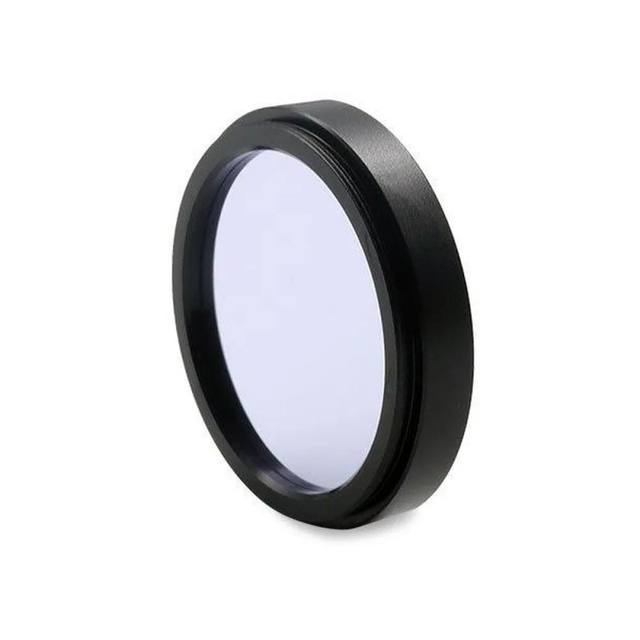
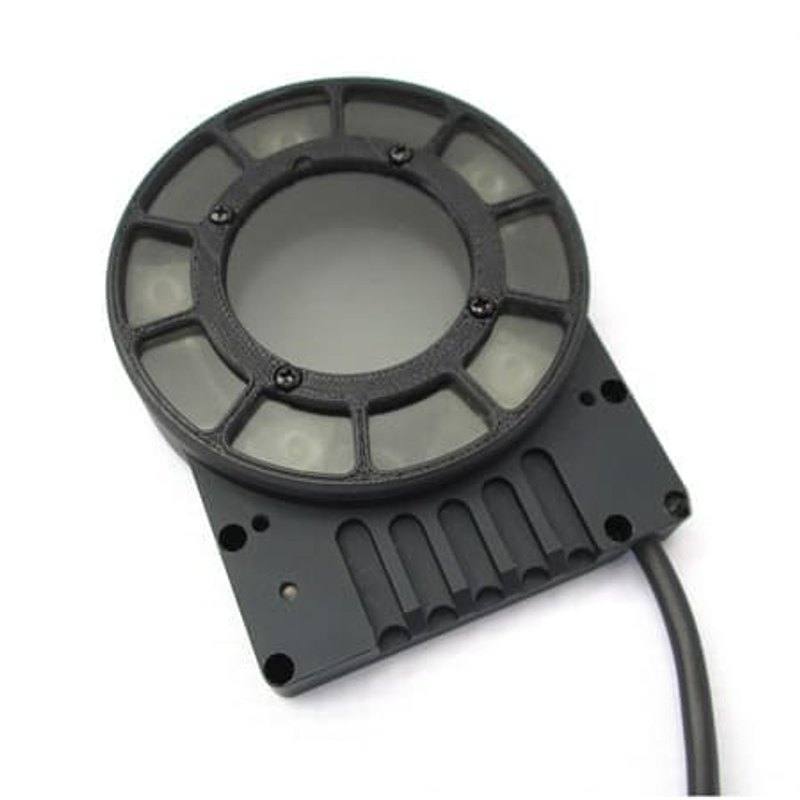
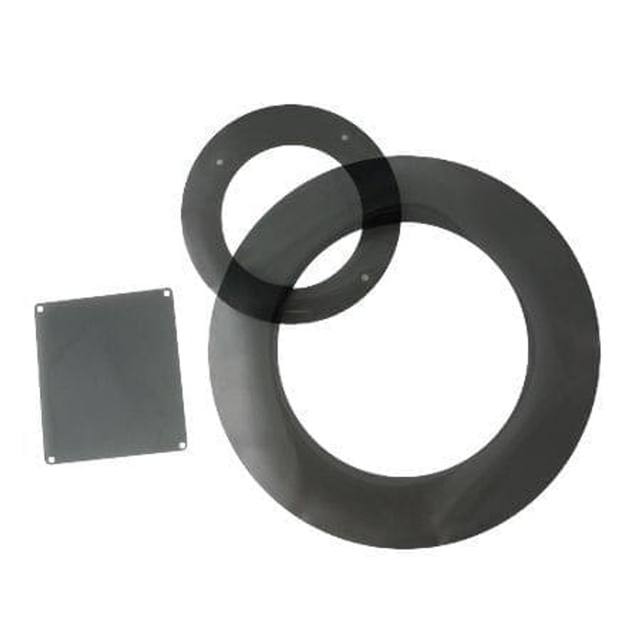
The VPC Series is a cross-polarizer antiglare filter set specifically engineered for DCM Sistemes ALB series direct ring lights (ALB0804A, ALB0810A, ALB1716A). It consists of two factory-matched and factory-aligned linear polarizing filters orientated at 90° to each other: one is mounted on the LED lighting unit and one is placed in front of the camera lens, creating a crossed-polarization arrangement that rejects directly reflected (specular) light while transmitting diffusely scattered light from the inspected surface. The kit is pre-adjusted from the factory and requires no field alignment. By combining the light filter and optical filter in a single accessory kit, the VPC reduces system cost and setup complexity. The specific model for the ALB0804A and ALB0810A lights is VPCALB0804A (USD 110 via Soda Vision); the model for the ALB1716A is VPCALB1716A.
The VPC Series is a factory-matched cross-polarization kit designed to work as an integrated system with DCM Sistemes ALB direct ring lights (ALB0804A, ALB0810A, and ALB1716A). Cross-polarization works by placing two linear polarizing filters oriented at exactly 90 degrees to each other: one filter sits on the lighting unit and polarizes the outgoing illumination, while the second filter mounts in front of the camera lens. Specular reflections — the bright mirror-like hotspots produced when polarized light bounces directly off a shiny surface — retain their polarization state and are blocked by the orthogonally-aligned camera filter. Diffusely scattered light, which randomizes its polarization upon interacting with surface texture or sub-surface structure, passes through the camera filter and reaches the sensor. The result is an image where reflective glare is suppressed and true surface detail — scratches, contamination, print defects, dimensional edges — becomes visible against a more uniform background.
Because the polarizer pair is factory-aligned and factory-matched to the specific ALB light geometry, no field calibration of the polarizer angles is required. The kit is sold as a matched two-piece set — model VPCALB0804A covers the ALB0804A and ALB0810A ring lights, while VPCALB1716A is matched to the larger ALB1716A — ensuring the spatial extent of the polarizing film on the light side correctly covers the ring aperture for that fixture. By combining both filters in a single accessory kit, the VPC reduces system cost and setup complexity compared to sourcing and aligning individual polarizing films separately. The system operates across a standard industrial temperature range of 0 to 40 degrees Celsius.
As with all cross-polarizer arrangements, users should expect a meaningful reduction in transmitted light intensity relative to unpolarized illumination: each polarizing filter transmits roughly 50 percent of randomly polarized light in isolation, and the crossed arrangement further attenuates diffuse return. In practice this means the camera exposure time, gain, or light output power typically needs to be increased compared to a standard direct-ring setup. This trade-off is almost always worthwhile when inspecting polished metals, lacquered or varnished surfaces, glass, wet materials, electronic component leads, or any substrate where specular reflections would otherwise mask the features under inspection.
Best for
Inspection of polished or mirror-like metallic surfaces — such as stamped automotive parts, machined components, or connector pins — where specular hotspots from direct ring lighting obscure surface defects.
Packaging and label inspection on glossy, laminated, or foil-backed materials where reflective glare prevents reliable OCR, barcode reading, or print-quality verification.
Electronics and semiconductor inspection of solder joints, PCB traces, and IC package surfaces, where bare-metal and resin surfaces produce mixed specular and diffuse reflections that confuse defect classifiers.
Quality control of lacquered, painted, or varnished parts in automotive and consumer-goods manufacturing, where the coating gloss level varies across the production run.
Any application already using DCM Sistemes ALB series direct ring lights that needs to upgrade to glare-free imaging without replacing the lighting hardware — the VPC kit integrates directly with the existing fixture.
Selection notes
Match the VPC model to the specific ALB light in use: VPCALB0804A is for the ALB0804A and ALB0810A ring lights; VPCALB1716A is for the ALB1716A. The polarizing film on the light-side filter is sized to the ring aperture of its matched fixture — using a mismatched model will leave portions of the ring unpolarized and defeat the glare-rejection function.
Plan for a meaningful reduction in effective light level compared to standard direct-ring operation. To compensate, consider widening the camera aperture if the lens permits, increasing sensor gain (monitoring for acceptable SNR), or extending exposure time (monitoring for motion blur on moving parts).
Cross-polarization is optimized for specular surfaces. On truly diffuse, matte, or rough surfaces — where there is little or no specular component to eliminate — the technique offers minimal contrast benefit while still imposing the light-level penalty. Evaluate whether the target surface type genuinely produces disruptive specular reflections before selecting this kit.
The system is rated for 0 to 40 degrees Celsius. In environments near this upper boundary — such as high-ambient industrial cells — verify that the camera-side filter mount does not contact the lens barrel in a way that traps heat near the polarizing film, as sustained elevated temperatures can degrade polarizer transmission uniformity.
For maximum glare-rejection efficiency, verify that no ambient light sources in the inspection cell are unpolarized and bright enough to contribute a competing specular component. In cells with strong overhead fluorescent or daylight ingress, add shielding or use a darkfield enclosure alongside the VPC kit.
Specifications: General
Brand
DCM Sistemes
Specifications: Optical
Filter type
Cross-polarizer (antiglare)
Specifications: Environment
Operating temperature
0–40°C
Applications this camera is commonly selected for. Open one to see the full recommended hardware and approach.
Diffuse and dome lights reduce glare by spreading illumination across a wide solid angle so that no single specular reflection path dominates. A cross-polarizer takes the opposite approach: it keeps the direct ring geometry (and its working-distance and contrast advantages) but physically blocks the specular return path using the orthogonal polarizer pair. For surfaces that still produce concentrated specular reflections even under dome lighting — such as mirror-polished metals or flat glass — cross-polarization can deliver cleaner glare suppression without changing the lighting geometry.
Yes. The camera-side filter is a standard optical polarizer that mounts in front of the camera lens; it is not specific to any camera brand or model. The key constraint is that the light-side filter must match the ALB ring light fixture in use (VPCALB0804A for ALB0804A and ALB0810A, or VPCALB1716A for ALB1716A). Any area-scan camera — regardless of manufacturer — paired with a compatible lens and the correct ALB light can use this kit.
Yes, and these are among the most common use cases. Semi-gloss and anodized surfaces produce a mixture of specular and diffuse reflectance. The cross-polarizer selectively suppresses the specular component while transmitting the diffuse component, which typically reveals underlying texture and color more clearly. The degree of improvement depends on the ratio of specular to diffuse reflectance for the specific material and finish.
No field alignment is required. DCM Sistemes factory-aligns and factory-matches the two polarizers at exactly 90 degrees before shipping. Simply mount the light-side filter on the ALB ring fixture and the camera-side filter in front of the lens as directed in the installation guide. This factory alignment is one of the primary advantages of the VPC kit over sourcing individual polarizing films separately.
Each linear polarizer transmits approximately 50 percent of randomly polarized incident light. With both polarizers in the crossed arrangement, total light throughput for diffuse (non-specular) return is substantially reduced. To compensate, open the aperture, raise sensor gain, or lengthen exposure time as needed, balancing against depth-of-field requirements and motion blur constraints for the application.