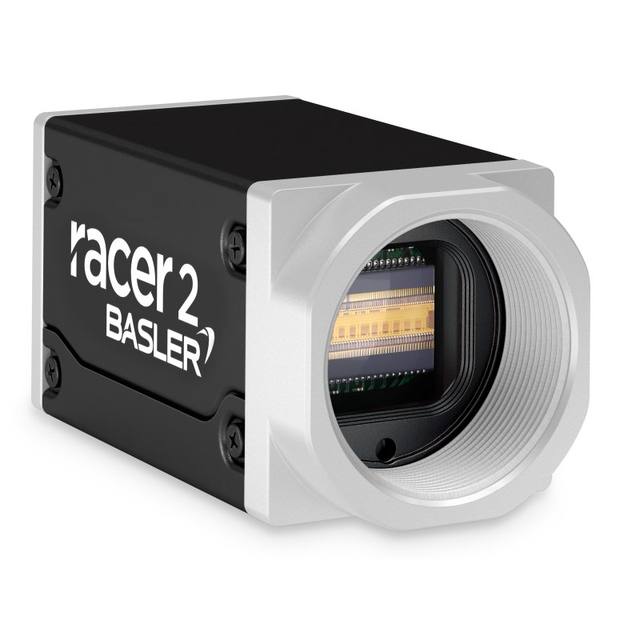
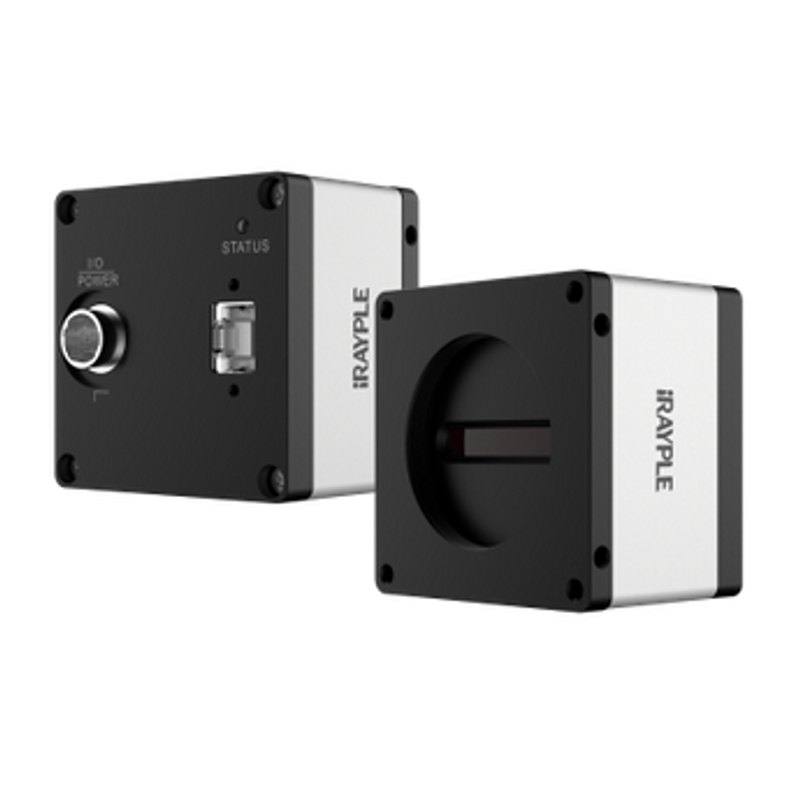
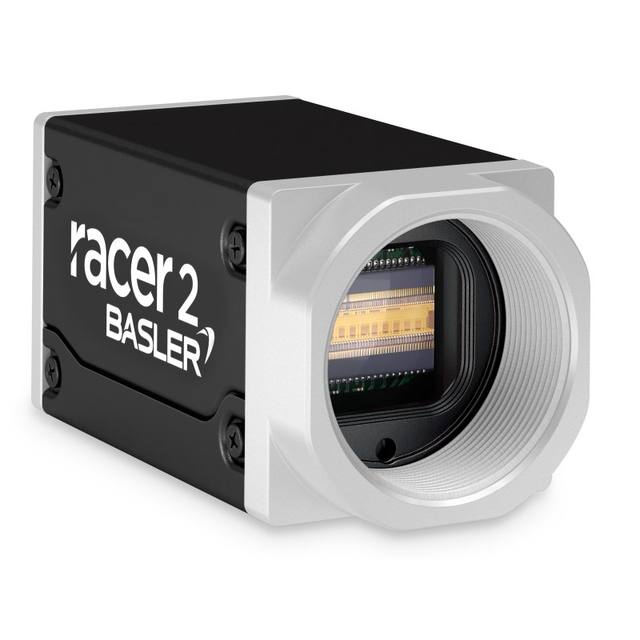
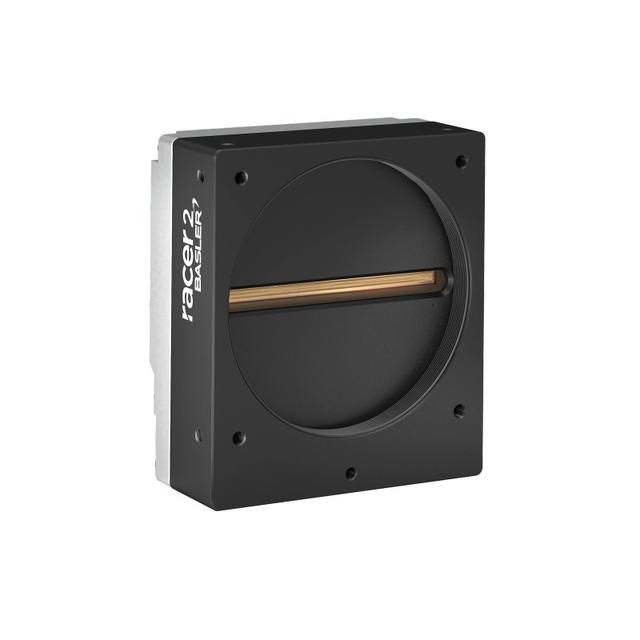
The L5047MG140E is a 4K GigE line scan camera built around a 4K CMOS sensor (Gpixel) with 4096 pixels per line at a 7 × 7 µm pixel pitch. At 28 kHz maximum line rate, a web or conveyor moving at 196 mm/s yields a 7 µm along-web pitch — matching the cross-web pixel size for square pixels — or, with coarser along-web sampling of 10 µm/pixel, the line rate supports web speeds up to 280 mm/s. The 12-bit analogue-to-digital conversion produces 4096 grey levels (or Bayer colour levels on the L5047CG140E), preserving subtle contrast gradients that 8-bit cameras crush; this is especially useful in graded-defect classification and AI-based anomaly detection where pixel-level dynamic range feeds the training pipeline. The sensor's >39 dB SNR and 66 dB wide dynamic range mean bright specular highlights and dark matte regions on the same object — common in battery electrode or metal sheet inspection — can both be faithfully captured without saturation or noise floors obscuring relevant texture.
For the mono variant (L5047MG140E), output formats are Mono8, Mono10, and Mono12, giving integrators the choice between bandwidth-efficient 8-bit streaming at full 28 kHz and full-fidelity 12-bit capture when downstream algorithms demand the headroom. The colour variant (L5047CG140E) uses a two-line Bayer array (4096 × 2) and supports BayerRG8/10/12, RGB8Packed, and YUV422Packed — the YUV option halves colour bandwidth over the GigE link while retaining perceptual colour fidelity for print registration and label verification. Both cameras communicate over standard GigE Vision / GenICam, so any compliant SDK (Halcon, VisionPro, pylon, Sapera) can control them without custom drivers. The 64 MB onboard image cache absorbs line-rate bursts during host processing spikes, reducing dropped-line risk on non-real-time operating systems. Onboard PRNU and FPN correction flatten pixel-to-pixel gain and offset non-uniformity across the 4096-element array, a prerequisite for accurate grey-level thresholding over wide fields without per-installation shading calibration.
The M42 × 1 lens mount is the standard thread for line scan optics, giving access to the full range of telecentric and fixed-magnification lenses commonly used in high-accuracy gauging. The active sensor width is 4096 × 7 µm = 28.67 mm, so lenses must cover at minimum a 29 mm image circle. At 62 × 62 × 43.5 mm and 245 g, the camera fits inside compact scanner housings alongside a line light without encroaching on beam path clearance. Power is drawn over a 12-pin Hirose connector accepting DC 12–24 V at 4.5 W, compatible with both 12 V DIN-rail supplies and 24 V PLC-side power rails common in factory automation panels. The differential GPIO supports encoder-triggered acquisition for encoder-slaved scanning on conveyor systems where belt speed varies; the same I/O can drive a strobe signal to synchronise a line light in flash mode, keeping average power low and line radiance high. An operating range of −30 °C to +50 °C covers refrigerated food and pharmaceutical lines at the cold end, and unventilated scanner enclosures in warm production halls at the top.
Best for
- Continuous web and roll-to-roll surface inspection — films, paper, textiles, or metal strip — where the 28 kHz line rate and 4096-pixel swath deliver fine spatial sampling across wide, fast-moving material without mechanical scan heads.
- Flat-panel display and semiconductor wafer surface defect detection, where the 66 dB WDR handles mixed-reflectance surfaces and 12-bit depth supports grey-level defect classification algorithms that distinguish scratch depth from particle contamination.
- Colour print registration and label verification on packaging lines, using the L5047CG140E variant's BayerRG and RGB8Packed outputs to compare printed colour patches, barcodes, and date codes against golden samples in a single pass.
- Battery electrode and tab inspection in EV cell manufacturing, where the combination of high SNR, FPN/PRNU correction, and 12-bit dynamic range resolves fine coating-edge irregularities and pinholes on metallic foil that appear as subtle grey-level shifts.
- Dimensional measurement of strip or sheet material using a calibrated telecentric or fixed-magnification M42 line scan lens, exploiting the uniform 7 µm pixel pitch and onboard shading correction to achieve sub-pixel edge detection across the full 4096-pixel array.
Selection notes
- GigE bandwidth ceiling at 28 kHz full resolution: a single GigE link (125 MB/s usable) supports Mono8 at approximately 28 kHz (4096 bytes/line × 28 000 lines/s ≈ 115 MB/s), leaving little headroom. Switching to Mono12Packed or RGB8Packed at full line rate will exceed the link — use the 64 MB cache and lower pixel clock, or plan for a 10GigE frame grabber upgrade path if throughput needs to grow.
- Lens selection must match the 7 µm pixel pitch to avoid being the resolution bottleneck. Choose a line scan lens whose MTF at the Nyquist frequency (71 lp/mm at the sensor) is specified, and verify the image circle covers 4096 × 7 µm = 28.67 mm at the chosen working distance. M42 telecentric lenses are preferred when dimensional accuracy matters; standard finite-conjugate line scan lenses are adequate for surface texture inspection.
- Colour variant Bayer interpolation introduces a half-pixel resolution penalty in one axis; if both colour fidelity and full spatial resolution are simultaneously required, consider a tri-linear (RGB) line scan camera instead. The L5047CG140E is well suited to colour verification tasks where the colour channel is the primary discriminant, not fine spatial edge detection.
- Trigger and encoder wiring: the differential GPIO requires a differential encoder signal (RS-422 level) or a level-conversion board from single-ended 24 V encoder outputs. Confirm the encoder resolution delivers the desired along-web pixel pitch — at 7 µm cross-web, matching along-web pitch needs encoder pulses spaced to trigger one line per 7 µm of travel for square pixels.
- Thermal management: 4.5 W dissipation in a 62 × 62 mm aluminium body is moderate but should be considered in sealed enclosures. Mounting via the housing's threaded faces to a metal bracket or scanning bar acts as a heat sink and keeps operating temperature within the −30 °C to +50 °C envelope.