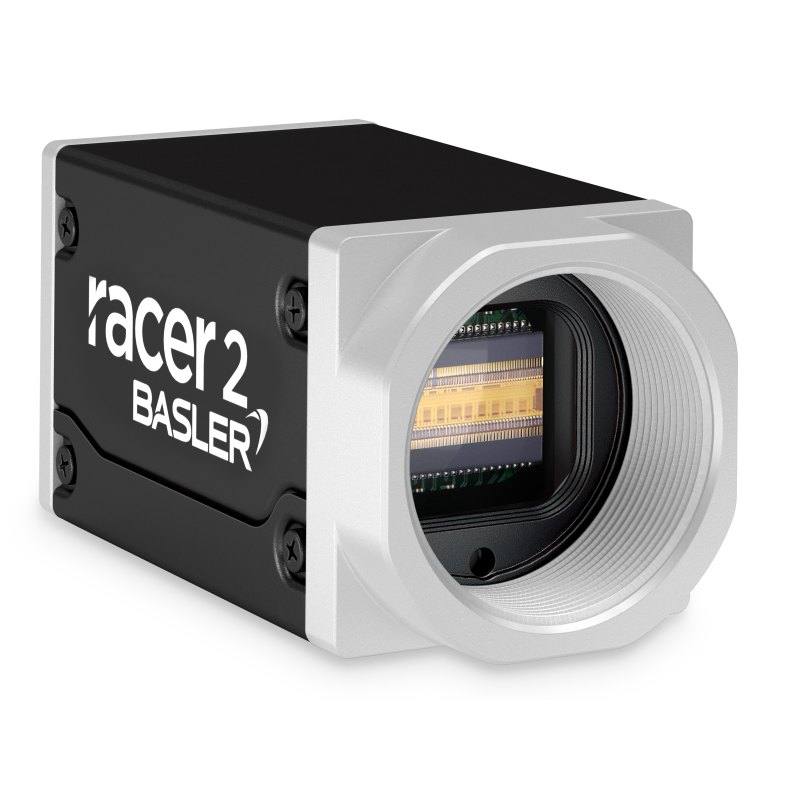
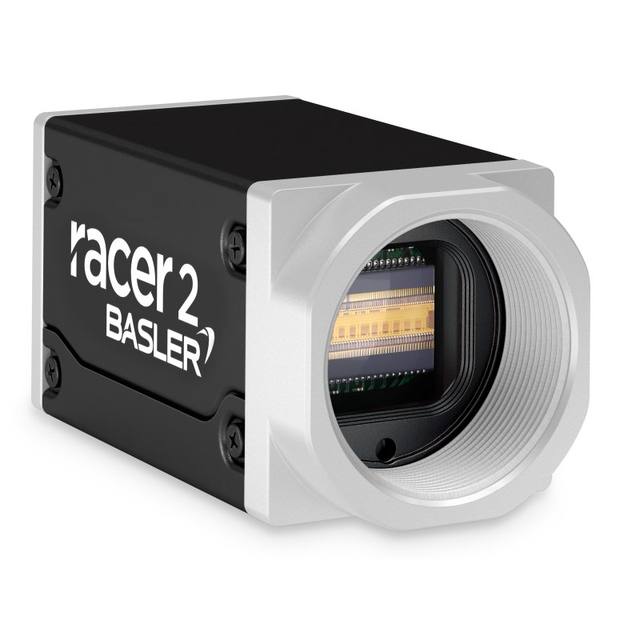
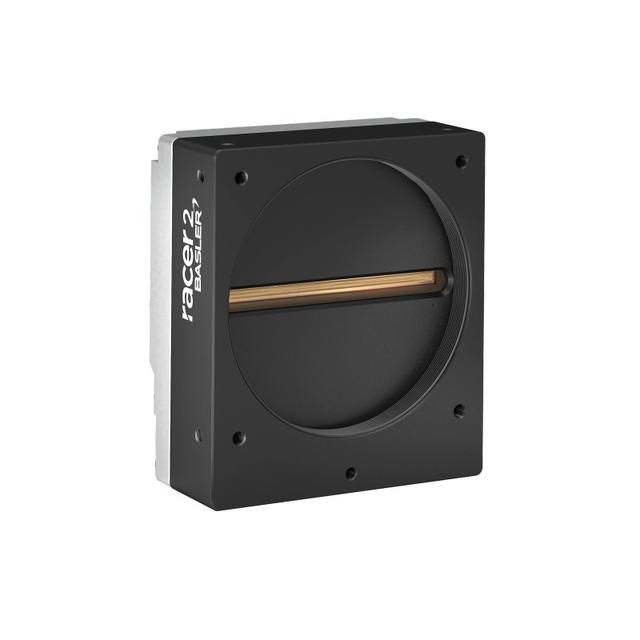
The Basler r2L4096-29gm is a compact GigE line scan camera in the racer 2 S family, featuring a 4096 x 1 pixel Gpixel GL3504 monochrome CMOS sensor with global shutter and 3.5 µm square pixels. It achieves a standard line rate of 29 kHz over a standard GigE interface (100/1000 Mbit/s), with a maximum free-run line rate of 84.3 kHz under optimized settings. The camera supports Power over Ethernet (IEEE 802.3af) or 12–24 VDC via its M8 I/O connector, and conforms to GigE Vision 2.0 and GenICam standards. Its compact 55.5 × 29 × 29 mm housing weighs under 100 g and carries an IP30 ingress protection rating.
The Basler racer 2 r2L4096-29gm is a 4096-pixel monochrome line scan camera built around the Gpixel GL3504 CMOS sensor, with 3.5 µm square pixels arrayed across a 14.34 mm sensor length. What distinguishes this sensor from CCD-based alternatives is its global shutter architecture: every pixel integrates simultaneously rather than sequentially, which eliminates the smear and geometric distortion that rolling-shutter sensors introduce on fast-moving webs or conveyor lines. For an installer, this means the camera tolerates imperfect encoder synchronization and brief illumination transients without producing line-to-line artifacts — a meaningful benefit when commissioning lines where encoder jitter or lighting ripple is hard to eliminate entirely. At 3.5 µm pitch over 4096 pixels, the sensor covers 14.34 mm optically, giving you a resolution budget that maps cleanly onto common inspection widths when paired with an appropriate C-mount line scan lens.
The camera's standard line rate of 29 kHz over GigE (100/1000 Mbit/s) is the operative figure for sustained, lossless image transfer: at 29 kHz the 4096-pixel line data fits within the 1 Gigabit Ethernet bandwidth envelope with headroom for protocol overhead. The maximum free-run rate of 84.3 kHz is available in reduced-bandwidth or triggered-burst scenarios where not every line must reach the host — useful for characterizing sensor response or burst-mode acquisition, but not for continuous full-throughput inspection. For a packaging line running at 2 m/s and requiring 100 µm cross-web resolution, 29 kHz comfortably supports down-web pixel pitches well below 100 µm with typical encoder-triggered operation. Power delivery via PoE (IEEE 802.3af) or 12–24 VDC through the M8 I/O connector gives integrators flexibility: PoE simplifies cabling on gantries and roller frames where pulling a separate power cable is awkward, while direct DC suits panels where a PoE switch is not available. At 5.2 W total consumption the camera draws within the 802.3af power envelope, so a standard 802.3af-compliant switch port suffices.
The housing measures 55.5 × 29 × 29 mm and weighs approximately 100 g — compact enough to fit inside tight enclosures or on pneumatic traverse slides without requiring counterbalancing. The C-mount interface covers the 14.34 mm sensor length; installers should verify that the chosen line scan lens has an image circle and resolution specification at 3.5 µm pixel pitch that covers the full 4096-pixel width at the intended working distance, since many standard C-mount lenses vignette or soften toward the corners on sensors longer than about 10 mm. GigE Vision 2.0 and GenICam compliance means the camera integrates with any conformant frame grabber or software stack — Basler's own pylon SDK, Cognex VisionPro, Halcon, and open-source wrappers — without vendor-specific driver work. The IP30 rating protects against solid-particle ingress sufficient for a clean or lightly controlled industrial environment; for wash-down zones or high-particulate areas, additional enclosure protection will be required. Operating temperature range of -10 to +60 °C covers most indoor factory environments without active cooling.
Best for
Continuous web and sheet inspection — printed film, paper, nonwoven textile, or metal foil — where the 4096-pixel width and 29 kHz line rate provide the cross-web and down-web resolution density needed to detect sub-millimeter defects at production speed.
Flat-panel and PCB surface inspection on conveyor systems where global shutter prevents the geometric distortion that rolling-shutter sensors introduce on boards moving at varying speeds.
Packaging print quality verification — label registration, barcode completeness, colour-block edge sharpness — where monochrome contrast is sufficient and GigE connectivity ties the camera into an existing plant Ethernet infrastructure without a dedicated frame grabber.
Logistics sortation and parcel dimensioning applications that require reading codes or inspecting surfaces on parcels moving at belt speeds compatible with 29 kHz line rates, benefiting from PoE to simplify mounting on overhead gantries.
Semiconductor wafer and substrate macro-defect scanning in controlled environments where the compact housing fits tight gantry envelopes and the global shutter avoids motion artefacts from precision stage vibration.
Selection notes
Line rate vs. conveyor speed vs. down-web resolution: at 29 kHz and a target down-web pixel pitch of p mm, maximum belt speed is 29,000 × p m/s. For 50 µm pitch that is 1.45 m/s; for 100 µm pitch it is 2.9 m/s. Confirm your line speed and resolution requirement before assuming the GigE line rate is sufficient — the 84.3 kHz free-run rate is not available for continuous lossless transfer over 1GbE.
Lens selection for a 14.34 mm sensor at 3.5 µm pitch: the lens must resolve at least 143 lp/mm at the sensor plane across the full image circle diameter. Many standard C-mount lenses are characterized for area-scan sensors smaller than 14 mm diagonally; request MTF data at the sensor corners from the lens supplier and confirm image circle coverage to avoid edge softening on pixels near channel 1 and 4096.
PoE switch compatibility: the camera draws 5.2 W and supports PoE per IEEE 802.3af. Ensure the switch port is 802.3af-compliant, not merely 'PoE-capable' at a non-standard voltage, and that cable runs do not exceed 100 m or cause voltage drop that pushes delivered power below the camera's minimum.
IP30 is not suitable for wash-down or high-dust environments. If the installation area involves coolant mist, cutting fluid, or regular hose-down cleaning, house the camera in a sealed enclosure with a glass window and route the M8 I/O cable through a gland rated to the required IP class.
Encoder and trigger wiring via the M8 I/O connector: line scan operation depends on shaft encoder pulses for accurate down-web pixel spacing. Verify that the M8 connector pinout and electrical levels (12–24 VDC logic) are compatible with the encoder output driver before finalising the control cabinet design — a level mismatch or floating encoder input will cause irregular line spacing in the acquired image.
Get a first image quickly with the pylon Viewer, then move into the pylon SDK for your application. These cameras are GenICam/GenTL-compliant, so any compliant vision software can drive them as well.
Download and install the pylon Camera Software Suite for your OS from Basler. This provides the pylon Viewer, the GenTL transport-layer producers and the pylon SDK (C/C++/.NET/Python). On Windows the installer adds the needed drivers; on Linux follow the included setup notes for USB and network permissions.
2. Connect the camera and check the link
Cable the camera to its matching interface: GigE Vision to a GigE port (use a quality cable and, ideally, a dedicated NIC with jumbo frames enabled), USB3 Vision to a USB 3.x port with the supplied cable, or CoaXPress to the frame grabber. Provide power where required (PoE, USB bus power, or PoCXP). Open the pylon Viewer and confirm the camera appears in the device list; for GigE, make sure the camera and NIC are on the same subnet.
3. Grab a first image and set exposure, gain and pixel format
Select the camera in the pylon Viewer and start a continuous grab. Adjust exposure time and gain until the image is well exposed (avoid clipped highlights), set the pixel format (e.g. Mono8 or a Bayer/RGB format), and focus the lens. Use a test pattern if the lens or scene is not ready yet.
4. Configure triggering and acquisition
Decide between free-run and triggered acquisition. For synchronized capture, set the trigger source (software or a hardware line on the I/O connector), trigger mode and any debounce or exposure mode, then verify timing. Note the parameter names you change in the Viewer feature tree, as you will reuse them in code.
5. Move to the SDK or a GenICam-compliant library
Recreate your settings in code with the pylon SDK (C, C++, .NET or Python) to open the device, apply the same features and pull frames into your pipeline; pylon vTools and pylon AI can add processing blocks. Because the cameras are GenICam/GenTL standard, third-party vision libraries work too. Once the image stream is stable, you can route frames to a deep-learning inspection such as Rosepetal for automated defect detection.
Frequently asked questions
The 29 kHz figure is the sustained line rate at which all 4096 pixels per line are transferred continuously and losslessly over the 1 Gigabit Ethernet link. The 84.3 kHz maximum free-run rate is achievable when the camera is not streaming every line to a host at full bandwidth — for example, in triggered-burst or reduced-resolution modes. For a continuous web inspection application where every line must be captured and processed, design around 29 kHz.
Yes, if your conveyor speed is not perfectly constant or your illumination has any intensity ripple. A global shutter integrates all 4096 pixels simultaneously, so a brief vibration or encoder jitter produces a uniform exposure across the line rather than a smeared or geometrically distorted one. Rolling-shutter line scan sensors integrate pixels in sequence, which can introduce artefacts when line timing is imperfect.
Yes. The camera consumes 5.2 W and supports PoE per IEEE 802.3af. A standard 802.3af-compliant switch port is sufficient. Alternatively, 12–24 VDC can be supplied via the M8 I/O connector if a PoE switch is not available.
The camera uses a C-mount. The Gpixel GL3504 sensor is 14.34 mm long across its 4096 pixels. The chosen lens must project an image circle that covers at least 14.34 mm and must resolve detail at 3.5 µm pixel pitch — approximately 143 lp/mm at the sensor plane — across the full width. Verify the lens manufacturer's MTF and image-circle specifications at your intended working distance.
IP30 protects against solid objects larger than 2.5 mm (tool tips and wires) but provides no protection against liquids, dust, or particulate. It is appropriate for clean, dry environments such as electronics assembly, printing, or pharmaceutical secondary packaging. For automotive body shops with paint mist, cutting lines with coolant spray, or environments with regular hose-down cleaning, the camera must be housed in a sealed enclosure rated to the required IP class.